

The Development Mistake
Too many youth coaches train children like adults. Complex formations. Winning at all costs. Fitness drills that would challenge a professional. Then we wonder why 70% of kids quit organised sport by age 13.
Research is clear: age-appropriate training produces better players and keeps them in the game longer. The U8 who does endless laps today is the U14 who quits tomorrow. But the U8 who falls in love with the ball? That's your future first-teamer.
Understanding Developmental Windows
Children go through distinct phases where different skills are most trainable. Miss these windows and you're fighting biology. Work with them and development accelerates naturally.
The key insight: technique before tactics. A child needs thousands of touches with the ball before tactical concepts make sense. Prioritise the foundation.
The 4 Stages of Youth Development
Stage 1: FUNdamentals (U6-U8)
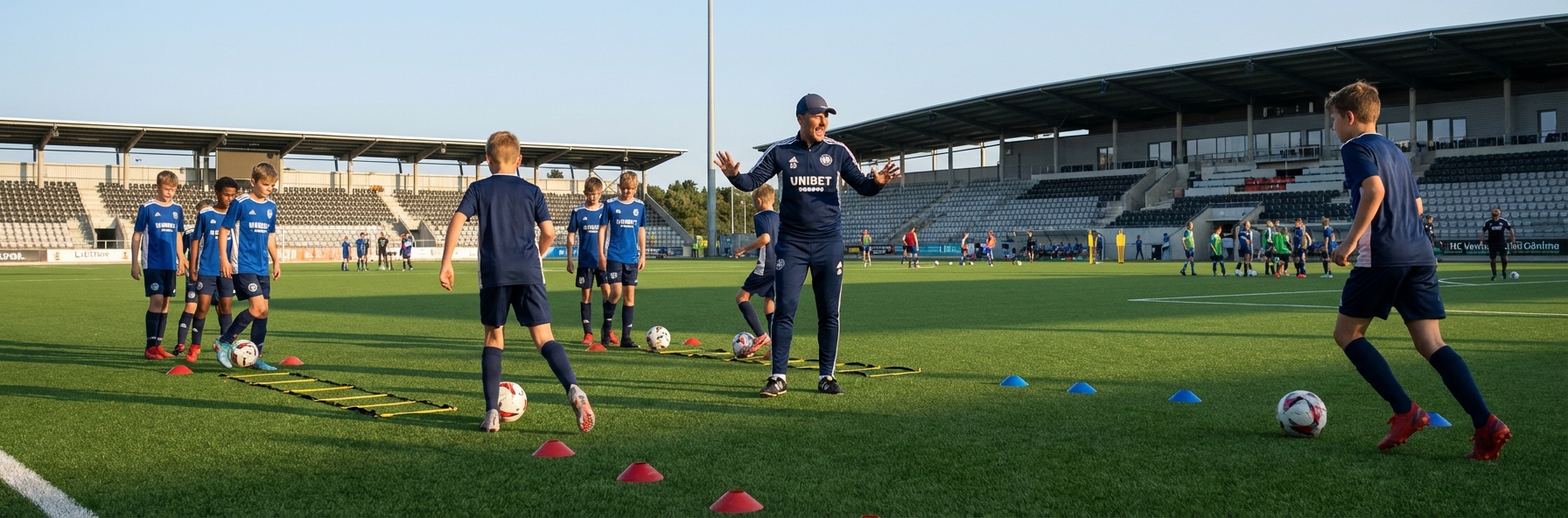
The goal is simple: make them love the ball. Every session should be play-based. ABCs of movement (Agility, Balance, Coordination, Speed) developed through games, not drills. Ball each - every child has a ball for the entire session. Winning and losing don't exist. Fun does.
Stage 2: Skill Acquisition (U9-U12)
This is the "golden age" of motor learning. Children can learn techniques faster than at any other time in their lives. Focus on individual skills: dribbling, passing, shooting, first touch. Small-sided games (3v3, 4v4, 5v5) with maximum touches. Positions don't matter - rotation is essential.
Stage 3: Training to Train (U13-U15)
Physical changes create a temporary loss of coordination. Be patient. Now introduce tactical concepts: shape, transitions, pressing. Increase game size gradually. Individual technique remains paramount but team play enters the picture.
Stage 4: Training to Compete (U16+)
Position-specific training begins. Physical conditioning increases. Match realism in training. Full tactical work. But never forget - technique still matters. The best senior players are the ones who developed exceptional technique young.
Practical Coaching Principles
Apply these principles regardless of age group:
More Touches, Less Talking
Young players learn by doing, not listening. Aim for 1000+ touches per session. If you're talking for more than 30 seconds, you're talking too much. Demonstrate, don't explain.
Make It a Game
Disguise skill work as competition. Instead of "passing drill," play "can you hit the cone from 5 metres?" Points, teams, challenges - these motivate far more than instructions.
Embrace Mistakes
If players aren't making mistakes, they aren't learning. Create a safe environment for failure. The player who tries 20 tricks and fails 15 times develops faster than the one who plays safe.
Recommended Drills
These drills are proven winners for youth development:

Close Control Dribble
Technical dribbling practice building foundation ball mastery.
View This Drill
Sample Session: U10 Development
A 60-minute session for the skill acquisition phase:
- Arrival Activity (5 mins): Free play with a ball each - let them experiment
- Warm-up Game (10 mins): "Traffic Lights" dribbling - different colours mean different moves
- Technical (15 mins): 1v1 moves - step-overs, feints, changes of direction. Small competitions.
- Game-Related (15 mins): 2v2 to mini-goals - apply the moves learned
- Game (15 mins): 4v4 free play - coach only intervenes for safety
Common Youth Coaching Mistakes
- Too much standing: Lines kill sessions - design activities where everyone moves constantly
- Adult pitch sizes: Massive spaces mean few touches - small areas create more learning
- Specialising too early: Kids should play every position until at least U14
- Over-coaching: Let them play, make mistakes, and solve problems themselves
- Winning over development: The best U10 team often isn't producing the best U18 players
Frequently Asked Questions
When should I start teaching formations?
Not before U12 at the earliest. Before that, players shouldn't be in fixed positions. Let them experience the whole pitch. Formations matter far less than individual skill development in the early years.
How do I handle parents who want to win every game?
Education is key. Share research on long-term player development. Explain that the early winners often burn out while the late developers succeed. Frame development as the path to winning later, not an alternative to winning.
Should young players do fitness training?
Not dedicated fitness sessions. Their cardiovascular system develops naturally through play. Game-based activities provide all the conditioning they need. Formal fitness training can wait until U14+.
What's the best format for youth games?
Smaller is better: 3v3 for U7-U8, 5v5 for U9-U10, 7v7 for U11-U12, then gradually to 11v11. More touches, more decisions, more involvement. Big pitches with few players create boredom and bad habits.