Cricket: batting skills

Test cricket rewards patience. The great innings aren't about strike rates or boundary counts - they're about time at the crease, weathering difficult periods, and being there at the end.

Yet in a cricket landscape dominated by franchise T20, developing batters who can concentrate for six hours is increasingly challenging. The skills that win T20s can undermine Test performance.

The Concentration Challenge

Test batting demands a different mental approach than limited-overs cricket:

Time perception: T20 batters think in terms of balls remaining. Test batters think in sessions. The mental framework is fundamentally different.

Risk calculation: In T20, the risk of getting out is weighed against run rate requirements. In Tests, the risk of getting out is weighed against nothing - survival is its own value.

Attention spans: Modern players have grown up with constant stimulation. The quiet periods in Test cricket - between balls, between overs - feel longer to brains trained for rapid input.

Building Concentration Capacity

Concentration is trainable. Like any skill, it develops through progressive overload:

Extended net sessions: Move beyond the typical 20-minute net. Build towards sessions lasting 60-90 minutes, simulating the physical and mental demands of Test batting.

Simulation practice: Create match scenarios with realistic rest periods between overs, drink breaks, and the rhythm of Test cricket. The training environment should mirror match conditions.

Mindfulness training: Simple meditation practices improve the ability to sustain attention and return focus when it wanders. Even 10 minutes daily builds the mental muscle.

Ball-by-Ball Focus

Elite Test batters don't concentrate for six hours continuously. They concentrate intensely for each delivery, then release.

The cycle:

  1. As bowler begins run-up: increase focus
  2. At delivery: peak concentration
  3. After the ball: release, breathe, reset
  4. Between overs: complete mental break

This rhythm prevents the exhaustion that comes from trying to maintain constant high concentration. The releases are as important as the focus periods.

Managing Difficult Periods

Every Test innings includes periods where survival is the only goal - new ball spells, turning pitches, tricky light. Mental strategies for these phases:

Shrink the game: Don't think about session targets or day totals. Focus only on the next ball. The rest takes care of itself.

Process goals: Rather than outcome goals (don't get out), focus on process goals (watch the ball onto the bat, move feet first). Process focus is controllable; outcomes aren't.

Positive self-talk: When survival becomes dominant, the internal voice often turns negative. Consciously redirect to positive or neutral statements.

Technical Adjustments for Test Cricket

Test batting technique differs from T20 in key ways:

Leave the ball: The ability to not play is crucial. Knowing when a ball doesn't need a response and having the discipline to not respond.

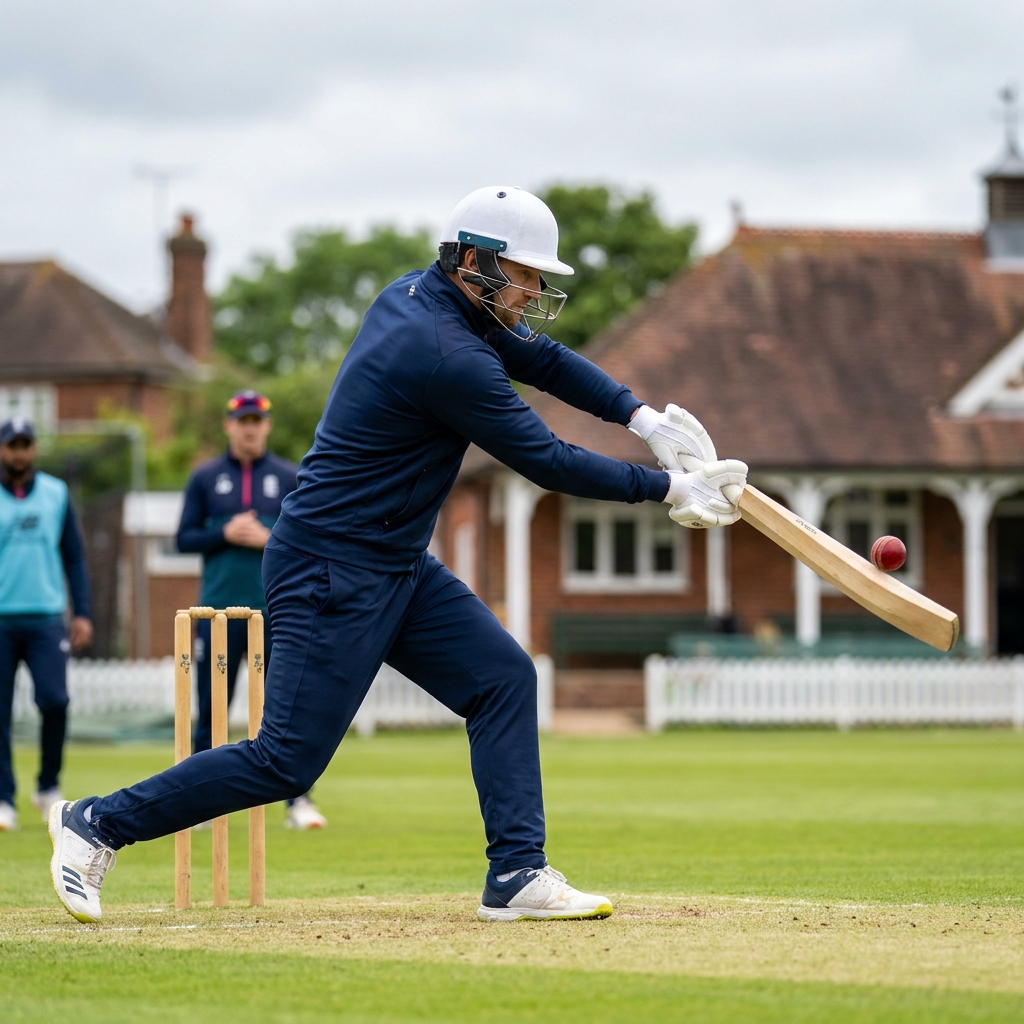
Defensive solidity: The forward defence, often neglected in white-ball cricket, becomes a primary scoring shot. Dead bat, soft hands, ball dropping safely.

Back foot options: Against quality bowling, the back foot punch and cut become essential. These shots require less risk than drives against moving balls.

Rotation: Singles keep the scoreboard moving and the mind engaged. Running also creates mini-breaks in concentration.

Practice Structures

Survival innings: Set a target of time rather than runs. "Face 100 balls" rather than "score 50 runs." Judge success by duration, not productivity.

Consequence practice: Create consequences for dismissal - extra fitness work, loss of batting position, whatever motivates. Match-like pressure improves match-like performance.

Video review focus: After practice innings, review the deliveries you got out to in recent matches. Recreate those specific scenarios and practise survival responses.

Physical Preparation

Mental stamina connects to physical stamina. Long innings require:

Aerobic fitness: The ability to maintain light activity for extended periods without fatigue

Core endurance: Hours in batting stance stresses the lower back. Build endurance, not just strength

Nutrition strategies: What to eat and drink during breaks to maintain energy without causing sluggishness

Heat/humidity tolerance: Training in challenging conditions builds resilience for Test cricket environments

Key Coaching Points

  • Concentration is a skill that can be trained through progressive overload
  • Focus intensely on each ball, then release completely between
  • Shrink the game during difficult periods - next ball only
  • Technical adjustments for Test cricket differ from T20
  • Physical preparation underpins mental stamina

Drills for Batting Development

VIEW ALL BATTING DRILLS

JOIN SPORTPLAN FOR FREE

  • search our library of 350+ cricket drills
  • create your own professional coaching plans
  • or access our tried and tested plans
batting skills DRILLS
View All
Unfortunately there were no results for your search! Please try again
batting skills ANSWERS
View All

How do I start the coaching with 8 year old kids

How do I start the coaching with 8 year old kids

Dravish Hamin Coach, Benin

Hi, I am nagaraj state cricket coach, in karn

Hi, I am nagaraj state cricket coach, from karnataka,India.since 20 years working with 8-19 boys. i need,new conditional  games, for the both the age group, it should hepl, fitness,fielding, batting, skills. and also need recriational games for u-8 boys.Thanks

PV Nagaraj Coach, India

Batting & Bowling Skills Assessment forms

Does anyone have any batting or bowling skills assessment forms they could share? The purpose would be for providing feedback and agreeing major areas for development / improvement

Archived User Coach

when i am batting facing fast bowlers i feel nervous?

when i am batting facing fast bowlers i feel nervous and fear that it will make injury on me what to do overcome that

Archived User Coach

2day cricket clinic

we are hosting a 2day cricket clinic for children age 8-14years old.any aids drills and idees would be appreciated.

Archived User Coach

Individual Developement Plan Templates

Does anyone have individual developement plan templates I can use for junior cricketers? Looking at skills and individual asperations as well as coach and club tasks to help achieve the goals set. Thanks Liam

Liam Schooling Coach, England

What should I coach at a beginners training session?

Im coaching an under 9's team ( GOD HELP ME!) and all though i have played extensively i have not coached such a young team before. Can anyone advise on a training plan designed for beginners / young players. Some ideas on how to make it fun and keep them interested would be great... thanks in advance.

Archived User Coach

What's the best cricket workout for an all rounder?

cricket workout ( training ) for All rounder

Archived User Coach

drills for batting practice by yourself?

Since i cannot get someone to have a bowl at me or throw downs as every one is busy in their own parallel worlds, i would like to know if whether there is a drill or two to improve my batting and learn new skills which i can do myself.

Archived User Coach

off break bowling tips

please give me some tips for off break bowling to i improve my bowling skills

Rab Nawaz Afridi Coach, Pakistan

question concerning batting and general

how do you practice your batting skills,by the way ive done cricket for just over a year now but I haven't been on top of my cricket skills as much as ive also had other commitements such as karate and aslo I had a fondness for badminton during the last winter so the only time I trainedwas really the last years seaon but the traing I did was self made and was in the park as my school cricket team cant really afford enough equipment to train the rest of the team (The team is makeshift by the way).all I did in the park was bowling to my friend who would devlop his batting skills by just tying to find a way of hitting the ball so this is th e reason why im asking you first how can I develop my batting skills and secondly what drills do you do individually and as a team which makes you and your players good?

ismail mehrban Coach, Scotland

How do I plan for age specific players ?

I’m wanting to plan a session for early years players (8yrs old) Can sportplan give me appropriate drills for this age group please Asked using Sportplan Mobile App

Rupert Bouverie Coach, England

Kids Selection Trials For cricket tournament

We have 40 kids registered for 15 spots. We need to run trials to select 15 kids based on their skills. Does anyone have online resource/template used for these kind of selction?Batting, bowling and fielding trials need to be conducted for age of 10-13 years old kids.

Sivakumar kumarasamy Coach, United States of America

Batting & Bowling Skills Asses...

Does anyone have any batting or bowling skills assessment forms they could share? The purpose would be for providing feedback and agreeing major areas for development / improvement

Archived User Coach

Teaching a 9-year old to be br...

Hi there. I need help coaching a 9 year old not to be scared of the ball. The kid has a sound technique but steps away while batting. Any Tips?

Nick Gall-Tomassen Coach, England

JOIN SPORTPLAN FOR FREE

  • search our library of 350+ cricket drills
  • create your own professional coaching plans
  • or access our tried and tested plans

Sportplan App

Give it a try - it's better in the app

YOUR SESSION IS STARTING SOON... Join the growing community of cricket coaches plus 350+ drills and pro tools to make coaching easy.
LET'S DO IT