
Cricket: quick

Test cricket rewards patience. The great innings aren't about strike rates or boundary counts - they're about time at the crease, weathering difficult periods, and being there at the end.

Yet in a cricket landscape dominated by franchise T20, developing batters who can concentrate for six hours is increasingly challenging. The skills that win T20s can undermine Test performance.

The Concentration Challenge

Test batting demands a different mental approach than limited-overs cricket:

Time perception: T20 batters think in terms of balls remaining. Test batters think in sessions. The mental framework is fundamentally different.

Risk calculation: In T20, the risk of getting out is weighed against run rate requirements. In Tests, the risk of getting out is weighed against nothing - survival is its own value.

Attention spans: Modern players have grown up with constant stimulation. The quiet periods in Test cricket - between balls, between overs - feel longer to brains trained for rapid input.

Building Concentration Capacity

Concentration is trainable. Like any skill, it develops through progressive overload:

Extended net sessions: Move beyond the typical 20-minute net. Build towards sessions lasting 60-90 minutes, simulating the physical and mental demands of Test batting.

Simulation practice: Create match scenarios with realistic rest periods between overs, drink breaks, and the rhythm of Test cricket. The training environment should mirror match conditions.

Mindfulness training: Simple meditation practices improve the ability to sustain attention and return focus when it wanders. Even 10 minutes daily builds the mental muscle.

Ball-by-Ball Focus

Elite Test batters don't concentrate for six hours continuously. They concentrate intensely for each delivery, then release.

The cycle:

  1. As bowler begins run-up: increase focus
  2. At delivery: peak concentration
  3. After the ball: release, breathe, reset
  4. Between overs: complete mental break

This rhythm prevents the exhaustion that comes from trying to maintain constant high concentration. The releases are as important as the focus periods.

Managing Difficult Periods

Every Test innings includes periods where survival is the only goal - new ball spells, turning pitches, tricky light. Mental strategies for these phases:

Shrink the game: Don't think about session targets or day totals. Focus only on the next ball. The rest takes care of itself.

Process goals: Rather than outcome goals (don't get out), focus on process goals (watch the ball onto the bat, move feet first). Process focus is controllable; outcomes aren't.

Positive self-talk: When survival becomes dominant, the internal voice often turns negative. Consciously redirect to positive or neutral statements.

Technical Adjustments for Test Cricket

Test batting technique differs from T20 in key ways:

Leave the ball: The ability to not play is crucial. Knowing when a ball doesn't need a response and having the discipline to not respond.

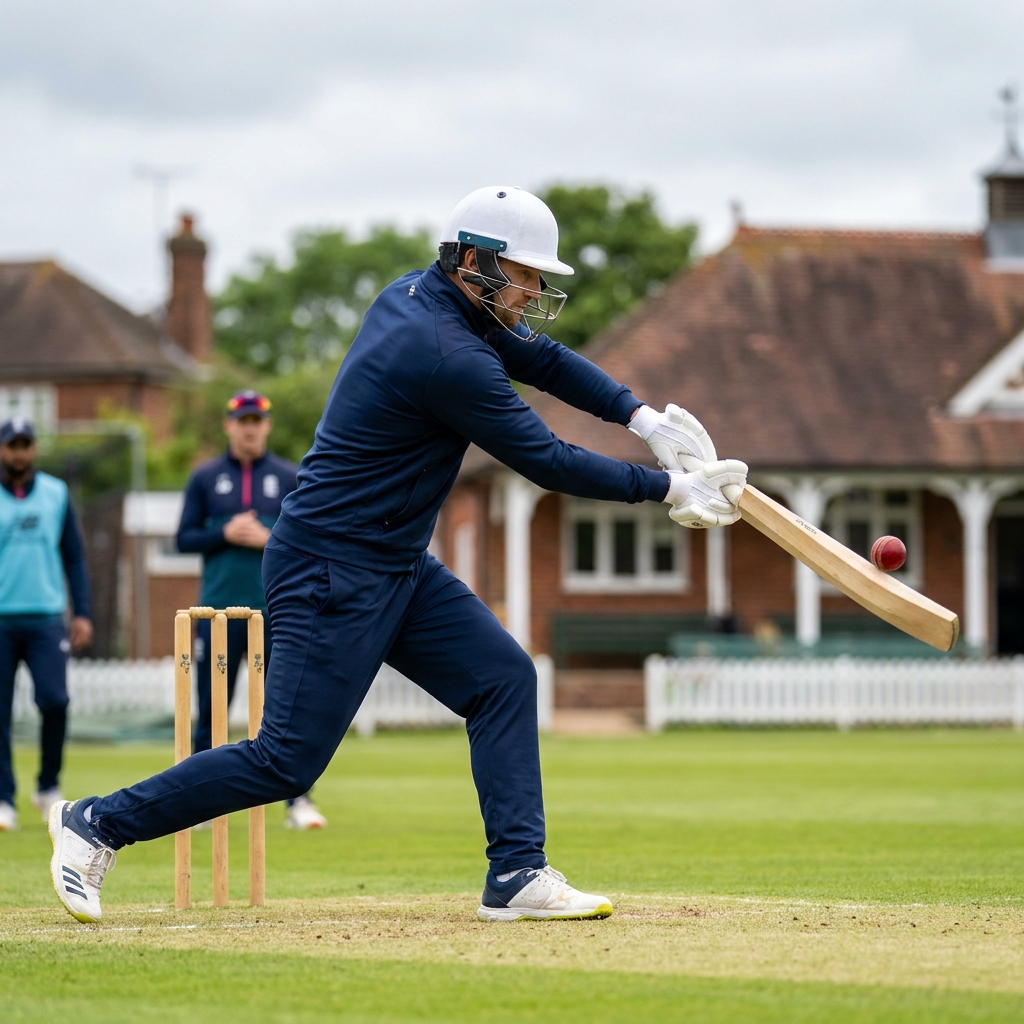
Defensive solidity: The forward defence, often neglected in white-ball cricket, becomes a primary scoring shot. Dead bat, soft hands, ball dropping safely.

Back foot options: Against quality bowling, the back foot punch and cut become essential. These shots require less risk than drives against moving balls.

Rotation: Singles keep the scoreboard moving and the mind engaged. Running also creates mini-breaks in concentration.

Practice Structures

Survival innings: Set a target of time rather than runs. "Face 100 balls" rather than "score 50 runs." Judge success by duration, not productivity.

Consequence practice: Create consequences for dismissal - extra fitness work, loss of batting position, whatever motivates. Match-like pressure improves match-like performance.

Video review focus: After practice innings, review the deliveries you got out to in recent matches. Recreate those specific scenarios and practise survival responses.

Physical Preparation

Mental stamina connects to physical stamina. Long innings require:

Aerobic fitness: The ability to maintain light activity for extended periods without fatigue

Core endurance: Hours in batting stance stresses the lower back. Build endurance, not just strength

Nutrition strategies: What to eat and drink during breaks to maintain energy without causing sluggishness

Heat/humidity tolerance: Training in challenging conditions builds resilience for Test cricket environments

Key Coaching Points

  • Concentration is a skill that can be trained through progressive overload
  • Focus intensely on each ball, then release completely between
  • Shrink the game during difficult periods - next ball only
  • Technical adjustments for Test cricket differ from T20
  • Physical preparation underpins mental stamina

Drills for Batting Development

VIEW ALL BATTING DRILLS

JOIN SPORTPLAN FOR FREE

  • search our library of 350+ cricket drills
  • create your own professional coaching plans
  • or access our tried and tested plans
quick DRILLS
View All

The back foot driving game Con...

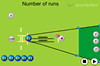
<BR>Setup the practice as shown.Coach throws on one knee.All fielders except the wicket keeper and the player backing up must stand on the boundary between the cones until the ball is bowled. (Coach keeps hold of the ball when feeding every so often, to check whether fielders are moving too early).<BR>The Ball must be driven towards the target area, along the ground, and not defended. It must pass the first set of cones or the batsman is out. The batsman must complete 2 runs after striking the ball. The ball must be hit in the V to score runs. If it is hit outside that area or behind the wicket the batsman is out. (Give younger players another feed.)The wicket keeper must take incoming throws to the stumps either side of the original ones. Off side shots must be thrown to stumps on the off side (safety) and likewise on the leg side. Scoring: (Batsman bat one at a time):<br>4 runs if the ball is hit through the target area along the ground.<BR>2 runs if the ball is hit towards the boundary and the batsman completes 2 runs.<BR><b>Penalty runs</b><BR> 2 runs if a fielder stops the ball with his foot.<BR>1 run if a fielder move off the boundary too early.<BR>4 runs if the player backing up the wicket keeper misses the ball (when boundary is not hit).Ways of getting out: Bowled, caught, stumped, run out (no LBW). Also: not completing 2 runs after hitting the ball (unless boundary is hit); hitting the ball outside the V; not hitting the ball past the first set of cones; hitting the ball over the fielders on the boundary.

General

Unfortunately there were no results for your search! Please try again
quick SESSIONS
View All
quick ANSWERS
View All

practising quick singles

practising quick singles

Archived User Coach

How to find drills, quick save and print

Here is how to find drill, quick save and print use the Sportplan animator

Archived User Coach

How to change text size in a session

Archived User Coach

Different Content on my mobile app than on my computer?

When I log onto the mobile app my folders are different than when I log into Sportplan on my computer, can anyone help explain why?

Lisa Letchford Coach, England

how to increase bat speed

sometimes by bat was coming late after the ball is gone so by question is how to increase the bat speed tu hit the ball

Vijaypal Chhaba Coach, India

How to improve bowling realease point

How to improve bowling release point Asked using Sportplan on Mobile

Aggarwal Coach, India

Why are game sense activities important?

Question 1: Why are game sense activities important? Please give 2-3 examples relating to Game sense. Question 2: Please explain 4 areas you need to consider when planning a game-specific session.

Raja Kibria Coach, Pakistan

Middle practice scenarios

Hi all - have any of my fellow coaches spent any time running middle practice (outdoors) scenarios eg redeeming a batting collapse, batting against really defensive fielding, running between the wickets under pressure etc. Would appreciate your experiences. Thanks, Graham Asked using Sportplan Mobile App

Graham Furber Coach, England

what is the coaching point

what is the coaching point to this

Dave Bunn Coach, England

How to smack boundaries/sixes on a fast bowler?

How to smack fast bowlers for boundaries/sixes?

Kucharkul Akshat Coach, India

how t

how to back up in the field

Jon Fry Coach, England

harder

how to mh

Coach, United Kingdom

how to take easy singles | Spo...

what is the drills for taking easy singles while match

Msathiyanarayanan Coach, India

My son is getting caught out o...

My son is getting caught out on the leading edge when trying to hit through the on side. Any quick fixes???

Archived User Coach

Exercise and height factor for...

what exercise should be made to ball as quick as possible(maximum quick)?I am a good fast bowling all rounder, but i have 5.7" height, should i go as a fast bowler in future with this height?

Muhammad Arham Coach, Pakistan

How can I BOWL a really fast b...

How can I BOWL a really fast bouncer?

Archived User Coach

How do I develop cricket fitne...

My stamina's not enough for playing 50 over match, how can I achieve the best level of fitness?

PANDIARAJ N Coach, India

How can I avoid full tosses? |...

i m facing this problem from quite a long time and do try to make it better but it is not helping me by any means..!!can some1 plz suggest me a usefull method to overcome this..??

Archived User Coach

JOIN SPORTPLAN FOR FREE

  • search our library of 350+ cricket drills
  • create your own professional coaching plans
  • or access our tried and tested plans

Sportplan App

Give it a try - it's better in the app

YOUR SESSION IS STARTING SOON... Join the growing community of cricket coaches plus 350+ drills and pro tools to make coaching easy.
LET'S DO IT