Cricket: sixes

July 2026

By mid-July the English club season is in full swing, and so, quite literally, is the ball. Overnight rain, uncovered outfields and a well-grassed square mean the seam is still nipping around long after pre-season has been forgotten. For a lot of batters this is the toughest cricket of the summer: the pitch looks flat, the sun is out, and yet edges keep flying to the cordon.

Playing the moving ball is a skill in its own right, and it is one that too many club batters never get taught properly. It is not about a bigger backlift or a harder push. It is about a still head, late hands and the discipline to leave what you can leave. Get those three right and the swinging Dukes stops being a threat and starts being an opportunity, because bowlers who move it also bowl plenty of half-volleys chasing the perfect delivery.

Why the Ball Moves More in an English July

Coaches can help batters enormously simply by explaining what is actually happening. Swing comes from the shine and the seam angle in the air; seam movement comes off the pitch when the ball lands on its seam and deviates. A grassy surface after a wet week gives you both at once, and the harder Dukes ball holds its seam and shine far longer than a Kookaburra, so the difficult period can last twenty overs rather than six.

The practical message for a batter is simple. Early in an innings, and early in a bowler's spell with a new ball, the ball will do most. As the shine wears and the pitch dries through the afternoon, movement drops away. Survive the hard bit and the rewards come later. That single idea reframes the whole innings: the first half hour is about occupation, not run-rate.

The Technical Fixes That Actually Work

When the ball is moving, the batter has less time to react to the deviation, so the answer is always to play later and straighter, never harder. A rushed, committed drive at a moving ball is how club batters get out. The framework below gives your players a clear order of priorities to work through in the nets.

Step One: Get the head still and leading. Ask the batter to feel their eyes and nose arriving over the ball at contact. A head that falls to the off side drags the hands across the line and turns a solid defence into a nick.

Step Two: Play the ball under the eyes and as late as possible. The longer a batter can watch the ball, the more of the movement has already happened before they commit the bat. Late equals safe.

Step Three: Soften the hands and let the ball come. A relaxed bottom-hand grip means an edge dies at the batter's feet rather than carrying to slip. Hard hands feed the cordon.

Step Four: Build a clear leaving game. Every ball the batter leaves outside off is a ball that cannot get them out, and it forces the bowler to bowl straighter, where the runs are.

Coaching the Leave and the Judgement of Line

The single biggest gain against the moving ball is a trustworthy leave. Batters who chase every ball outside off will nick one eventually; batters who leave well make the bowler come to them. In practice, set a clear off-stump line with a cone or a spare stump and reward players for leaving anything they judge to be missing it, exactly as you would reward a well-timed cover drive.

Judgement of length matters just as much. Against movement, the danger ball is the good length delivery that a batter is not sure whether to go forward or back to. Teach a decisive forward press to smother the fuller ball and a firm back-foot game to give time against anything short of a length. Indecision is what the moving ball punishes hardest.

Key Coaching Points

  • Still head, leading eyes: the head should finish over or just outside the ball at contact, never falling away to the off side.
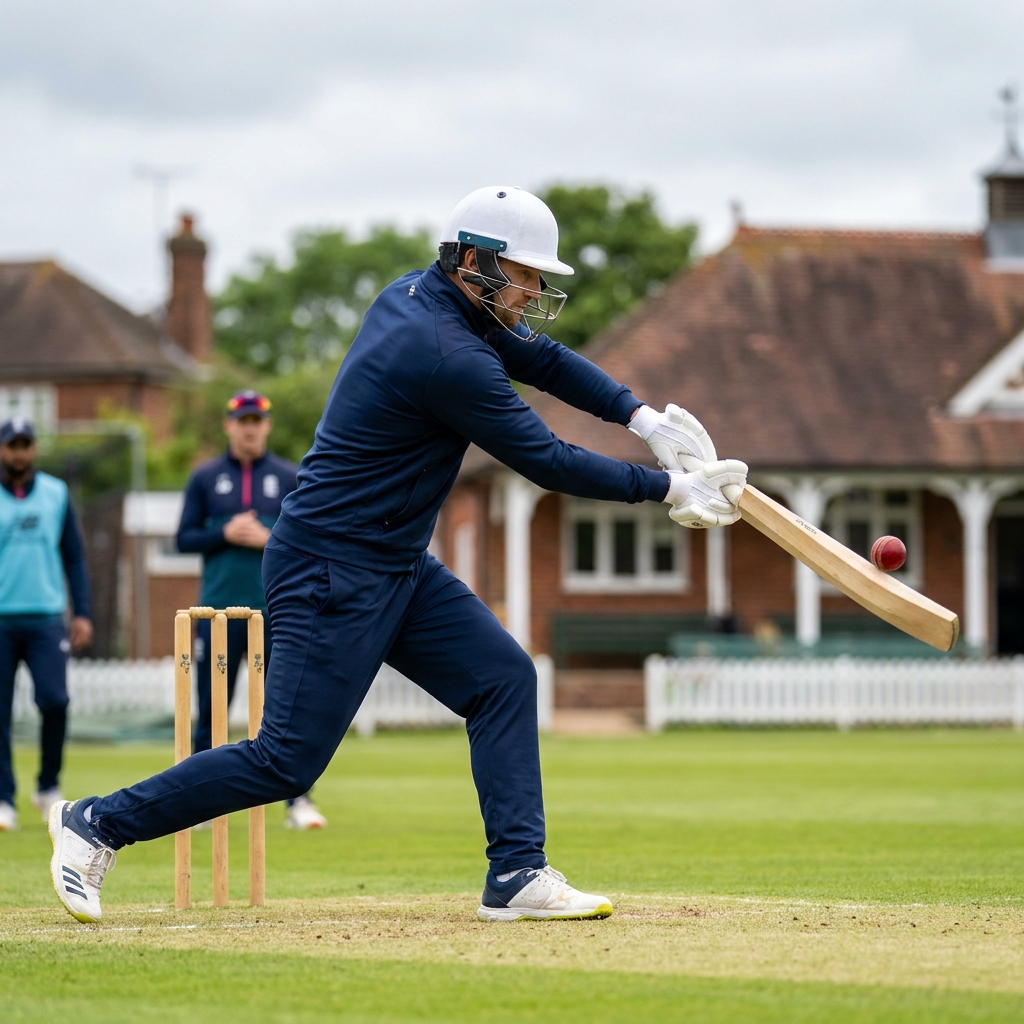
  • Play late, play straight: present a full, straight face as close to the body as possible and let the movement finish before committing.
  • Soft hands, relaxed bottom hand: deaden the edge so it drops short of the slips rather than carrying.
  • Leave with intent: a deliberate, well-judged leave is a positive shot, not a wasted ball. Praise it like a boundary.
  • Decisive footwork: commit fully forward or fully back on length; the half-cock push at a moving ball is the highest-risk option.
  • Respect the phase: occupy the crease while the ball is hard and shiny, then cash in once the movement fades in the afternoon.

Recommended Drills

VIEW ALL FORWARD DEFENSIVE DRILLS

Frequently Asked Questions

Should batters look to leave more or defend more against the swinging ball?

Both, and the leave comes first. Encourage players to leave anything they judge is missing off stump, then defend late and straight at anything on the stumps. A good leaving game forces the bowler to bowl straighter, which is exactly where a batter wants the ball.

Is it worth driving at all when the ball is moving?

Yes, but only at the genuine half-volley and only with soft hands and the head over the ball. The drop-and-drive drill trains this well. Drive the over-pitched ball, leave the fuller-length ball that is still swinging, and never drive on the up early in an innings.

How do I recreate movement in practice if I have no bowling machine with a swing setting?

Sidearm throwdowns with a slightly worn ball, or feeds angled across the batter from wide of the stumps, replicate the decision-making. The aim is not to reproduce exact swing but to train a still head, late hands and clear leaving decisions under time pressure.

sixes DRILLS
View All
Unfortunately there were no results for your search! Please try again
sixes ANSWERS
View All

Hitting sixes and lofting the ball

How can I loft the ball to hit sixes? I can hit it hard but unable to hit it in the air.

Archived User Coach

How do I hit long sixes in cricket?

I know I can hit sixes, but always they come in short from the boundary. I hit as hard as I could, yet the same. Why? Any known 'Chris Gayle' technique?

TBKR Coach, Sri Lanka

How to smack boundaries/sixes on a fast bowler?

How to smack fast bowlers for boundaries/sixes?

Kucharkul Akshat Coach, India

Indoor Fielding Drills - Sport...

Hi...just looking for suggestions as to which would be good indoor fielding drills to mix up indoor net sessions. We'll probably have half a sports hall with max 20 players - mixed abilities. Cheers

Simon Lee Coach, England

I'm coaching an u/14 cricket t...

I'm coaching an u/14 cricket team and none of these boys have ever played the game let alone held a cricket bat. Help!!

Carl Wilkinson Coach, South Africa

Opening Batting - Getting Bowl...

Hi I open the batting for my team and have been getting bowled a substantial amount of times more often then not early in the innings Generally a straight ball/ in swinging to the right hander.I am coming forward to it but seems to misjudge it and ball is generally going between bat and pad although I am thinking I have it covered. Take guard on middle and bat one foot in the crease.Thanks for your help Regards

Archived User Coach

How do I start the coaching wi...

How do I start the coaching with 8 year old kids

Dravish Hamin Coach, Benin

this question is for people wh...

hi!! to all my dear coaches and people assosiated with this website. i am 20 years old and i am a right arm medium fast bowler and a right arm middle order batsmen from india. i like to hit the ball all over the park as i am a natural hitter of the cricket ball.well i am facing problems with my bowling action as i am not able to practice every day, so there is always gap of 2 or 3 days between my practice sessions,so whenever i go and start bowling in the nets i always get confused and sometimes i even have to start allover again starting from my action!!!i even dont have a coach but i am determined to make to my international squad,every one laughs at me when i say this to them.i have never played a single match till now with the proper cricket ball.but i am hugely appreciated in the nets while i am bowling, as i can swing the bowl both ways with an average speed of 115-120kmph.here in india its very hard for a young player to come up in this game even if he has loads of talent,but no money,i am not even allowed to get into the nets when other clubs are practicing, beacause of that i have to practice before they come, that is from morning 4.00am to 6.00am.and i have to study as well because i am computer science engineer, which is a huge mental pressure as well,so i am not able to practice every day.well thats not an execuse for me though, because no matter how hard it gets i am gonna make to the IPL(indian premier league)and then to my international team.and just a month ago i have been picked by a new local club who were quite impressed by me,i played my first practice match against our oppositon club of under 23 age group,i scored 16 balls 42runs,and got 4 wickets of my four overs and concided 11 runs so i am really happy, i was able to swing the ball both the ways but my problem is whenever there is break in my practice session,as other club people dont allow me in the nets. i cant take my run up properly and i tend to change my action from side on to front on which decreses my speed . so plss give some sugessions on 1.how to take my run up properly. 2.how to increase my bowling speed. 3.how to bowl accurately without changing my action.

Archived User Coach

Ideas for Game Scenarios - Spo...

I ran a coaching session on Sunday where I took along a number of handwritten cards, from which the kids (U11s) could randomly choose "Super Over", "Bowl Off" or "Game Scenario". If they chose the latter, I had another set of cards they could choose from "Wicket Target", "Run Target", "Run Target - but boundaries don't count".Finally, they then draw from some more cards - runs (20-30), max wickets (1-3), overs (3-5).Each game scenario lasted around 10-20 mins, so in our session, we had time for about 4 or 5 scenarios. They appeared to enjoy it, but most of them said they wanted to bowl/bat individually for longer! Kids, eh?The idea behind these if to get them thinking about batting intelligently - rotating the strike, keeping the score ticking over, managing achievable run rates, etc. It's also a chance to give some of them some experience at captaining and having to make key decisions (bowling and batting order, how to place a field for different scenarios).Any ideas for variations I could try would be welcome. My session lasts for 2 hours including warm ups and any specific exercises I want to do beforehand.

Matt OToole Coach, England

Any tips with starting my own ...

I am looking at starting my own cricket academy and I am looking for a few ideas anyone care to share

Clay Smith Coach, Bermuda

JOIN SPORTPLAN FOR FREE

  • search our library of 350+ cricket drills
  • create your own professional coaching plans
  • or access our tried and tested plans

Sportplan App

Give it a try - it's better in the app

YOUR SESSION IS STARTING SOON... Join the growing community of football coaches plus 500+ drills and pro tools to make coaching easy.
LET'S DO IT