Tennis: around

July 2026

Everybody spends hours grooving the serve. Far fewer players put the same care into the shot that answers it. Yet the return of serve is one of only two shots that happens on every single point, and at every level below the very top it is where matches are quietly won and lost. A player who can neutralise a big first serve and punish a soft second serve is a nightmare to hold serve against.

The summer hard and grass swing is the perfect moment to work on it. Post-Wimbledon, juniors are inspired and the LTA Youth programmes are in full flow, so there is real appetite for practice that feels like the tennis they have just watched. This month we look at how to turn the return from a defensive reflex into a genuine attacking weapon.

The Coaching Problem

Watch a club-level return and you usually see one of two errors. Either the player stands flat-footed and swings too big, arriving late and spraying the ball long, or they get so worried about the serve that they bunt it back short and hand the server an easy first ball to attack. Both come from the same root cause: no clear intention before the serve is struck.
The attacking return is not about hitting harder. It is about being ready earlier, reading the toss and body shape sooner, and having a plan for where the ball is going before it arrives. Power is a by-product of good position, not the goal itself.

Why This Happens

Most players treat the return as a reaction, and reaction alone is too slow against a decent serve. The ball is only in the air for a few tenths of a second, so a player who starts thinking at the bounce has already lost. The good returners are not faster - they are earlier.

The second issue is footwork. A static player cannot generate a compact, balanced strike. Without a well-timed split-step the feet are heavy, the body is late, and the swing has to do all the work. That is when the big backswing creeps in and errors multiply.
The third issue is mindset. Many players see the return as damage limitation - just get it back and hope. That passive frame invites the server to dictate. The fix is to give the player a job on every return, so their attention is on execution rather than fear.

How to Fix It: The Ready, Read, React Framework

The LTA teaches a simple three-part model for the return, and it is a brilliant coaching scaffold because a player can self-check each stage. Build your practice around these three words.

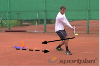
Step One: Ready. Set a strong athletic base a step behind where the player thinks they need to be. Racket out in front, weight on the balls of the feet, knees soft, eyes level. Against a first serve, stand deeper to buy time; against a second serve, step in to take time away. The starting position is a decision, not a default.

Step Two: Read. Teach players to watch the server's ball toss and shoulder line, not the racket. A toss out to the side hints at a slice wide; a toss over the head hints at a kicker. Even reading one serve in three earlier than before transforms the return.

Step Three: React with a split-step. The split-step lands as the server strikes the ball, not before and not after. This tiny hop loads the legs so the first step explodes in the right direction. Get the timing right and the swing can stay short and clean.

Step Four: Commit to a target. Every return needs a destination. Cross-court and deep is the safe, high-percentage default - it gives the biggest margin and pushes the server back. Only go down the line when the ball and the balance genuinely invite it.

Key Coaching Points

  • Split-step timing is the single biggest lever - drill it until it is automatic
  • Deep starting position for first serves, a step inside the baseline for seconds
  • Read the toss and shoulders early rather than waiting for the bounce
  • Keep the backswing compact and let the legs and body supply the power
  • Cross-court and deep is the default target; down the line is the exception
  • Give the player a specific job on every return so intention replaces anxiety

Recommended Drills

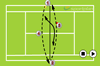
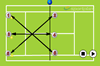
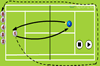
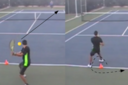
VIEW ALL SERVE & RETURN DRILLS

Frequently Asked Questions

Should players stand further back to return a big serve?

Against a heavy first serve, yes - stepping back buys precious reaction time and lets the ball drop into a comfortable strike zone. For second serves, do the opposite and step inside the baseline to take time away from the server and apply pressure.

What is the most common return of serve mistake?

Too big a backswing. Players try to muscle the return and arrive late. Coach a compact take-back with the racket already out in front, and let a well-timed split-step and body rotation supply the pace instead.

Where should the return be aimed?

Deep and cross-court is the reliable default. It offers the largest margin over the lowest part of the net and pushes the server back behind the baseline, taking away their chance to attack the next ball. Save the down-the-line return for when your balance and the incoming ball genuinely allow it.

around DRILLS
View All
Unfortunately there were no results for your search! Please try again
around SESSIONS
View All
around ANSWERS
View All

What is my fault? Difficulty coaching some of the older players - advice?

Helo, my name is Fernando, I am a Spanish tennis teacher who started teaching six months ago. I am working in a public sportcenter and I am having some problems with adults. When I started I realiced that the students were used to playing tennis without any control. Young students told me that the other teacher only used to leave them play - he rarely explained them how to hit the ball. Consequently the do enjoy my clases and they are learning a lot and impoving their level of tennis. So far so good, but the problem is that with the adults I have the impression that they don´t like my clases. In fact some of them left the group at the begining. I try to mix different kinds of drills during the class and I usually finish it with a game like for example 21, winner........ But it seems that they don´t enjoy it. During the exercises most of them don´t try to do what I tell them. As a result, they don´t have a good level of tennis. But as far as I know, the other teacher was a tennis player who uses to play against them during the clases. As this is my first time teaching tennis, I don´t fell confidence and that is the reason whay I do´t like to play against them. Appart from that I think that this is not my role as a teacher. So I would like you to tell me how to deal with that situation. I don´t care if they leave me because this is not going to affect my job, but i wouldn´t like them to leave just because I like tennis and I like teaching tennis. Thank you very much for your help. I am sorry for my English. Best wishes!!!!

Fernando Coach, Spain

I'm coaching middle school tennis for the first time. Where to begin?

Coaching tennis to middle school athletes for the first time. How do I begin?

Rhonda R Lang Coach, United States of America

perception of the ball

hi! I am a beginner coach, so need help! coaching a men around 45, he has trouble of understanding where the ball will land. he does backswing to early, to late, focusing to much on the ball and having trouble with footwork. any drills to make it easier to understand where the ball will land and how to prepare for it? thank you

Ekaterina Grib Coach, Russia

Best player - bad attitude/determination?

I have a learner that is super talented, he gets the game, he handles pace, power and depth well. He is aggressive and tennis just comes naturally when it comes to this kid but he lacks determination. I am really struggling to keep him motivated not to loose focus or to let one mistake make his shoulders hang for the rest of the lesson. Footwork is unfortunately a big problem and when he loses a point it's even worse, this kid is just draining me mentally every session, its a mental thing but i'm having trouble defeating it. If i'm too hard on him, he closes down and might as well stop and if i play too much and don't push him, he plays with no effort and just hit very sloppy shots. I do know that his situation at home is not good and i think it has a lot to do with his bad attitude on the court but i really need some advise, this is my hardest lesson to plan, what is most important about my lesson with a student with a bad attitude, no temper but just unmotivated and i don't want to give up because this kid really has the talent...he really can be the next junior champion in Africa if he really wants to. Would really appreciate some tips from the professionals that dealt with this before.

Archived User Coach

How to Improve Error Detection and Correction

HI there,I am an assistant coach for a small tennis academy. It has been 2.5 years since I’ve started. I do not have any certification of being a coach but I was a state player(representing my state) back when I was a player in high school. The only knowledge/experience I have as a tennis player was from when I had training back then and even so it was limited. A big issue/challenge I am facing right now is error detection and correction. I realized I am unable to identify the problems of my players which is beyond the obvious and I tend to correct the effect of the problem instead of the root cause of it. i believe what I don’t have is a coach eye, I was wondering if you have some kind of materials or course or even guidance on that matter. I am really keen on improve that part of me. I feel like that part is holding me back as I can give an accurate correction to my players which then hinders my player’s improvement. Hope to hear from you soon. Thank you

sesagi153 Coach, Malaysia

cancel subscription

hi when I go to manage my subscription in my profile I do not get an option to cancel my subscription. I have been reading some of the other questions around this trying to trouble shoot how ever I can't seem to get the help I need cheers Jo

Johanna Coach, Australia

Cant print/pdf a plan - error message

I have made a rather large plan (circuits) and every time I try to print/pdf it, I get an error message "Maximum of three practices per row. Found: 4".I have checked many times and I don't have more than 3 practices in a section.Please Help! Getting very frustrated with it!

Arana Coaching Coach, Australia

how do I transfer drills from the clipboard to my plan

how do i transfer drills from my clipboard to my plan

John Winton Coach, Australia

session plan draw

how do I draw my own session plan

Ami Wallace Coach, Scotland

Beginner Group Rally Games/Drills

Hello, I have a group of 8 players who are orange ball level 1. I need a game or drill that will help them get introduced/comfortable with rallying. Something where they might all get a chance to rotate in and they do not have to sit around? I only have one court. Thank you.Regards, Coach Cory

cory Coach, United States

making lesson plans

how do I put the things I want to do in my training session in one place? I would just fav them but I coach 4 Diffrent age groups

Tillie House Coach, England

high ball

hi what is the best drill to improve high ball contact point and footwork.

samala ashok Coach, India

Flag Football

Are you going to add flag football drills? It is really big in the U.S. and even growing around the world. I'm fact, if you haven't heard, it is being added to the 2028 Olympics. Please add it to the options. Thank you

Corey Beall Coach, United States

Hand eye coordination

I like this drill. I also have this drill in my arsenal with addition of run around the other part of court after the third/fourth ball. ideal for 1.5 students, able to make contact with ball 50/50 or better.

Tim De Coach, United Arab Emirates

footwork

show me some footwork and recovery drills

Don Boyle Coach, United Kingdom

group coaching

I want to design an 8 sessions for 2 beginners players

Asim 0 Coach, Qatar

I'm coaching middle school ten...

Coaching tennis to middle school athletes for the first time. How do I begin?

Rhonda R Lang Coach, United States of America

Positioning on the court - Spo...

Positioning on the court can give us an advantage or put into really difficult situation. Players have to remember that right spot on the court is on the opposite side where they perviously hit the ball. can somebody please share some examples?

Nick Madahar Coach, Azerbaijan

perception of the ball | Sport...

hi! I am a beginner coach, so need help! coaching a men around 45, he has trouble of understanding where the ball will land. he does backswing to early, to late, focusing to much on the ball and having trouble with footwork. any drills to make it easier to understand where the ball will land and how to prepare for it? thank you

Ekaterina Grib Coach, Russia

JOIN SPORTPLAN FOR FREE

  • search our library of 1200+ tennis drills
  • create your own professional coaching plans
  • or access our tried and tested plans

Sportplan App

Give it a try - it's better in the app

YOUR SESSION IS STARTING SOON... Join the growing community of tennis coaches plus 1200+ drills and pro tools to make coaching easy.
LET'S DO IT