Tennis: grip

The one-handed backhand is increasingly rare on professional tours. Junior academies default to teaching two-handers. Yet Federer's backhand won 20 Grand Slams. Wawrinka's won three. Dimitrov and Tsitsipas have built careers around theirs.

Is the one-hander an anachronism or a secret weapon?

The Debate: One vs Two Hands

Arguments for the two-handed backhand:

Easier to learn: Two hands provide more stability and control, especially for younger players.

Return advantage: Compact preparation helps handle fast serves.

High ball handling: Two hands manage shoulder-height balls more easily.

Arguments for the one-handed backhand:

Greater reach: One hand extends further, especially on wide balls.

Natural slice: The one-hander naturally incorporates slice, adding variety.

Net play advantage: One-handed players typically transition more smoothly to volleys.

Tactical unpredictability: The disguise between topspin and slice creates uncertainty.

Technical Foundations

The one-handed backhand requires specific technique:

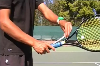
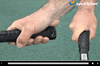
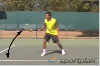
Grip: Eastern backhand or slightly more extreme. The grip position enables a vertical racket face at contact.

Shoulder turn: More pronounced than a two-hander. The hitting shoulder turns back fully, loading rotation.

Non-hitting arm: Extends back for balance and helps initiate rotation. Critical for timing and power.

Contact point: Further in front than a two-hander. Early preparation is essential.

Follow through: Over the shoulder for topspin, across the body for slice.

The Topspin One-Hander

Generating topspin with one hand:

Racket drop: The racket drops below the ball during preparation, creating an upward swing path.

Wrist action: The wrist rolls over through contact, brushing up the back of the ball.

Leg drive: Power comes from the legs driving upward. The arm alone produces weak shots.

Full finish: The follow-through goes up and over the opposite shoulder.

The Slice Backhand

Every one-hander needs a reliable slice:

Preparation: Racket high, roughly ear height. Different from topspin preparation.

Swing path: High to low, carving under the ball.

Contact: Slightly later than topspin, with an open racket face.

Uses: Approach shots, defensive retrievals, changing pace, staying in points.

Handling High Balls

The traditional weakness of one-handers:

Early recognition: Identify high balls early and take them on the rise when possible.

Position adjustment: Move further back to let high balls drop to comfortable height.

Slice option: A high backhand slice, while defensive, is safer than a struggling drive.

Run around: When possible, move to hit a forehand instead.

Development Pathway

Should you teach the one-hander?

Physical requirements: One-handers require more core strength and timing. Very young players often lack both.

Natural preference: Some players naturally gravitate to one hand. Forcing a two-hander on a natural one-hander can backfire.

Long-term view: One-handers take longer to develop but may have higher ceilings for certain player profiles.

Playing style: If a player naturally gravitates to net play and variety, the one-hander fits better than for a pure baseliner.

Practice Priorities

Timing drills: The one-hander is unforgiving of timing errors. Repetition builds the precise timing required.

Footwork emphasis: Good preparation position is even more critical for one-handers.

Slice development: The slice should be as reliable as the drive. Practice both equally.

High ball work: Specifically practice handling high bounces - the known vulnerability.

Key Coaching Points

  • The one-handed backhand remains viable at all levels when well-executed
  • Technical foundations - grip, shoulder turn, contact point - are critical
  • A reliable slice backhand is essential, not optional
  • High balls require specific strategies and practice
  • Player profile and natural preference should guide the choice

Drills for Backhand Development

VIEW ALL BACKHAND DRILLS

JOIN SPORTPLAN FOR FREE

  • search our library of 1200+ tennis drills
  • create your own professional coaching plans
  • or access our tried and tested plans
grip DRILLS
View All
Unfortunately there were no results for your search! Please try again
grip ANSWERS
View All

Backhand grip

In Nick Saviano's book, Maximum Tennis, Andre Agassi is said to have a very 'soft' left hand on his backhand, and yet often I hear and read many tips suggesting a very dominant, or active, supporting hand for the two handed backhand. Especially now, with the more semi-open stanced players, what should I suggest when teaching the backhand to developing players?

Archived User Coach

how do you teach topspin? what grip to you use?

how do you teach topspin? what grip to you use?

becky farmer Coach, United States of America

I'm having trouble teaching the backhand volley. The?

I'm having trouble teaching the backhand volley. The girls don't seem to have enough arm/wrist strength and/or they don't get the correct angle on their racquet. Suggestions?

Archived User Coach

What can you do to help a player with their serve?

What can you do to help a player with their serve, when they say they want to get more power on it?

Archived User Coach

Hi Guys, How best to teach a return of serve

Hi Guys, Just wondering if anyone has a suggestion on how to teach a block return from serve and a slice return from serve to 13y.o juniors who are playing against big servers Cheers

Ciaran Cahill Coach, Ireland

What is my fault? Difficulty coaching some of the older players - advice?

Helo, my name is Fernando, I am a Spanish tennis teacher who started teaching six months ago. I am working in a public sportcenter and I am having some problems with adults. When I started I realiced that the students were used to playing tennis without any control. Young students told me that the other teacher only used to leave them play - he rarely explained them how to hit the ball. Consequently the do enjoy my clases and they are learning a lot and impoving their level of tennis. So far so good, but the problem is that with the adults I have the impression that they don´t like my clases. In fact some of them left the group at the begining. I try to mix different kinds of drills during the class and I usually finish it with a game like for example 21, winner........ But it seems that they don´t enjoy it. During the exercises most of them don´t try to do what I tell them. As a result, they don´t have a good level of tennis. But as far as I know, the other teacher was a tennis player who uses to play against them during the clases. As this is my first time teaching tennis, I don´t fell confidence and that is the reason whay I do´t like to play against them. Appart from that I think that this is not my role as a teacher. So I would like you to tell me how to deal with that situation. I don´t care if they leave me because this is not going to affect my job, but i wouldn´t like them to leave just because I like tennis and I like teaching tennis. Thank you very much for your help. I am sorry for my English. Best wishes!!!!

Fernando Coach, Spain

Forehand groundstroke. contact point?

Forehand groundstroke. Coach A teaches a classic FH with the C loop and says that the modern FH (western Grip) contact point is at the side. I understood that the Eastern FH was hit at the side but the Semi western was hit 6 to 8" in front when the racket face is vertical to the ground. Which is correct?

Norman Frey Coach, United States of America

forehand

On my forehand I like to play a multi segmented forehand and have a extreeme westrn grip. ,Hitting a multi segment forehand with a semi-western grip particularly off serve does not feel natural for me. What can I do? With thanks, Stephen

stephen Coach, Australia

How to teach single and double-handed backhands to U10s?

teaching single and doublehanded backhands to under 10s

Archived User Coach

How do I improve my backhand in tennis?

how do i improve my handback in tennis?

Maria Paola Molteni Coach, Argentina

How do I teach my non-tennis playing friend to feed me practice balls?

I'm a 4.5 player (recovered competitive junior player) ... my parents used to take me out and feed balls to me to work on my strokes ... now that I'm an adult - and living on the opposite coast - I need someone to feed balls to me. How do I teach a non-tennis player to feed balls to me? What grip should I have them use? Where should they feed the ball?

Archived User Coach

What is the best way to share playing vocab at this site...

...where it will list and describe playing terminology such as shave, tackle-back, steal, forehand.

Ejaz Syed Coach, United States of America

TopSpin Forehand

How should I put more topspin and depth and height on my forehand shots, I want to get it more consistent and practice putting more power on them.

stefo Coach, United States of America

high ball

hi what is the best drill to improve high ball contact point and footwork.

samala ashok Coach, India

Private tennis lesson

Hi, I am going to teach a first private lesson for a woman age 30 . She is a beginner. I would love to hear some tips for our first one on one interaction and what to focus on. Thanks

Moran Cohen Coach, Israel

group coaching

I want to design an 8 sessions for 2 beginners players

Asim 0 Coach, Qatar

how do you teach topspin? what...

how do you teach topspin? what grip to you use?

becky farmer Coach, United States of America

Backhand grip | Sportplan

In Nick Saviano's book, Maximum Tennis, Andre Agassi is said to have a very 'soft' left hand on his backhand, and yet often I hear and read many tips suggesting a very dominant, or active, supporting hand for the two handed backhand. Especially now, with the more semi-open stanced players, what should I suggest when teaching the backhand to developing players?

Archived User Coach

What can you do to help a play...

What can you do to help a player with their serve, when they say they want to get more power on it?

Archived User Coach

Forehand groundstroke. contact...

Forehand groundstroke. Coach A teaches a classic FH with the C loop and says that the modern FH (western Grip) contact point is at the side. I understood that the Eastern FH was hit at the side but the Semi western was hit 6 to 8" in front when the racket face is vertical to the ground. Which is correct?

Norman Frey Coach, United States of America

JOIN SPORTPLAN FOR FREE

  • search our library of 1200+ tennis drills
  • create your own professional coaching plans
  • or access our tried and tested plans

Sportplan App

Give it a try - it's better in the app

YOUR SESSION IS STARTING SOON... Join the growing community of tennis coaches plus 1200+ drills and pro tools to make coaching easy.
LET'S DO IT