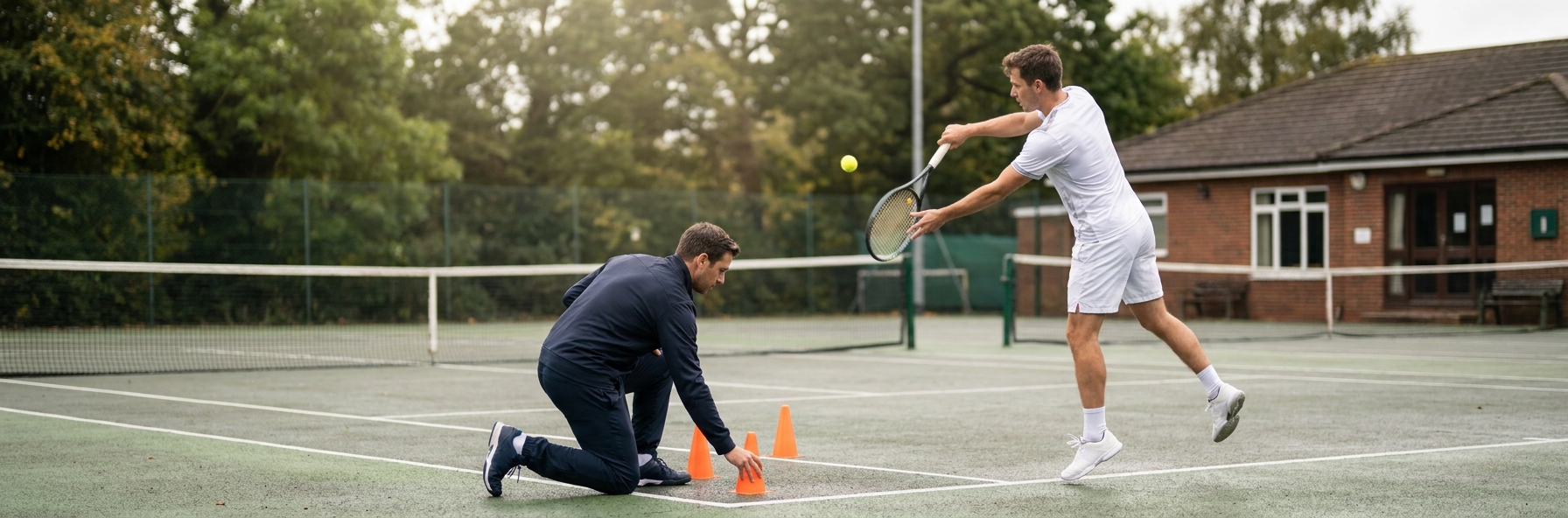
Tennis: group

Traditional tennis coaching follows a familiar pattern: the coach demonstrates the "correct" technique, the player attempts to copy it, the coach provides feedback on deviations from the model. This approach produces technically proficient players - but often players who struggle to adapt when things don't go according to plan.

Ecological dynamics offers a different approach: rather than prescribing technique, coaches design environments that guide players to discover solutions themselves.

What is Ecological Dynamics?

The theoretical foundations:

Movement emerges from constraints: Movement patterns aren't pre-programmed but emerge from the interaction between the player, the task, and the environment.

Variability is valuable: Traditional coaching sees variability as error to be eliminated. Ecological dynamics sees it as exploration that leads to adaptable skill.

Representative design: Practice should represent competition. Drills that remove decision-making remove the most important element.

Perception-action coupling: Technique and decision-making shouldn't be separated. Players need to practice reading the game while executing skills.

Constraints-Led Coaching

Coaches manipulate three types of constraints:

Task constraints: Rules of the game, equipment, targets. Examples: play only with topspin, hit to the backhand side, rally must include a drop shot.

Environmental constraints: Court surface, weather, opponent behaviour. Examples: practice on different surfaces, add wind, use different ball speeds.

Individual constraints: Player's physical capabilities, experience, psychological state. Examples: handicap stronger players, adjust court size for ability.

Practical Applications

How to apply ecological dynamics in tennis:

Games-based practice: Replace isolated drilling with modified games. Players learn to serve by playing games where serving matters, not by hitting into an empty service box.

Target manipulation: Instead of telling players where to aim, create targets that guide them there. Scoring zones encourage certain patterns without explicit instruction.

Equipment modification: Slower balls, smaller courts, different rackets. These constraints guide technique without prescribing it.

Opponent variation: Practice against different styles of players. Each opponent presents different problems to solve.

Discovery Learning

The coach's role changes from prescriber to designer:

Ask, don't tell: Instead of "bend your knees more," ask "what happens if you get lower?" Let players discover the relationship.

Problem presentation: Present problems for players to solve. "Your opponent keeps lobbing you - what could you try?"

Attention direction: Guide attention to relevant information rather than prescribing solutions. "Watch where they're standing before you hit."

Allow exploration: Players need freedom to try different solutions, including unsuccessful ones.

Benefits of the Approach

Adaptability: Players who have explored solutions transfer better to new situations. Match play is never exactly like practice.

Creativity: Players develop unique solutions suited to their bodies and games, not copies of a model technique.

Engagement: Games and problem-solving are more engaging than repetitive drilling. Players practice longer and with more focus.

Retention: Self-discovered solutions are better retained than prescribed techniques.

Challenges and Limitations

Ecological dynamics isn't a complete rejection of traditional coaching:

Time requirements: Discovery learning can take longer than direct instruction for basic skills.

Coach expertise: Designing effective constraints requires deep understanding of the game and skill development.

Player frustration: Some players prefer being told what to do. Managing frustration during exploration is important.

Balance needed: Most coaches blend approaches - some direct instruction with discovery learning.

Designing Practice Sessions

Principles for constraints-led session design:

Start with the game: What do you want players to be able to do in matches? Work backward from there.

Add context: Even technique work should include decision-making elements.

Vary conditions: Don't let players groove one pattern. Change something regularly.

Reflect and discuss: Ask players what they noticed, what worked, what they might try next.

Key Coaching Points

  • Movement emerges from constraints - design the environment, not just the technique
  • Variability in practice creates adaptable players
  • Games and problem-solving develop decision-making alongside technique
  • Ask questions rather than giving answers - guide discovery
  • Balance exploration with direct instruction based on player needs

Drills for Adaptable Development

VIEW ALL GAMES-BASED DRILLS

JOIN SPORTPLAN FOR FREE

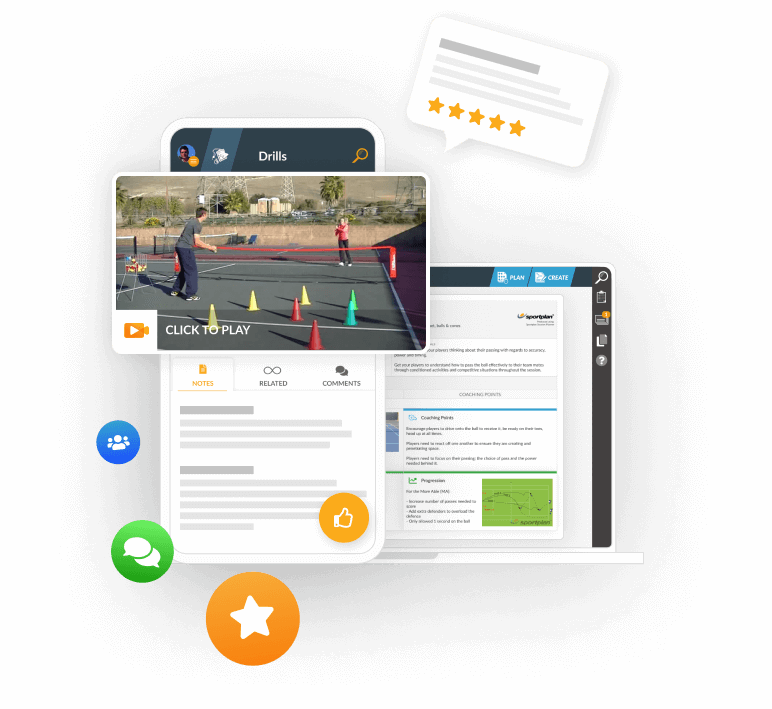
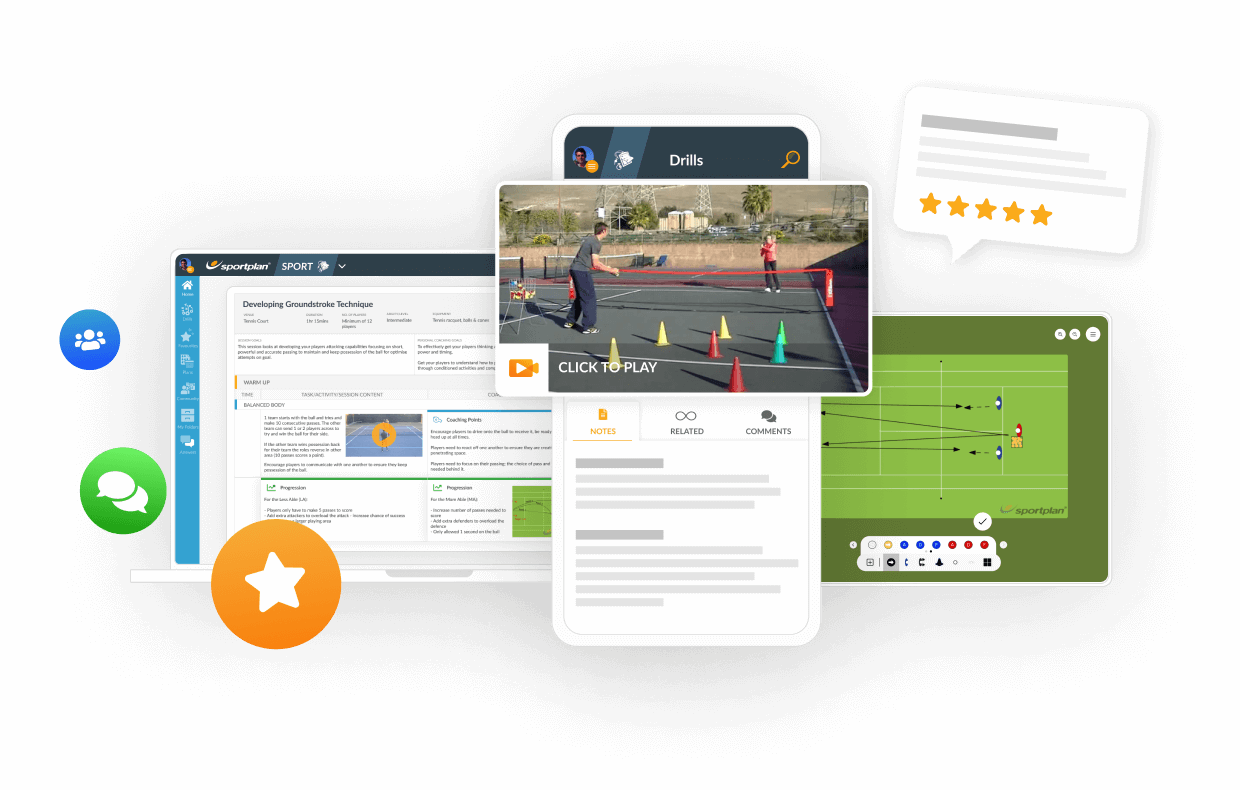
  • search our library of 1200+ tennis drills
  • create your own professional coaching plans
  • or access our tried and tested plans
group DRILLS
View All
Unfortunately there were no results for your search! Please try again
group SESSIONS
View All
group ANSWERS
View All

How many different types of drills are reccomended for an hour and a half group session

How many different types of drills are reccomended for a group session for the main part for an hour and half lesson in total

liz Sharman Coach, England

What is my fault? Difficulty coaching some of the older players - advice?

Helo, my name is Fernando, I am a Spanish tennis teacher who started teaching six months ago. I am working in a public sportcenter and I am having some problems with adults. When I started I realiced that the students were used to playing tennis without any control. Young students told me that the other teacher only used to leave them play - he rarely explained them how to hit the ball. Consequently the do enjoy my clases and they are learning a lot and impoving their level of tennis. So far so good, but the problem is that with the adults I have the impression that they don´t like my clases. In fact some of them left the group at the begining. I try to mix different kinds of drills during the class and I usually finish it with a game like for example 21, winner........ But it seems that they don´t enjoy it. During the exercises most of them don´t try to do what I tell them. As a result, they don´t have a good level of tennis. But as far as I know, the other teacher was a tennis player who uses to play against them during the clases. As this is my first time teaching tennis, I don´t fell confidence and that is the reason whay I do´t like to play against them. Appart from that I think that this is not my role as a teacher. So I would like you to tell me how to deal with that situation. I don´t care if they leave me because this is not going to affect my job, but i wouldn´t like them to leave just because I like tennis and I like teaching tennis. Thank you very much for your help. I am sorry for my English. Best wishes!!!!

Fernando Coach, Spain

Strategy to win senior 70´s tournament singles?

How to win senior 70´s tournament singles? Strategy?

Archived User Coach

Any suggestions for some bad weather drills I can run indoors with my players?

How can I run drills inside before the weather is okay to go out?

Archived User Coach

How do I coach 14 girls (varying abilities) on just 2 courts?

How do I coach 14 girls, all of varying levels from beginner to advanced on just two courts?

Archived User Coach

Drills for a group of 14

Hello! I want some help for a group of 14 boys (aged 12-15) in a sports camp. I want to be in action all of my athletes and do not get bored. Can you suggest me some exercises, like "five alive"?

Anghel Br Coach, Greece

Red tennis coaching benchmarks?

Hi All, I'm new to 10 and under tennis coaching and currently I'm coaching a group for red tennis and I need to measure the group progress.To know if I am doing fine in coaching them.for example after how many session they should be able to rally?

Ahmed Fadl Coach, Saudi Arabia

Group Membership

I am wondering if there is a group membership for a team/department?Thank youSam

Sam Clarke Coach, England

Beginner Group Rally Games/Drills

Hello, I have a group of 8 players who are orange ball level 1. I need a game or drill that will help them get introduced/comfortable with rallying. Something where they might all get a chance to rotate in and they do not have to sit around? I only have one court. Thank you.Regards, Coach Cory

cory Coach, United States

Adding coaches to our organisation?

Morning,I need to add new coaches to our organisation group. How do I do this?Regards,Hermann - St John's Northwood

Hermann Kruger Coach, England

Group Membership

Hello, I would like to give all members of my department full access to Sportsplan, please can you let me know the cost and what I need to do?Thanks

mike andrew Coach, England

making lesson plans

how do I put the things I want to do in my training session in one place? I would just fav them but I coach 4 Diffrent age groups

Tillie House Coach, England

what

What drill do u recommend for large group of new players

Mona R Forster Coach, United Arab Emirates

begginer tennis lesson age 5years

Please provide a structured 5 year old begginner lesson

Florence Madzimbamuto Coach, South Africa

First time Coaching

It's my first time coaching I need some advice?

steven chiriboga Coach, United Kingdom

group coaching

I want to design an 8 sessions for 2 beginners players

Asim 0 Coach, Qatar

How do I coach 14 girls (varyi...

How do I coach 14 girls, all of varying levels from beginner to advanced on just two courts?

Archived User Coach

I'm coaching middle school ten...

Coaching tennis to middle school athletes for the first time. How do I begin?

Rhonda R Lang Coach, United States of America

High school tennis team practi...

Can you provide some help with running a high school tennis team practice?

Archived User Coach

What is my fault? Difficulty c...

Helo, my name is Fernando, I am a Spanish tennis teacher who started teaching six months ago. I am working in a public sportcenter and I am having some problems with adults. When I started I realiced that the students were used to playing tennis without any control. Young students told me that the other teacher only used to leave them play - he rarely explained them how to hit the ball. Consequently the do enjoy my clases and they are learning a lot and impoving their level of tennis. So far so good, but the problem is that with the adults I have the impression that they don´t like my clases. In fact some of them left the group at the begining. I try to mix different kinds of drills during the class and I usually finish it with a game like for example 21, winner........ But it seems that they don´t enjoy it. During the exercises most of them don´t try to do what I tell them. As a result, they don´t have a good level of tennis. But as far as I know, the other teacher was a tennis player who uses to play against them during the clases. As this is my first time teaching tennis, I don´t fell confidence and that is the reason whay I do´t like to play against them. Appart from that I think that this is not my role as a teacher. So I would like you to tell me how to deal with that situation. I don´t care if they leave me because this is not going to affect my job, but i wouldn´t like them to leave just because I like tennis and I like teaching tennis. Thank you very much for your help. I am sorry for my English. Best wishes!!!!

Fernando Coach, Spain

JOIN SPORTPLAN FOR FREE

  • search our library of 1200+ tennis drills
  • create your own professional coaching plans
  • or access our tried and tested plans

Sportplan App

Give it a try - it's better in the app

YOUR SESSION IS STARTING SOON... Join the growing community of tennis coaches plus 1200+ drills and pro tools to make coaching easy.
LET'S DO IT