Tennis: on the run

Traditional tennis coaching follows a familiar pattern: the coach demonstrates the "correct" technique, the player attempts to copy it, the coach provides feedback on deviations from the model. This approach produces technically proficient players - but often players who struggle to adapt when things don't go according to plan.

Ecological dynamics offers a different approach: rather than prescribing technique, coaches design environments that guide players to discover solutions themselves.

What is Ecological Dynamics?

The theoretical foundations:

Movement emerges from constraints: Movement patterns aren't pre-programmed but emerge from the interaction between the player, the task, and the environment.

Variability is valuable: Traditional coaching sees variability as error to be eliminated. Ecological dynamics sees it as exploration that leads to adaptable skill.

Representative design: Practice should represent competition. Drills that remove decision-making remove the most important element.

Perception-action coupling: Technique and decision-making shouldn't be separated. Players need to practice reading the game while executing skills.

Constraints-Led Coaching

Coaches manipulate three types of constraints:

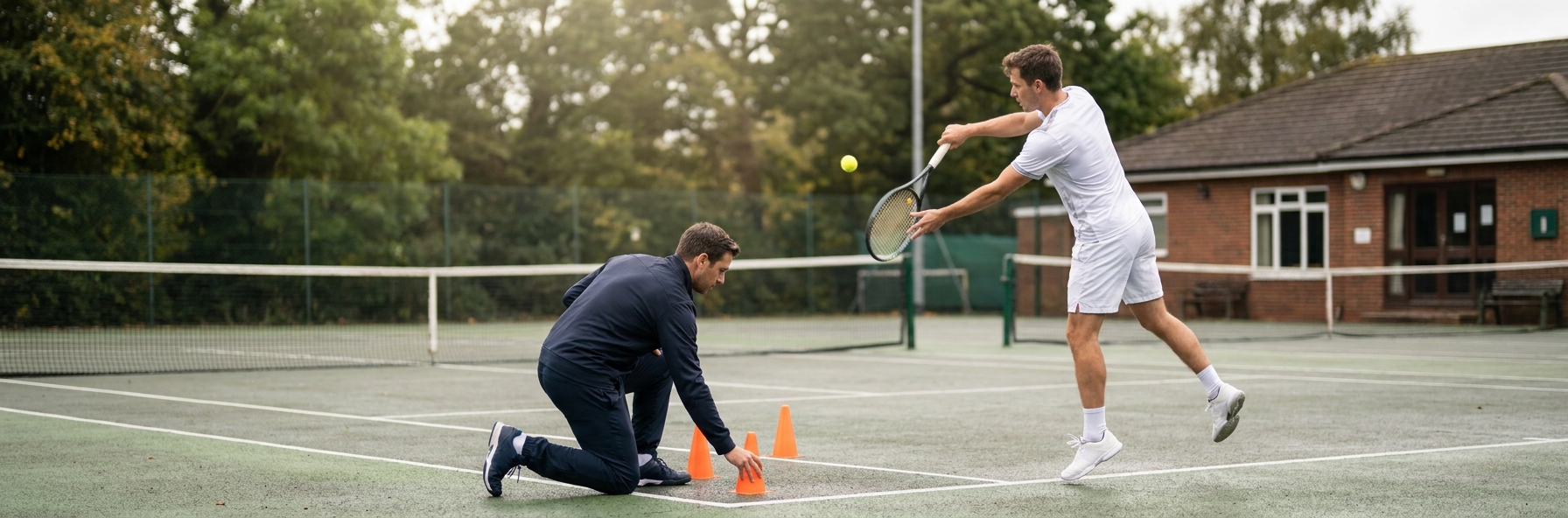
Task constraints: Rules of the game, equipment, targets. Examples: play only with topspin, hit to the backhand side, rally must include a drop shot.

Environmental constraints: Court surface, weather, opponent behaviour. Examples: practice on different surfaces, add wind, use different ball speeds.

Individual constraints: Player's physical capabilities, experience, psychological state. Examples: handicap stronger players, adjust court size for ability.

Practical Applications

How to apply ecological dynamics in tennis:

Games-based practice: Replace isolated drilling with modified games. Players learn to serve by playing games where serving matters, not by hitting into an empty service box.

Target manipulation: Instead of telling players where to aim, create targets that guide them there. Scoring zones encourage certain patterns without explicit instruction.

Equipment modification: Slower balls, smaller courts, different rackets. These constraints guide technique without prescribing it.

Opponent variation: Practice against different styles of players. Each opponent presents different problems to solve.

Discovery Learning

The coach's role changes from prescriber to designer:

Ask, don't tell: Instead of "bend your knees more," ask "what happens if you get lower?" Let players discover the relationship.

Problem presentation: Present problems for players to solve. "Your opponent keeps lobbing you - what could you try?"

Attention direction: Guide attention to relevant information rather than prescribing solutions. "Watch where they're standing before you hit."

Allow exploration: Players need freedom to try different solutions, including unsuccessful ones.

Benefits of the Approach

Adaptability: Players who have explored solutions transfer better to new situations. Match play is never exactly like practice.

Creativity: Players develop unique solutions suited to their bodies and games, not copies of a model technique.

Engagement: Games and problem-solving are more engaging than repetitive drilling. Players practice longer and with more focus.

Retention: Self-discovered solutions are better retained than prescribed techniques.

Challenges and Limitations

Ecological dynamics isn't a complete rejection of traditional coaching:

Time requirements: Discovery learning can take longer than direct instruction for basic skills.

Coach expertise: Designing effective constraints requires deep understanding of the game and skill development.

Player frustration: Some players prefer being told what to do. Managing frustration during exploration is important.

Balance needed: Most coaches blend approaches - some direct instruction with discovery learning.

Designing Practice Sessions

Principles for constraints-led session design:

Start with the game: What do you want players to be able to do in matches? Work backward from there.

Add context: Even technique work should include decision-making elements.

Vary conditions: Don't let players groove one pattern. Change something regularly.

Reflect and discuss: Ask players what they noticed, what worked, what they might try next.

Key Coaching Points

  • Movement emerges from constraints - design the environment, not just the technique
  • Variability in practice creates adaptable players
  • Games and problem-solving develop decision-making alongside technique
  • Ask questions rather than giving answers - guide discovery
  • Balance exploration with direct instruction based on player needs

Drills for Adaptable Development

VIEW ALL GAMES-BASED DRILLS

JOIN SPORTPLAN FOR FREE

  • search our library of 1200+ tennis drills
  • create your own professional coaching plans
  • or access our tried and tested plans
on the run DRILLS
View All
Unfortunately there were no results for your search! Please try again
on the run SESSIONS
View All
on the run ANSWERS
View All

re The Art of Feeding

I received your email on 'The Art of Feeding' and like to read your suggestions of drills. When looking at your suggested drills on this newsletter, I would like to ask for a bit of clarification on the coaching point 'as players move sideways they must take last step towards ball at contact'. I thought that the player must have stopped before making contact with the ball. Do you mean that the player's balance takes him into another step at contact? I'm really interested in your drills and plan to make a purchase in the near future. Best wishes, Nick-submitted by email

Sportplan Team Coach, United Kingdom

How to run try-outs, getting 50 students down to 32?

There are 50 students, and I need to select 32 of them. How will you plan your try-out? Test for accuracy? Fitness?

Farhad Roshanaie Coach, United States of America

I want to improve my tennis toughness & play more aggressively - any tips?

I used to play on clay court for 20 years, now it's been two years that I've been exposed to hard court. About my game%3A I have a very good technique on all my strokes including volley, good kick serve, I am 192 cm. My issue%3A I was not taught to play aggressively, now in my matches I don't take the net; consequently, in spite of executing a high level tennis, I loose to some players that I never should. I've read some tennis mental toughness books, I teach them, but I don't know how can I change my own mental set. When I hit top spin (groundies), I enjoy and feel secure, even though it results in my loss and sorrow. I'm ready for change but how?

Farhad Roshanaie Coach, United States of America

Any suggestions for some bad weather drills I can run indoors with my players?

How can I run drills inside before the weather is okay to go out?

Archived User Coach

How do I coach 14 girls (varying abilities) on just 2 courts?

How do I coach 14 girls, all of varying levels from beginner to advanced on just two courts?

Archived User Coach

Coaching players with language-based l.d. /dyslexia

We have some players on a girls high school team who hit well, have good form and serve well but do run into confusion sometimes with remembering scores, hearing instruction when playing matches and processing speed can be a challenge as well because these players have language-based learning disabilities. They are strong players but I need some advice about best practices for lessons/coaching that will bring them the most success on the court. Are there specific drills/coaching techniques that are helpful? Also, I'm going to purchase some wrist score keeper bracelets unless someone knows of a better way for them to keep track of the score discreetly and quickly. (wrist or racket)

Archived User Coach

Videos will not run ...

I cannot pull up video's without the Adobe Flash player crashing ... got any solutions?

Dr Louis Emmons Coach, United States of America

How to Improve Error Detection and Correction

HI there,I am an assistant coach for a small tennis academy. It has been 2.5 years since I’ve started. I do not have any certification of being a coach but I was a state player(representing my state) back when I was a player in high school. The only knowledge/experience I have as a tennis player was from when I had training back then and even so it was limited. A big issue/challenge I am facing right now is error detection and correction. I realized I am unable to identify the problems of my players which is beyond the obvious and I tend to correct the effect of the problem instead of the root cause of it. i believe what I don’t have is a coach eye, I was wondering if you have some kind of materials or course or even guidance on that matter. I am really keen on improve that part of me. I feel like that part is holding me back as I can give an accurate correction to my players which then hinders my player’s improvement. Hope to hear from you soon. Thank you

sesagi153 Coach, Malaysia

cancel subscription

Hi, could you please cancel my subscription, the system is not allowing me to. Sam Naayen

Sam Coach, Australia

Restricted access on a premium membership account!

Hi, I have paid for the 3 month premium account which is due to run out in 14th february 2022. But for some reason, I am being met with restrictions on drills and plans when I go to look at them. Can you please help me with this? Thanks!

Alex Mae Chaisty Coach, England

footwork

show me some footwork and recovery drills

Don Boyle Coach, United Kingdom

JOIN SPORTPLAN FOR FREE

  • search our library of 1200+ tennis drills
  • create your own professional coaching plans
  • or access our tried and tested plans

Sportplan App

Give it a try - it's better in the app

YOUR SESSION IS STARTING SOON... Join the growing community of tennis coaches plus 1200+ drills and pro tools to make coaching easy.
LET'S DO IT