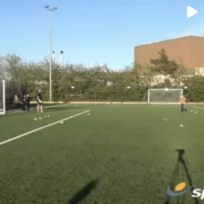
Setup: 30 x 20 metres with a 3m goal at both ends Aim of game: The attackers start in their half and attempt to score in opposite half. Defenders begin passively, cannot enter attackers half and cannot tackle, only block so they learn where they should be in relation to the ball. If the defenders win the ball they score a point If attackers score they get a point and retain possession, starting from their half again Progression: defenders can tackle attackers can only shoot if 4 passes Make sure all players have a go at defending.
Nearest defender: pressure ball. Covering: at angle and goalside of first defender, plus close enough to pressure ball if they are beaten. Third: add depth; cover back post area. General: centrally â form a triangle pointing at ball; wide â form an angled line back from the ball âGive clear instructions to each other âclose the ballâ, âcover meâ, âget closerâ, âforce them down the lineâ â âForce attackers towards corners or sidewaysâ âStay compactâ âThink about your changing role â the ballâs moved so are you now marking a man or space? Remember: the closer to the ball or goal you are, the closer you have to be to an opponentâ
This practice has no coaching points
This practice has no progressions

in more ways than one
 sportplan_football



Deliberate heading is now out of U11 grassroots matches. Here is how to coach chest, thigh and foot control so your players still win the ball in the air.

Long-range goals doubled at the 2026 World Cup as teams sat deep. Here is how to coach when to shoot from distance, the technique, and the follow-up.

Under FutureFit, your Under-9s stay at 5v5, your Under-11s stay at 7v7 and your Under-13s stay at 9v9. Same pitch, same numbers, one more year. Here is how to make sure that year feels like a step forward rather than a repeat.