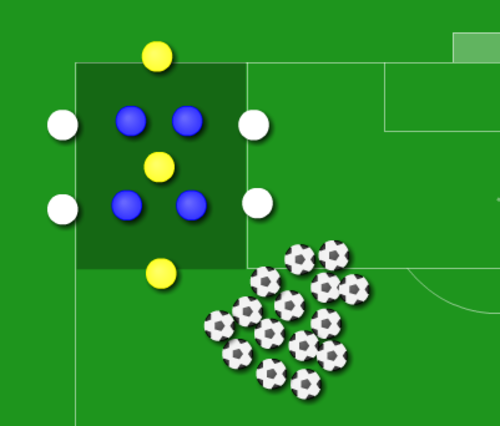

3 yellows (1 on each side, 1 in the middle). 4 whites (2 on each side). 4 blues (all inside area). Plenty of balls ready to be passed in by the coach to allow for continuity. Size of area as above: 18 yds. [penalty area] x approx. 12 yds. The outside team (whites in this case) and the yellows act as one team and keep possession of the ball. Rules: Players must not be static. The team of 4 on the outside (whites) cannot pass to each other on the same side. If the team of 4 in the middle (blues) intercept the ball from a pass made by one of the team of 4 on the outside (whites), they must switch places as quickly as possible [quick transitions, expansive shape to compact shape and vice versa]. When switching places, the team must on the outside must press quickly to win the ball back [pressing in transition â counter pressing
Receiving [open body shape, receiving the ball across the body]. Which foot to receive on [front foot under pressure, back foot when not under pressure]. Opposite movements to create angles [ nearest player coming close to support, furthest player moving far to create width/depth]. Quick transitions [expansive shape to compact shape and vice versa]. Pressing types [cutting off passing lanes, pressing in numbers, covering the presser(s)]. Pressing body shape [showing outside, showing inside] Pressing in transition (aka counterpressing/gegenpressing) [speed of press, pressing when team has numerical balance]. Speed of thought [quick adjusting of mentality from in possession to transition to defending â uses all 4 moments of a match]. Scanning play [mental image of next pass or position].
This practice has no coaching points
This practice has no progressions
in more ways than one
 sportplan_football



Deliberate heading is now out of U11 grassroots matches. Here is how to coach chest, thigh and foot control so your players still win the ball in the air.
Long-range goals doubled at the 2026 World Cup as teams sat deep. Here is how to coach when to shoot from distance, the technique, and the follow-up.

Under FutureFit, your Under-9s stay at 5v5, your Under-11s stay at 7v7 and your Under-13s stay at 9v9. Same pitch, same numbers, one more year. Here is how to make sure that year feels like a step forward rather than a repeat.