


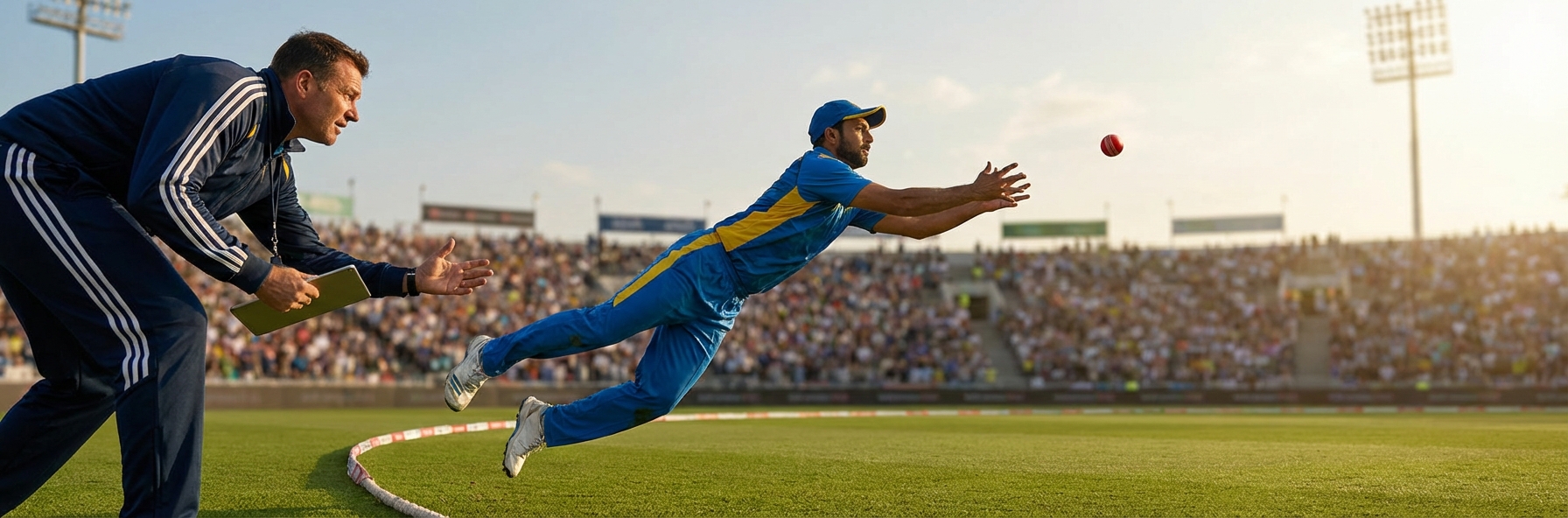
Watch any modern T20 tournament and the fielding will astonish. Players diving at full stretch to stop boundaries, leaping to take catches then throwing the ball back before landing outside the rope, hitting the stumps from 40 metres while off balance.
Fielding has evolved from a necessary part of cricket into a specialist discipline requiring dedicated training, athletic development, and tactical understanding.
The Boundary Catch Revolution
The relay catch on the boundary - catching, throwing back before landing out, then a teammate completing the catch - has become routine at elite level:
The technique:
- Time the jump to meet the ball at maximum height
- Catch with soft hands, immediately looking for the relay partner
- Throw the ball back into the field before momentum carries you over
- Partner catches cleanly to complete the dismissal
This requires hours of specific practice. The coordination between catcher and relay, the timing of the jump, the throw while off-balance - none of it happens without repetition.
Athletic Requirements
Modern fielding demands physical capabilities:
Explosive power: Diving, jumping, rapid direction changes. Short sprints rather than endurance running.
Core strength: Throwing accuracy and power come from the core. Weak cores mean weak throws.
Flexibility: Full diving extensions, recovery from awkward positions, low catching positions.
Hand-eye coordination: Tracking the ball through flight, judging the catch timing, maintaining focus through the grab.
The Direct Hit
Run-out accuracy has become a game-changer. Elite fielders hit the stumps 70%+ of the time from any position:
Throwing mechanics:
- Pick up with two hands where possible - one hand when speed demands it
- Body aligned to target before release
- Throwing arm travels past the ear for accuracy
- Follow through towards the target
One-handed pick-up: When there's no time for two hands, the one-handed sweep-and-throw in one motion. Requires countless repetitions to groove the release point.
Position-Specific Training
Different positions demand different skills:
Slip cordon: Reaction catching, soft hands, lateral movement. Practice focuses on edge catches at varied heights and angles.
Point/cover: Ground fielding speed, throwing accuracy, diving stops. The premium position for athletic fielders.
Boundary: High catching, relay throws, running catches along the rope. Spatial awareness to track ball and boundary simultaneously.
Inner ring: Quick movement both ways, sharp catching, fast hands for run-out attempts. The busiest positions in limited-overs cricket.
Reading the Game
Athletic ability without game awareness wastes energy. Smart fielders:
Anticipate: Watch the batter's feet and bat angle to move early. The best fielders are moving as the bat makes contact.
Communicate: Call for the ball, direct teammates, alert to running between wickets. Silence costs runs.
Position dynamically: Adjust position between deliveries based on field changes, bowling variations, and batter tendencies.
Training Sessions
High-intensity catching: Rapid catches from different angles. Build both skill and work capacity.
Target throwing: Vary distances, angles, and pressure. Add movement before the throw - pick up while running, throw while off-balance.
Game scenarios: 2 to win, 1 ball remaining. Dive or slide? Throw to keeper or bowler's end? Decision-making under pressure.
Relay practice: Partner work on boundary catches. Build the timing and communication.
Injury Prevention
Athletic fielding increases injury risk. Prevention strategies include:
Shoulder pre-hab: Band work, rotator cuff strengthening, throwing preparation before sessions.
Landing mechanics: How to fall safely, roll through dives, absorb impact.
Graduated intensity: Build throwing volume progressively through pre-season. Don't go from zero to match intensity.
Team Fielding Standards
Individual skills combine into team systems:
Backing up: Every throw has someone behind the target. Non-negotiable.
Cut-off positions: Deep fielders throw to cut-offs to improve accuracy on long throws.
Communication standards: Who calls, what calls mean, how loud. Practice until it's automatic.
Key Coaching Points
- Fielding is a specialist skill requiring dedicated training time
- Athletic development underpins fielding improvement
- Different positions need different skill focus
- Anticipation multiplies athletic ability
- Protect shoulders - throwing injuries end careers