

Recent advances in smart ball technology have achieved something remarkable: the ability to identify Type 1 (finger spin) and Type 2 (wrist spin) deliveries without motion capture systems. Sensors embedded in the ball measure spin rate, axis, seam position, and release characteristics to classify every delivery.
For coaches, this opens new possibilities in spin bowling development. Objective feedback replaces guesswork.
Type 1 vs Type 2 Spin: The Key Distinction
Understanding the fundamental difference between spin types is crucial for correct coaching:
Type 1 (Finger spin): The ball rotates primarily around a near-vertical axis. Off-spinners and left-arm orthodox bowlers use this method. The fingers impart the spin through a "flicking" action. The ball drifts predictably and turns consistently.
Type 2 (Wrist spin): The ball rotates around a tilted axis, creating more complex flight. Leg spinners, googlies, and variations use the wrist as the primary spin generator. The ball can dip, drift sideways, and turn more sharply.
Matching the correct technical model to the spin type is essential. A finger spinner trying to bowl like a wrist spinner - or vice versa - creates fundamental problems.
What Smart Balls Measure
Modern smart cricket balls track multiple parameters:
Spin rate (revolutions per minute): Elite finger spinners typically achieve 1800-2200 rpm. Elite wrist spinners reach 2500-3000+ rpm. Higher spin rates generally correlate with more turn.
Spin axis: The angle of rotation determines drift and turn direction. The axis distinguishes finger spin from wrist spin mechanically.
Seam orientation: Where the seam points at release affects movement. Upright seams give straight flight; angled seams create drift.
Release speed: Variation in pace is a weapon. Smart balls show how much speed varies between deliveries.
Efficiency: How much of the spin rate translates into actual turn. Poorly released deliveries lose spin through wobble.
Using Data for Development
The numbers guide coaching decisions:
If spin rate is low: Focus on wrist/finger strength and technique at release. The spin generators need development.
If efficiency is poor: The seam isn't stable. Work on grip and release to create cleaner rotation.
If axis is inconsistent: The wrist position varies between deliveries. Build consistency through repetition and video review.
If speed variation is minimal: Every ball arrives at the same pace. Develop arm speed variation without changing action.
Session Structure with Smart Balls
Baseline measurement: Start sessions with 6-12 deliveries to establish current parameters. What's the average spin rate today?
Focused practice: Work on specific technical points. Does the change improve the numbers?
Variation comparison: How do the parameters change between stock ball and variations? The googly might have different optimal characteristics.
Fatigue monitoring: Do the numbers drop as the session continues? This shows when technique deteriorates.
Interpreting Results
Numbers without context mislead. Consider:
Individual baselines: A spinner with naturally lower spin rate might be more effective than a high-rpm bowler with poor control. Compare against personal history, not abstract ideals.
Match effectiveness: Lab numbers don't always translate to wickets. Some spinners prosper with lower technical numbers through guile and accuracy.
Development trajectory: Trends matter more than single readings. Is spin rate improving over weeks? Is consistency increasing?
Combining with Video
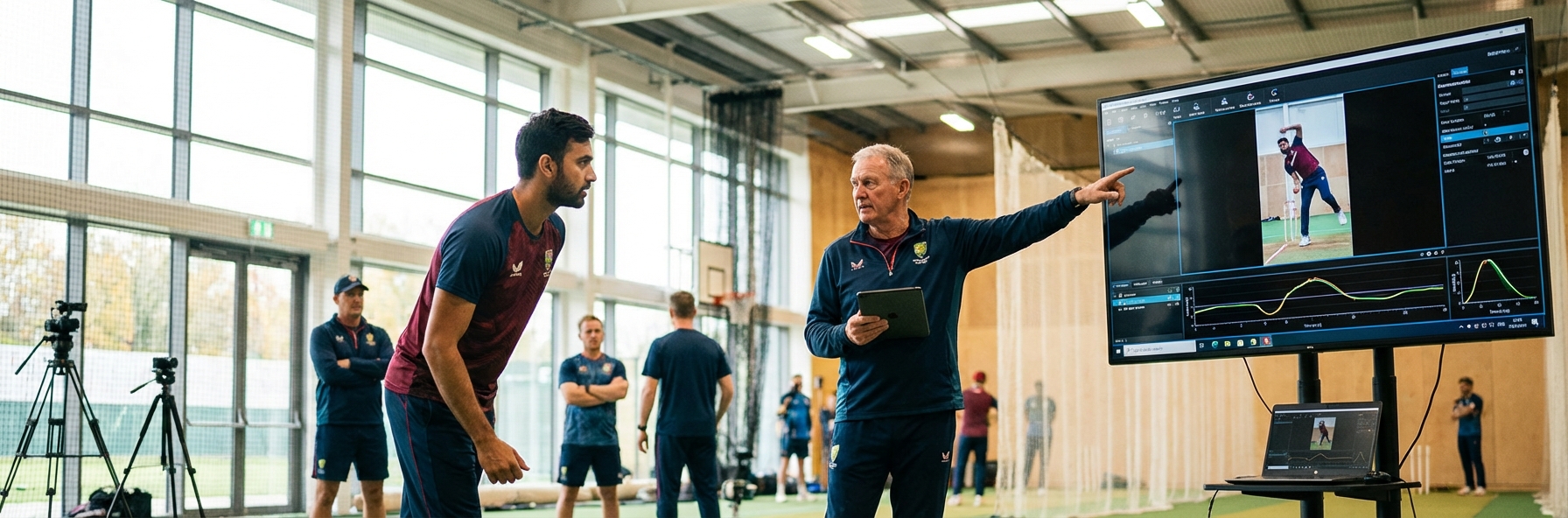
Smart ball data becomes powerful when matched with video analysis:
High spin rate deliveries: What did the technique look like? Can that be replicated?
Low efficiency balls: Watch the release - was the grip wrong? Did the fingers slip?
Axis changes: Compare wrist position between consistent and inconsistent deliveries.
Accessibility
Smart ball technology is becoming accessible beyond elite levels:
- Prices have dropped significantly from early professional-only models
- Smartphone apps provide instant feedback
- Coaching platforms aggregate data for long-term tracking
- Club-level spinners can access professional-grade analysis
Key Coaching Points
- Type 1 (finger) and Type 2 (wrist) spin require different technical models
- Smart balls provide objective measurement of spin characteristics
- Spin rate, axis, and efficiency all matter - not just one number
- Track trends over time rather than obsessing over single readings
- Combine data with video for complete understanding