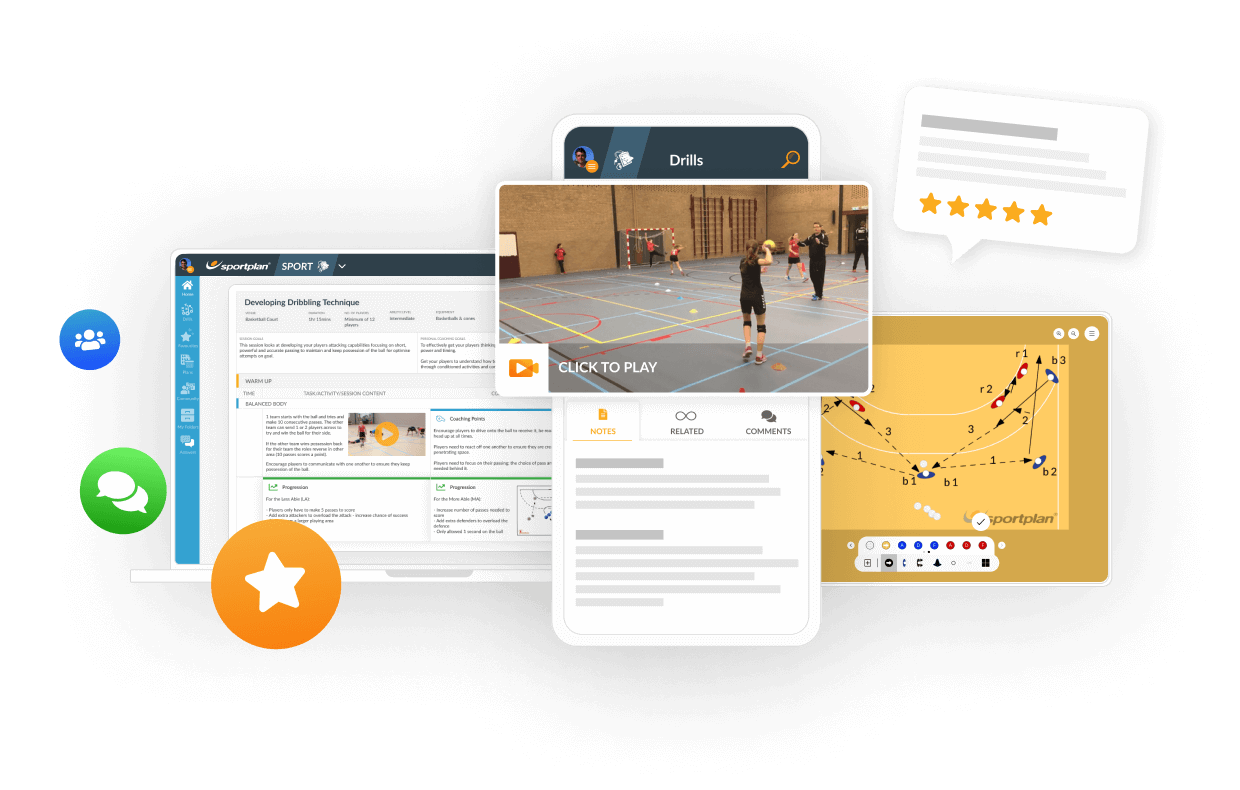
This is a game which requires two teams of 4 (in the diagram two games are being played simultaneously).
Two teams of three play inside the area, with one player from each team on the outside.
The teams inside should pass around so that everybody inside the area touches the ball at least once.
Once everyone on a team has touched the ball they should then try to pass to the player outside the area. If they do this they score 1 point. If they receive the return pass from the player they receive another 1 point.
If the ball is intercepted/dropped players must start again.
Rotate the player on the outside regularly.
Variations:
The 'spare' player outside the grid may now go around the area.
Every player must have had the ball 2,3,4 times before passing to the player outside.
Players inside the grid must complete a set number of passes before receiving the return pass.
Wing players operate in the most demanding shooting position on a handball court, where acute angles and a close goalkeeper make finishing a specialist skill. This article breaks down the technique, decision-making, and training progressions that coaches need to develop elite wing finishing.
The transition from attack to defence is the most vulnerable moment in handball. This article examines the 3-second recovery principle, the specific roles players must adopt during transition, and the training scenarios that build a team's ability to recover defensive shape under pressure.
Handball demands explosive power, repeated sprint ability, and the strength to compete physically for 60 minutes. Sport-specific conditioning develops the athletic qualities that underpin elite performance.