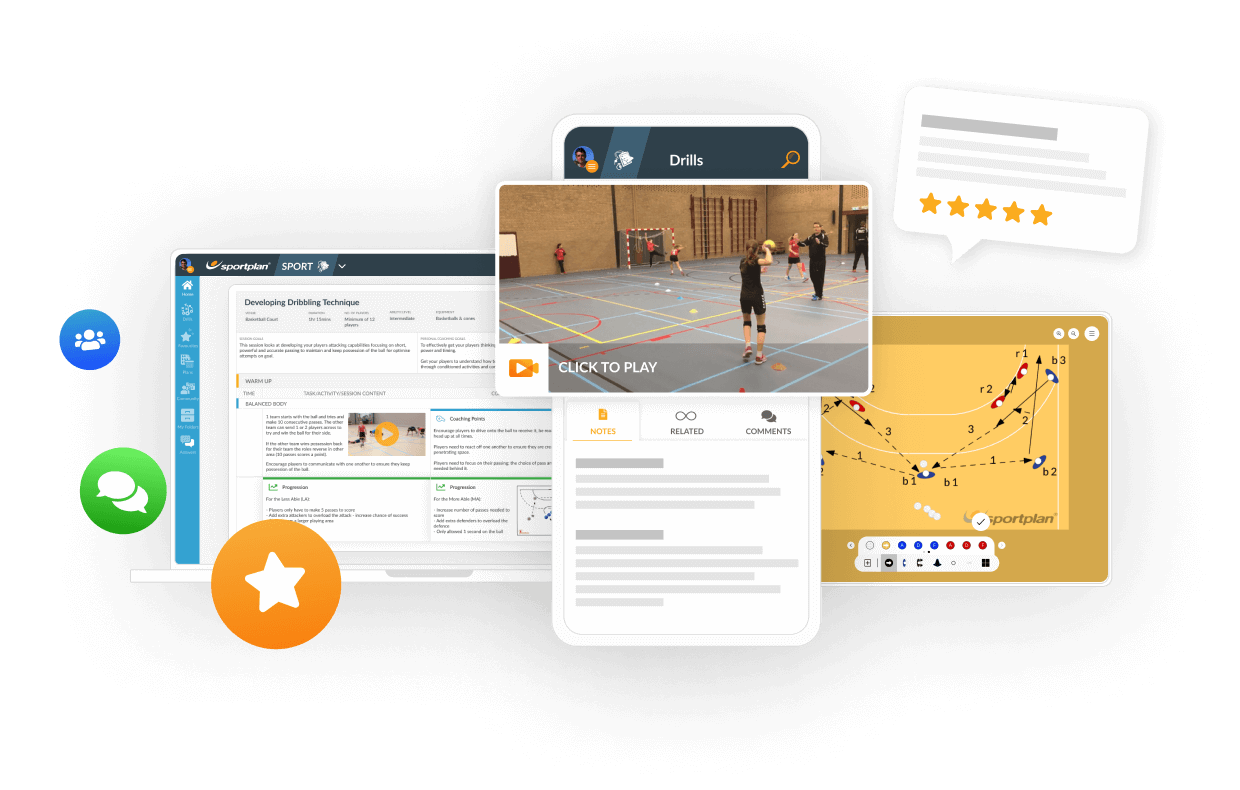
Set up 5 equal groups of players, one group on each sideline and 3 in the middle. Have several balls with both groups of sideline players.
Player 1 starts the drill with a pass to player 2. Player 2 runs out to meet the pass and then passes it on to player 3 who passes to player 4 who finishes with a shot on goal.
Immediately after passing though player 1 must chase down their own pass, making sure they're in a position to block the shot when blue 4 is in possession.
Players in the middle rejoin the back of their own lines after receiving the pass/shooting.
Sideline players join the back of the line on the opposite side of the court after blocking the shot.
After every 2 minutes groups of players rotate one position in a clockwise direction. This means after 10 minutes players will have played in each position.
Progression:
To make things tougher for the defender, and to ensure they're not just going through the motions, any player can now shoot after receiving the pass!
This means that the defender is going to have to work extra hard as they move from one side of the court to the other, ensuring they're always between the ball and the goal with arms up ready to block!
Wing players operate in the most demanding shooting position on a handball court, where acute angles and a close goalkeeper make finishing a specialist skill. This article breaks down the technique, decision-making, and training progressions that coaches need to develop elite wing finishing.
The transition from attack to defence is the most vulnerable moment in handball. This article examines the 3-second recovery principle, the specific roles players must adopt during transition, and the training scenarios that build a team's ability to recover defensive shape under pressure.
Handball demands explosive power, repeated sprint ability, and the strength to compete physically for 60 minutes. Sport-specific conditioning develops the athletic qualities that underpin elite performance.