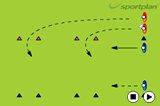
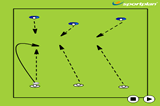
The players stood behind the line work the ball up through the channel in groups of 5. As they progress up the area they work the ball left and right.
Defenders are placed on cones which have been given a number.
As the group work their way up the channel the coach could call 1. At this point one player from cone 1 runs out to defend.
If a call of 1, 2 is made then one player from cone 1 and 2 come out to defend. A call of 2,2 means two players from cone 2 come out to defend and so on...
The diagram shows a call of 4, 1.
Work fast down the channel. The aim is to score a try through fast decision making.
Ball carrier needs to put pace onto the ball. Looking to pull the ball back. Supporting runners with their heads up!
Support runners hold off with one either side as passing options and one in behind to pick up any loose balls, creating a diamond shape.
Good communication from both groups of players - the attackers and defenders.
Move the ball and the point of attack quickly.
Note
As the coach you can put as many defenders into the channel as you like, making it as easy or difficult for the attackers as you like.
You can also play around with the spacing of the cones - closer together creating more contact or wider apart to make it easier to score.
Four players standing still make every ball handler's job harder. Teach V-cuts, L-cuts and back cuts so your team gets open and punishes defenders who overplay.
Good team defence is five players guarding the ball, not five separate one-on-ones. The shell drill is where that starts, so here is how to teach help-side positioning and rotations from the first week of the season.
Rebounding is the least glamorous thing in basketball and one of the most decisive. It is also almost entirely a habit, which means it is entirely coachable.


Register for FREE and get coaching tips, top drills, session and more every week!