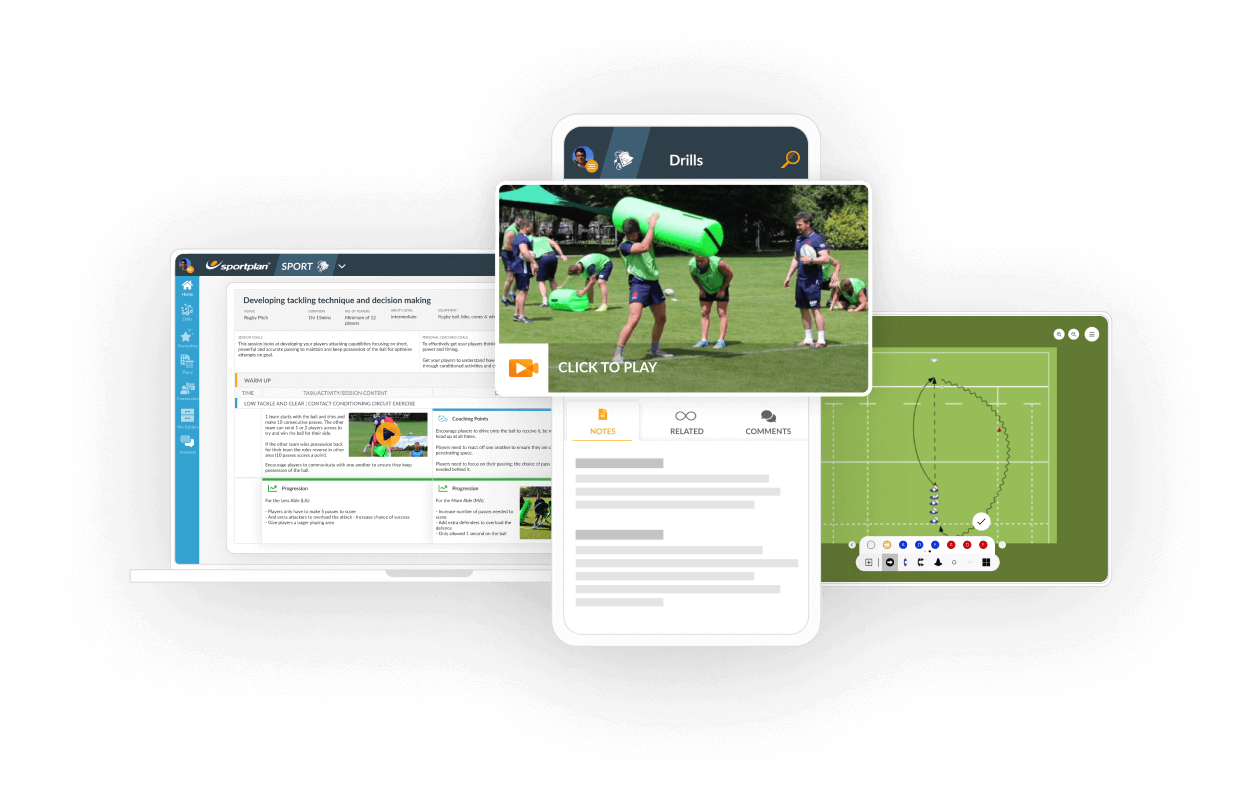
Drill to practice making multiple tackles in a period of time.
Set up a circle of 6 cones with a padman opposite each cone (between 2m and 5m away).
Players starts on a cone in the centre of the drill (as pictured) and run forward to tackle the padman. On completing the tackle they run back to the centre of the drill and move clockwise to the next cone.
On the coache's call they run forward to tackle the next padman, returning to the centre of the drill after completing the tackle and move clockwise to the next cone.
The drill continues until the players have tackled each bagman or at the coaches discretion.
Tackling technique
Progression -
Coach shouts 'left' or 'right' after each tackle and players have to adjust which cone they go to to make the next tackle
Players must start on their stomachs, and return to stomachs after each tackle
in more ways than one
The offload is one of rugby's most devastating weapons when executed well, turning a defensive collision into a second-phase attacking opportunity. This article breaks down the technique, timing, and training progressions coaches need to develop confident offloaders at every level.
Defensive line speed is the single most important factor in shutting down attacking opportunities before they develop. This guide explores how to coach your defensive line to push up as a connected unit, communicate under pressure, and deny the opposition time and space.
The teams winning in 2026 aren't taking risks - they're grinding out territory with relentless pick-and-go phases. Here's how to coach it.