TRANSFORM YOUR TEAM'S SEASON WITH PROFESSIONALLY PLANNED SESSIONS
Use our expert plans or build your own using our library of over 700+ drills, and easy-to-use tools.
JOIN NOWIn what situation is the miss pass best employed


Wayne
If you imagine a 3 v 2 situation where the three players have the ball, the worst thing is that the two defenders manage to halt the attack by tackling an attacker or intercepting the ball.Surprisingly, this happens a lot even in the top level of rugby!
The attackers need to commit the defenders and "fix" them by running at their inside shoulders. If this is done successfully the defenders can only defend against two of the attackers and there will be a "spare" man in attack.
The miss pass is used when the spare man is the outside attacker and to use it successfully the attackers should create the space for the third attacker by pretending to pass to the second attacker who calls for the ball and has their hands out as if to recive the pass but instead the pass goes across to the third free attacker.
See the drill in my second answer below.
I hope this helps you
Simon
Wayne
I have attached a simple 3v2 drill to help you - it doesn't show a miss pass but you could use the practice set up to get the players to understand it.
Simon
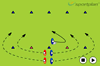
The miss pass can be employed in a situation where the fastest attacking player is on the outside and in space or where the attackers identify a mismatch (big v small; fast v slow) in good time to execute the move

in more ways than one
 sportplan_rugby


Tacklers are aiming lower, so carriers who dip late put heads at risk. Teach footwork, a strong early body height and leg drive to win the collision safely.

The hooker's brake foot moved from trial into full law in July 2026. Here is how to coach it so your front row stays stable, legal and safe.

Your players can pass beautifully in a warm-up grid. Then a defender closes, their lungs are burning, and the ball goes to ground. Here is how to build catch-pass skills that hold up when it matters.
Use our expert plans or build your own using our library of over 700+ drills, and easy-to-use tools.
JOIN NOW