TRANSFORM YOUR TEAM'S SEASON WITH PROFESSIONALLY PLANNED SESSIONS
Use our expert plans or build your own using our library of over 700+ drills, and easy-to-use tools.
JOIN NOWAsk a question and have it answered by Coaches from around the world and IRB Educators.


Nick It is easiest to practise the miss pass in a line - see attached practice. The key though is to get your players to understand when a miss pass is most effective. To develop this understanding perhaps you could get your players to play 3 v 2 in small grids and encourage players to make miss passes (reward with extra points)to put teammates in for a try. The key points are that the missed player in the middle calls for the ball and angles their run away from where the pass is going.
I hope this helps Simon

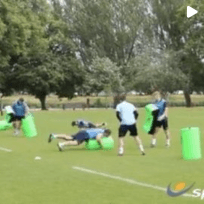
Nick, sorry, blowing my own trumpet time; look up the Technical Journal in the RFU website, archives Autumn 2006 (I think - but it is definitely 2006), and there is a series of practices for passing, including the one you need. Basically, I put 3 attackers in a line facing 2 tackle bags fairly close together. They represent the "best tacklers in the world (thereby answering the question "Why do that pass)," and the aim is for Player 1 to pass to Player 3 so that Player 3 receives the ball in the space outside the second bag. In my article, I have 5 in a line with 4 bags (2 then 2), so that Player 1 and Player 3 both have to try the miss pass. Start at jogging speed, and when the players get good, introduce a speed contest between the sets of players in some way. I made the players go through 5 times changing positions with each run so that they all played in every position, and timed the 5 runs. Reward for the fastest team. Dropped passes/any other miss voided the run. Do it left and right.

in more ways than one
 sportplan_rugby



Tacklers are aiming lower, so carriers who dip late put heads at risk. Teach footwork, a strong early body height and leg drive to win the collision safely.

The hooker's brake foot moved from trial into full law in July 2026. Here is how to coach it so your front row stays stable, legal and safe.

Your players can pass beautifully in a warm-up grid. Then a defender closes, their lungs are burning, and the ball goes to ground. Here is how to build catch-pass skills that hold up when it matters.
Use our expert plans or build your own using our library of over 700+ drills, and easy-to-use tools.
JOIN NOW