Rugby: back line

May 2026

Kicking from hand is at record levels in elite rugby. Six Nations 2026 was the most kicked-from-hand championship since stats began, and the same trend is showing across the URC, Champions Cup and Super Rugby. Coaches have realised that good kicks force opponents into pressured returns - and pressured returns are the easiest scoring opportunities in the game.

The flip side is just as important. If your side is on the receiving end of all those kicks, your counter-attack is no longer a luxury skill - it is a core part of your attacking game plan. The most exciting tries in 2026 are not coming from set-piece strike moves. They are coming from broken-field returns.

Why the Counter-Attack Has Become Central

When a team kicks, three things happen at once. Their forwards are spread across the field as chasers rather than packed around the ball. Their defensive line is in motion, not set. And the receiving team has the ball with space in front of them. Combined, those three factors mean the defence is at its most vulnerable in the seconds immediately after a kick.

Modern attacking analysts call this the "transition window". It typically lasts six to eight seconds. If the receiving team can move the ball into space inside that window, they create a numerical or positional advantage that no structured attack could engineer in open play.

The Three Decisions Every Receiver Must Make

Catching the ball is the easy part. The decision that follows is what separates good counter-attacking teams from poor ones. Train your back three to run through three questions every time they collect a kick.

Decision 1 - Time and space: How close is the nearest chaser? If a chaser is within five metres and closing fast, the answer is almost always to return the kick. If the nearest chaser is ten metres away or more, the carry is on.

Decision 2 - Width on the field: Where are my support runners? A counter-attack needs at least two players in support. If the wingers are still on their wings and the full-back caught it, there is no point trying to run - the carrier will be isolated. Better to step infield to a phase, then launch the next play.

Decision 3 - The defensive picture: Which side is undermanned? Most chase lines come up flat and even, but there is almost always a weakness - usually on the far side of the field where the original kicker stayed back. Counter to that space, not into the strongest chase channel.

How to Build Counter-Attack Habits

Counter-attacking cannot be taught from a whiteboard. It is a reactive skill and must be trained in environments that look like the game. Here is a progression that works at every level from U16 upward.

Stage 1 - Catch and scan: Two minutes of high-ball drills where every catcher must shout the position of the nearest chaser before they hit the ground. This trains the pre-catch scan, which is the foundation of every good counter-attack.

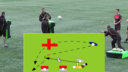
Stage 2 - 3v2 from a kick: Coach kicks the ball into a back three. Two chasers come from 20 metres. The back three must keep the ball alive and beat the chasers using one of three responses: switch infield, hit a support runner on the outside, or counter-kick.

Stage 3 - Full-pitch transition game: Conditioned game where every kick must be returned. No mark allowed, no exit kick allowed. Forces players to find solutions and exposes which units have not learned to support the back three quickly.

The Forwards' Role in Counter-Attack

This is where most teams fail. The back three can be brilliant, but if the forwards are still standing where they were before the kick, the counter dies at the first ruck. Coach your forwards to react to opposition kicks like a fire alarm - the closest three drop into the back-field as immediate support, while the rest fan out across the pitch ready to play.

This habit takes weeks to embed. Start by freezing training every time a kick is fielded and asking each forward to show where they should be running. Repetition turns it from a thought into a reflex.

Key Coaching Points

  • The transition window is six to eight seconds - move the ball before it closes
  • Train the pre-catch scan: who is chasing, how close are they, where is the space?
  • Counter to the weak side of the chase, not into the strongest channel
  • Forwards must react to kicks as quickly as the back three
  • Avoid contact in your own 22 - if the counter is not on, return the kick

Recommended Drills

VIEW ALL DECISION-MAKING DRILLS

back line DRILLS
View All
Unfortunately there were no results for your search! Please try again
back line ANSWERS
View All

How do I get the back line run...

Our back line is very sluggish and drift ,any ideas for simple plan to get them moving straight and fast?

Michael Strain Coach, Wales

Attacking scrum - what back li...

Any "simple" attacking moves from a scrum that you can recommend for a U15s XV side. Looking to get them to think about how the back line would would set up and have different options from a) center field and b) tight left or right all at the half way mark.

Dave Greenwood Coach, England

Tips on breaking through a def...

Hi my name is Mac and i am a 8 man and i struggle to push through a defensive line when i have the ball due to how my coaches make us practice so i wanted to know tips on how to push/break through a defensive line when i have the ball.

Mac Coach, United States of America

what are good beginner backlin...

what are good beginner backline moves

Oliver hughan Coach, New Zealand

I am coaching the U11 this sea...

U11 Rugby I am coaching the U11's this season. There are some significant rule changes from U10. Please can I get some advice on what lessons were learned from coaches who have been through a similar experience.

William OBrien Coach, England

Trouble gettng the ball to our...

We have two very fast wingers but we cannot get them the ball . Teams are coming up fast and we are lucky to get the ball to the O. C. We have tried setting up further back but too many times we are getting caught behind the gain lines when we do that. Any ideas?

john mcmullen Coach, United States of America

switch pass in rugby union

switch pass in rugby union

maria Coach, England

Please supply me with the positional play for a No8 at the maul,defence,and attack

Ask a question and have it answered by Coaches from around the world and Sportplan's team of Experts.

Buddy Walker Coach, New Zealand

Order of operations for a maul.

I'm kicking around two different orders for creating mauls. 1) 3rd Man Rip First supporters arrive and drive over rather than stripping ball. I like this one because it allows the supporters to join more quickly and keeps everything going forward. Because the original ball carrier keeps the ball until the 3rd man joins, this maul turns into a clean ruck very easily. I don't like this one because of the increased stress on the ball carrier to protect the ball, and the ball's slower movement to the back. 2) First man rip First supporter arrives and strips, third and fourth drive over. I like this one because the ball is cleared from the front straight away. I don't like this one because it can fall and be a mess, as well as as lack forward momentum as the focus is put on the ball. What do you think about the two ways of forming a maul? I've seen teams do both. Keep in mind I coach mainly older, new players.

Josh Macy Coach, United States of America

Back Row support of 12

Hi there. Does anyone have any session plans on back row support of 12 taking quick ball off the top of a lineout?

Archived User Coach

Forward running; positoning after breakdown

I am trying to explain to my Under 12 forwards where they should run to after a breakdown. Inevitably the committed lads end up running from ruck to ruck without getting there hands on the ball. How do you coach positioning? When to hang in the back line, when to cover wide, when to set up a chain play? Traditional unopposed has the forwards going thru ruck after ruck when the backs have broken the play down but how do you explain positioning to the big men?

David Mason Coach, England

how do you coach back line defence against attack from?

how do you coach back line defence against attack from midfield scrum

Mike Taylor Coach, England

Whats the different ways of placing the ball when tackled

Whats the different ways of placing the ball when tackled

Archived User Coach

Law 12 - the forward pass or throw forward

The law says that a forward pass is one "thrown forward" "in the direction of the opponents' goal line" Does that mean that, if the ball is passed and the receiver catches it NEARER to the opponents goal line than from where the ball was passed that the pass was forward? (Leaving to one side any other touches of the ball that might have taken place.) Maybe an example is better. Player 1 passes the ball sideways - releasing it on the 22 metre line. Player 2 (with no other player having touched the ball), running from well behind the 22 metre line, catches the ball when it has travelled sideways but the ball is now 20 metres from the opponents goal line (2 metres further forward from the place that the ball was passed). Is that a forward pass or throw forward? And if not, why not?

Archived User Coach

peeling off in the line

Peeling off the back in the line, dose anyone have diagrams of this move. Cheers

Archived User Coach

First time coaching U9 and U10s - anyone got any backline coaching tips?

Hi im a first time coach and is still getting the hang of how the technical details of the game works the back line is my department and whould like any help i can get to know what drills to do and anything helpfull in the backline im currently coaching for the under 9 and 10

Archived User Coach

Any examples of lineout calls suitable for u14s

Any examples of lineout calls suitable for u14s

Archived User Coach

How to stop U12s forwards picking the ball up?

My forwards constantly pick and go from the rucks in games and this is starving the backs from any ball. Is there anything I can do, drills etc, which would help them realise there is a time and a place for pick and go, but to do it every time narrows the game and it becomes ineffective and not good teamwork.

Simon Luxton Coach, England

Staying onside on defense

I need drills that emphasize staying onside on defense. Any suggestions?

Tim Reisler Coach, United States of America

JOIN SPORTPLAN FOR FREE

  • search our library of 1100+ rugby drills
  • create your own professional coaching plans
  • or access our tried and tested plans

Sportplan App

Give it a try - it's better in the app

YOUR SESSION IS STARTING SOON... Join the growing community of rugby coaches plus 1100+ drills and pro tools to make coaching easy.
LET'S DO IT