Rugby: break down

May 2026

Kicking from hand is at record levels in elite rugby. Six Nations 2026 was the most kicked-from-hand championship since stats began, and the same trend is showing across the URC, Champions Cup and Super Rugby. Coaches have realised that good kicks force opponents into pressured returns - and pressured returns are the easiest scoring opportunities in the game.

The flip side is just as important. If your side is on the receiving end of all those kicks, your counter-attack is no longer a luxury skill - it is a core part of your attacking game plan. The most exciting tries in 2026 are not coming from set-piece strike moves. They are coming from broken-field returns.

Why the Counter-Attack Has Become Central

When a team kicks, three things happen at once. Their forwards are spread across the field as chasers rather than packed around the ball. Their defensive line is in motion, not set. And the receiving team has the ball with space in front of them. Combined, those three factors mean the defence is at its most vulnerable in the seconds immediately after a kick.

Modern attacking analysts call this the "transition window". It typically lasts six to eight seconds. If the receiving team can move the ball into space inside that window, they create a numerical or positional advantage that no structured attack could engineer in open play.

The Three Decisions Every Receiver Must Make

Catching the ball is the easy part. The decision that follows is what separates good counter-attacking teams from poor ones. Train your back three to run through three questions every time they collect a kick.

Decision 1 - Time and space: How close is the nearest chaser? If a chaser is within five metres and closing fast, the answer is almost always to return the kick. If the nearest chaser is ten metres away or more, the carry is on.

Decision 2 - Width on the field: Where are my support runners? A counter-attack needs at least two players in support. If the wingers are still on their wings and the full-back caught it, there is no point trying to run - the carrier will be isolated. Better to step infield to a phase, then launch the next play.

Decision 3 - The defensive picture: Which side is undermanned? Most chase lines come up flat and even, but there is almost always a weakness - usually on the far side of the field where the original kicker stayed back. Counter to that space, not into the strongest chase channel.

How to Build Counter-Attack Habits

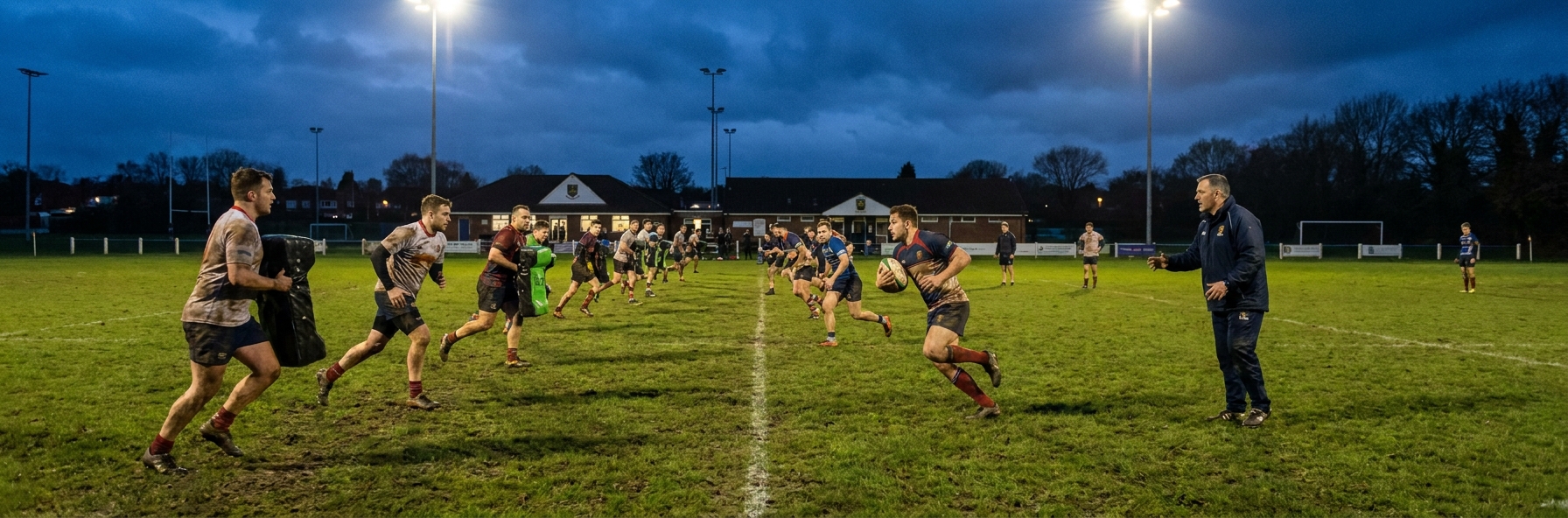
Counter-attacking cannot be taught from a whiteboard. It is a reactive skill and must be trained in environments that look like the game. Here is a progression that works at every level from U16 upward.

Stage 1 - Catch and scan: Two minutes of high-ball drills where every catcher must shout the position of the nearest chaser before they hit the ground. This trains the pre-catch scan, which is the foundation of every good counter-attack.

Stage 2 - 3v2 from a kick: Coach kicks the ball into a back three. Two chasers come from 20 metres. The back three must keep the ball alive and beat the chasers using one of three responses: switch infield, hit a support runner on the outside, or counter-kick.

Stage 3 - Full-pitch transition game: Conditioned game where every kick must be returned. No mark allowed, no exit kick allowed. Forces players to find solutions and exposes which units have not learned to support the back three quickly.

The Forwards' Role in Counter-Attack

This is where most teams fail. The back three can be brilliant, but if the forwards are still standing where they were before the kick, the counter dies at the first ruck. Coach your forwards to react to opposition kicks like a fire alarm - the closest three drop into the back-field as immediate support, while the rest fan out across the pitch ready to play.

This habit takes weeks to embed. Start by freezing training every time a kick is fielded and asking each forward to show where they should be running. Repetition turns it from a thought into a reflex.

Key Coaching Points

  • The transition window is six to eight seconds - move the ball before it closes
  • Train the pre-catch scan: who is chasing, how close are they, where is the space?
  • Counter to the weak side of the chase, not into the strongest channel
  • Forwards must react to kicks as quickly as the back three
  • Avoid contact in your own 22 - if the counter is not on, return the kick

Recommended Drills

VIEW ALL DECISION-MAKING DRILLS

break down DRILLS
View All

Continuous Passing Square 2

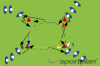
Set up a square of cones, and get the players to form equal lines behind each cone. The ball starts in the hands of a player behind cone 1, who runs (black running line) towards cone 2, passes the ball to the player behind cone 2 who passes the ball back to the first player. The first player then runs towards cone 3 and passes the ball to the player standing behind cone 3. The player who passed the ball from behind cone 2 runs (blue running line) following the run of the first player and receives a pass from the player behind cone 3 before running towards cone 4 and passing the ball to the player behind cone 4. The player who passed the ball from behind cone 3 runs (yellow running line) following the run of the second player and receives a pass from the player behind cone 4 before running towards cone 1 and passing the ball to the player behind cone 1. The player who passed the ball from behind cone 4 runs (red running line) following the run and receives a pass from the player behind cone 1 before running towards cone 2 and passing the ball to the player behind cone 2. The player who passed the ball from behind cone 1 runs (black running line) following the run and receives a pass from the player behind cone 2 before running towards cone 3 and passing the ball to the player behind cone 3, and the drill continues. Change the direction which the ball is going. Progressions: Get the players to change direction on your command (shout/whistle etc) Multiple balls As a group must complete 10 successful passes before the session can move on, every time a ball is dropped the whole group does an exercise (e.g. 10 press ups).

Passing

Unfortunately there were no results for your search! Please try again
break down ANSWERS
View All

How to run a swerve

I want to break down the running of a swerve into component parts so these can be coached. eg if you are swerving to the right, i read that the right leg should cross over the left so you naturally start falling to the right.Can you help?

Archived User Coach

Improving game awareness. How can I improve players?

Improving game awareness. How can I improve players insight into "what happens next", besides by whatching (games)? Players tend to be fixed on the ball(situation) and seldom look at what is in front of them%3A how can I stimulated them to take time to quickly look around and assess the situation?

Yvonne Bouman Coach, Netherlands

I am putting together a skills matrix of suggested/expected age specific skills

I am putting together a skills matrix of suggested/expected skills a child should have as they progress through the Continuum. eg, by under 7 a player should be able to do ABC, by under 8 they should be able to do DEF, by under 9 they should be able to do XYZ, etc. I want to break this down into novice, core and advanced, as well as positional (as they get older) Does anyone know of a format that exists like this already somewhere?

Archived User Coach

is a player deemed of their feet at a ruck when both?

is a player deemed of their feet at a ruck when both hands and feet are in contact with floor (basically in a press up position)

Archived User Coach

I'm working with kids aged 10 and 11. A major problem?

I'm working with kids aged 10 and 11. A major problem is getting them to have some sense of position on the pitch. In other words how do I stop them all running after the ball.e

Cameron Taylor Coach, Scotland

First time coaching U9 and U10s - anyone got any backline coaching tips?

Hi im a first time coach and is still getting the hang of how the technical details of the game works the back line is my department and whould like any help i can get to know what drills to do and anything helpfull in the backline im currently coaching for the under 9 and 10

Archived User Coach

First time coaching the U13s next season - any tips greatly appreciated!

I have just started helping our head coach with under12's team. He wants to retire and has put me forward to be head coach next season. I am a little worried on how i should aproach training with the boys, going to a full 15 a side team on a full pitch. Any ideas would be greatly appreciated.

Archived User Coach

U9s swarming around the ball

We coach U9s and one of the biggest problems is that they all swarm around the ball like bees around honey. We are repeatedly trying to explain the value of not doing this and use of space but to no avail. What coaching techniques can we introduce to get the kids to spread out and not all commit to the breakdown?

Damien Coach, Ireland

U7 and u8s tag rugby with low numbers

I coach under 7s and under 8s tag rugby and we often get low numbers at training as low as 2 or 3 any ideas for games for them to play that is related to skills without having to cancel a session. Asked using Sportplan Mobile App

James Gallagher Coach, England

struggle with the tackle during games

what to do?when on the field players struggle to make tackles, but when we use the junior bag they go in hard and tackle like animals.any drills to help us please?my group is under 9s

JOHAN BRENKMAN Coach, Namibia

men to men defence drill

i want the key ponts of men to men drill

serapelontaopane Coach, South Africa

Tips on breaking through a def...

Hi my name is Mac and i am a 8 man and i struggle to push through a defensive line when i have the ball due to how my coaches make us practice so i wanted to know tips on how to push/break through a defensive line when i have the ball.

Mac Coach, United States of America

Openside flanker position afte...

My coach has put me at openside flanker and I'm confused of where i should be after the scrum. Should I be attacking the opposing scrum half or just trailing behind the backs waiting to clean up/ form a ruck? It would be great to know what I'm doing !

Archived User Coach

Is anchoring at the breakdown ...

At the breakdown is blue ball carrier gets tackled going to ground. The next blue player arrives and crouches over the ball and anchors onto the tackled player. Is this legal? It is assumed that he's not off his feet etc which is a separate offence

Archived User Coach

Under 9`s rugby, fear of tackl...

I coach under 9`s rugby and a lot of the kids have a bad fear of tackling, they lack the confidence to get stuck in. What is the best thing to help them overcome this?

Archived User Coach

Coaching the Tackle for U9s wh...

Some of my U9s players, who are experiencing contact for their first season, are showing reticence in tackling - how do you coach or get through the fear factor/element?

Archived User Coach

My U11's are a mixed bunch whe...

My U11's are a mixed bunch when it comes to tackling. Some very good, most OK, some ...hmmmm... enough said. Been through all the drills and when we break things down, go back to basics, everything appears OK, but it doesn't always transfer into the game. Any ideas on small group games that will allow me to combine technique with confidence?

Archived User Coach

Getting 9-10 year olds to spre...

Getting quite frustrated that my u10's are not using the space on the pitch and tend to bunch up. Despite various drills and game scenarios to force them to spread out and pass to someone in space they revert in any game to bunching up around the ball and taking it back into the thick of the opposition rather than looking left or right! Any ideas how to change their ways?

Ian G Coach, England

JOIN SPORTPLAN FOR FREE

  • search our library of 1100+ rugby drills
  • create your own professional coaching plans
  • or access our tried and tested plans

Sportplan App

Give it a try - it's better in the app

YOUR SESSION IS STARTING SOON... Join the growing community of rugby coaches plus 1100+ drills and pro tools to make coaching easy.
LET'S DO IT