Rugby: one v one

May 2026

Kicking from hand is at record levels in elite rugby. Six Nations 2026 was the most kicked-from-hand championship since stats began, and the same trend is showing across the URC, Champions Cup and Super Rugby. Coaches have realised that good kicks force opponents into pressured returns - and pressured returns are the easiest scoring opportunities in the game.

The flip side is just as important. If your side is on the receiving end of all those kicks, your counter-attack is no longer a luxury skill - it is a core part of your attacking game plan. The most exciting tries in 2026 are not coming from set-piece strike moves. They are coming from broken-field returns.

Why the Counter-Attack Has Become Central

When a team kicks, three things happen at once. Their forwards are spread across the field as chasers rather than packed around the ball. Their defensive line is in motion, not set. And the receiving team has the ball with space in front of them. Combined, those three factors mean the defence is at its most vulnerable in the seconds immediately after a kick.

Modern attacking analysts call this the "transition window". It typically lasts six to eight seconds. If the receiving team can move the ball into space inside that window, they create a numerical or positional advantage that no structured attack could engineer in open play.

The Three Decisions Every Receiver Must Make

Catching the ball is the easy part. The decision that follows is what separates good counter-attacking teams from poor ones. Train your back three to run through three questions every time they collect a kick.

Decision 1 - Time and space: How close is the nearest chaser? If a chaser is within five metres and closing fast, the answer is almost always to return the kick. If the nearest chaser is ten metres away or more, the carry is on.

Decision 2 - Width on the field: Where are my support runners? A counter-attack needs at least two players in support. If the wingers are still on their wings and the full-back caught it, there is no point trying to run - the carrier will be isolated. Better to step infield to a phase, then launch the next play.

Decision 3 - The defensive picture: Which side is undermanned? Most chase lines come up flat and even, but there is almost always a weakness - usually on the far side of the field where the original kicker stayed back. Counter to that space, not into the strongest chase channel.

How to Build Counter-Attack Habits

Counter-attacking cannot be taught from a whiteboard. It is a reactive skill and must be trained in environments that look like the game. Here is a progression that works at every level from U16 upward.

Stage 1 - Catch and scan: Two minutes of high-ball drills where every catcher must shout the position of the nearest chaser before they hit the ground. This trains the pre-catch scan, which is the foundation of every good counter-attack.

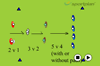
Stage 2 - 3v2 from a kick: Coach kicks the ball into a back three. Two chasers come from 20 metres. The back three must keep the ball alive and beat the chasers using one of three responses: switch infield, hit a support runner on the outside, or counter-kick.

Stage 3 - Full-pitch transition game: Conditioned game where every kick must be returned. No mark allowed, no exit kick allowed. Forces players to find solutions and exposes which units have not learned to support the back three quickly.

The Forwards' Role in Counter-Attack

This is where most teams fail. The back three can be brilliant, but if the forwards are still standing where they were before the kick, the counter dies at the first ruck. Coach your forwards to react to opposition kicks like a fire alarm - the closest three drop into the back-field as immediate support, while the rest fan out across the pitch ready to play.

This habit takes weeks to embed. Start by freezing training every time a kick is fielded and asking each forward to show where they should be running. Repetition turns it from a thought into a reflex.

Key Coaching Points

  • The transition window is six to eight seconds - move the ball before it closes
  • Train the pre-catch scan: who is chasing, how close are they, where is the space?
  • Counter to the weak side of the chase, not into the strongest channel
  • Forwards must react to kicks as quickly as the back three
  • Avoid contact in your own 22 - if the counter is not on, return the kick

Recommended Drills

VIEW ALL DECISION-MAKING DRILLS

one v one DRILLS
View All

Tabata Touch Tag Rugby - Rugby...

You can play any version of touch you like, I'm going to suggest One Touch Off-Load - but you can change this to suit your training goals for the session ahead. Mark out your training area for the game, but include one or more Tabata training zones for your players (these zones don't have to be very big). If you only have one other person helping you - you might have only one zone, but if you have more assistant coaches or helpers standing around, create more zones - you'll find they will be used. Split your players into two teams, giving them bibs if needed. Keep your law briefing, brief - telling the players the laws of the version of touch you have decided to play. Tell them that as an addition to the normal laws, we now have a sin binning for mistakes e.g. you may decide that all mistakes are sent to the sin bin (The Tabata Zone), you might just focus on forward passes, or penalties. My point is that you can tailor this to suit your coaching goals. Players sent to the sin bin will be there unit sent back by the supervising coach. Don't forget to swap the defense and the attack. Also you can focus the sin binning on the defence for not meeting your defensive goals. Using the Tabata Zones Small areas with one coach/helper. The Tatbata protocol is often 8 periods of intense 20 second activity - with 10 seconds of rest in between (sound simple - try it!). Tell the sin binned player they have 20 seconds to complete as many press-ups as they can, then give them 10 seconds to rest. Repeat 8 times, or reduce to a number of repetitions that work for you and your players. When the player has completed their reps - return them to the game. What you could do in the zones: Press ups, Lunges, Burpees, Sit ups, Etc.

General

Unfortunately there were no results for your search! Please try again
one v one ANSWERS
View All

what are simple drills for touch rugby...to get ready?

what are simple drills for touch rugby...to get ready for the season?

Archived User Coach

We have a new team forming, all of the fowards are novices except for two of us (Prop and Hooker) from a different team helping out. Any drilling advice woud be very appreciated

Ask a question and have it answered by Coaches from around the world and IRB Educators.

Tony Meza Coach, Costa Rica

what drills are there for a 3 v 2 situation?

what drills are there for a 3 v 2 situation?

Archived User Coach

What drills would you suggest to get players to focus on poaching the ball in rugby?

Ask a question and have it answered by Coaches from around the world and Sportplan's team of Experts.

John Coach, United States of America

Taking the ball into contact

Several of my players are taking the ball a yard too far into contact and losing possession as a result.Do you have any suggestions or drills that would help to address this? Dave Knights. Hong Kong

Archived User Coach

I need ideas for fun team building activities and any?

I need ideas for fun team building activities and any fun games to help towards team building. Has anyone got any ideas on what to do? Anything to spice up rugby training sessions in the dark, cold winter nights.

Archived User Coach

Does anyone have a really good drill to encourage backs to stay steep?

Does anyone have a really good drill to encourage backs to hold their steepness when attacking - my team of dreams are Under 11's

Archived User Coach

Introducing U9's to positional play?

I would like some help/drills to help me introduce U9's to positions ie%3A start playing in set positions during a game ie forwards/backs. Up til now they have not had set positions & its been everyone follow the ball. I need to get them to understand & keep to positions during a game.

Archived User Coach

I have just started to train girls under 15. Any fun drills to initiate them to the basics of the game?​

I have just started to train girls under 15. Some of them have knowledge of the game, but in mayority dont know anything. I ususally train girls M21 and Im afraid the drills and tecnics I know, are not fun enough for this age group. I wish to learn some fun, and interactive drills to iniciate them to the basics of the game.

Mariana Garcia Paz Coach, Colombia

Law 12 - the forward pass or throw forward

The law says that a forward pass is one "thrown forward" "in the direction of the opponents' goal line" Does that mean that, if the ball is passed and the receiver catches it NEARER to the opponents goal line than from where the ball was passed that the pass was forward? (Leaving to one side any other touches of the ball that might have taken place.) Maybe an example is better. Player 1 passes the ball sideways - releasing it on the 22 metre line. Player 2 (with no other player having touched the ball), running from well behind the 22 metre line, catches the ball when it has travelled sideways but the ball is now 20 metres from the opponents goal line (2 metres further forward from the place that the ball was passed). Is that a forward pass or throw forward? And if not, why not?

Archived User Coach

Looking for day 0 skills to teach children?

I am looking for a Day 0 type of session for American children who may have never held a rugby ball. If I move forward with a rugby exhibition/team creation in the neighborhood, I want to make sure I know how/what to teach Day 0. I'm hoping that interest is growing for touch and flag rugby due to the recent in Philadelphia between the USA Eagles and the Maori All Blacks. I was there. It was fantastic. Tickets sold out so fast, I think there will be more of these in the area. Thanks.

Doug Jones Coach, United States of America

Interpretation of the maul - for U10s?

I will be coaching under 10 next season and need some guidance on how to interpret the rules for the maul?

Ezra rushen Coach, England

progression

How do you make is easier or harder for people that find the drill too demaning/difficult or people that find it too easy

max gardiner Coach, England

JOIN SPORTPLAN FOR FREE

  • search our library of 1100+ rugby drills
  • create your own professional coaching plans
  • or access our tried and tested plans

Sportplan App

Give it a try - it's better in the app

YOUR SESSION IS STARTING SOON... Join the growing community of rugby coaches plus 1100+ drills and pro tools to make coaching easy.
LET'S DO IT