Rugby: quick hands attacking space session

Rugby is a game of decisions. Every second, players choose: pass, carry, or kick? Blitz or drift? Jackal or get back in the line? The team that makes better decisions more consistently wins matches - not necessarily the team with more talent or better fitness.

Game management is the skill of making these decisions correctly under pressure, with fatigue setting in, with the crowd noise, with the stakes rising. It can be developed.

The Decision-Making Framework

Good decisions start with good information. Players need to see the game clearly before they can choose correctly.

The OODA loop in rugby:

  • Observe: What do I see? Defensive structure, space, support
  • Orient: What does this mean? Opportunity, threat, neutral
  • Decide: What's my best option? Pass, carry, kick, hold
  • Act: Execute with commitment

The faster and more accurately players cycle through this loop, the better their decisions. Training should develop each stage.

Developing Observation Skills

Many poor decisions come from poor observation. Players who don't see the full picture can't make informed choices.

Training observation:

  • Pre-scan: look before receiving the ball
  • Peripheral awareness: what's beside you, not just ahead
  • Key cues: what specifically to look for (defender's hips, space, numbers)

Drills for observation: Play games where the coach calls "freeze" and asks players to describe what they see. What options exist? Where's the space? Where's the threat?

Situational Awareness

Understanding the game situation frames decision-making. The right decision at 0-0 in the first minute differs from 3-0 down in the 79th minute.

Situation factors:

  • Score: leading, trailing, or level
  • Time: first half, second half, final minutes
  • Field position: own 22, midfield, attacking 22
  • Conditions: wind, rain, surface
  • Momentum: who's on top right now?

Players need to know the situation without thinking about it. Score, time, and field position should be automatic awareness.

Risk Management

Every rugby decision involves risk. The question is whether the potential reward justifies the risk in this specific situation.

High-risk decisions:

  • Running out of your own 22
  • Offloads under pressure
  • Speculative kicks without chase support
  • Committing extra players to the ruck

When high-risk is acceptable:

  • Trailing with time running out
  • Attacking in the opposition 22
  • Momentum strongly in your favour

When to play conservative:

  • Protecting a lead late in the game
  • Deep in your own half
  • Opposition on top and looking for turnovers

Pressure Moments

Certain moments in matches carry extra pressure. Decision-making under pressure deteriorates without specific training.

High-pressure scenarios:

  • Final play of the half or game
  • Penalty opportunity to win/draw the match
  • Defending a one-point lead in your 22
  • Restart after conceding a score

Training pressure: Create pressure in training through consequences, time limits, and competitive scenarios. Players who've experienced pressure in training cope better when it matters.

Communication in Decision-Making

Rugby decisions are rarely individual. Communication coordinates group decision-making and ensures everyone understands the plan.

Essential communications:

  • Ball carrier: "Carrying!" "Kicking!" "Looking left!"
  • Support: "With you!" "On your shoulder!"
  • Defence: "Up!" "Drift!" "Numbers!"
  • General: "Time!" "Space outside!" "Keep it!"

Leaders must take ownership of communication. The fly-half and captain should constantly talk, directing the team's decision-making.

Learning from Decisions

Post-match review should examine decisions as much as execution. Why did we make that choice? What did we see? What would we do differently?

Effective review questions:

  • "What was your thinking there?"
  • "What options did you see?"
  • "Given what you know now, what would you do?"
  • "What can we learn from this?"

Avoid blame. Focus on understanding and improvement. Players who fear judgment stop taking responsibility for decisions.

Developing Decision-Makers

Coaching approaches:

  • Guided discovery: ask questions rather than give answers
  • Constrained games: rules that force specific decisions
  • Decision overload: faster game speed to develop instinct
  • Post-play review: brief discussions about choices made

The goal is players who can read, decide, and act without waiting for coach instruction. Games move too fast for external direction - players must be autonomous decision-makers.

Key Coaching Points

  • Good decisions require good observation - train players to see
  • Situation awareness frames every choice
  • Risk must match the situation
  • Pressure can be trained - create it in practice
  • Communication coordinates group decisions

Drills to Develop Game Intelligence

VIEW ALL DECISION MAKING DRILLS

JOIN SPORTPLAN FOR FREE

  • search our library of 1100+ rugby drills
  • create your own professional coaching plans
  • or access our tried and tested plans
quick hands attacking space session DRILLS
View All

Scoring Zones Warm Up - Rugby ...
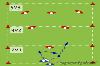
Be brief when telling the players the laws of this game, it's important to get them moving quickly. This is not a contact game. Break your players into two teams, giving each team their own colour of bibs if necessary. One team goes to attack, and one to defense. Nominate a Scrum Half for each team. There is no kicking in this game. Normal laws of rugby apply e.g. a forward pass will result in the ball being turned over to the opposition. If an attacking player is touched: they must go to ground, present the ball, two of their teammates ruck over (staying over the ball), and the Scrum Half moves the ball for the next phase of attack.The defence must commit three players to every ruck, or risk an infringement which will see tem pushed back ten meters. The ball must be moved from the ruck within 5 seconds. Make sure that the defense is employing your defensive pattern around the ruck.  Throughout the game the coach call the point of attack e,g, attack RED ZONE or Zone 2. The coach can also call the scoring zone, Score At Zone Yellow or Zone 3. As the game progresses have the players call the point of attack, and the scoring zones - but they must do this early and they must committ to that attack for a period of time. Have attacking players do what they normally would at the ruck. Depending on your goals decide on the number of touches you wish to allow e.g. unlimited is not a bad option as mistakes will be made! On a mistake or after a period of time, turn the ball over so that both teams get time in attack and defence. Don't hesitate to shape the game to focus on your session goals, and let us and other coaches know what worked for you!
General

Rugby Netball Agility & Runnin...

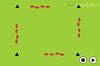
Drill to practice skills and creating space.Set up a pitch (roughly 25m x 20m depending on age and number of players) with two scoring zones at each end (green cones). Split the players into two even teams and give each team different colour bibs.Teams are aiming to score points by passing the ball to a team mate who is standing in the scoring zone (see diagram). Each time a player catches the ball on the full from a pass from a team mate in the scoring zone their team scores one point, and they turn and attack back the other way. Players cannot run while holding the ball, they must be standing still when they pass.The defending team cannot get closer than 2m to the player with the ball, and can only gain possession by intercepting a pass or if the attacking team drop the ball or give a poor pass which goes to ground. PROGRESSION:Players can only have possession of the ball for 2 seconds. If they hold the ball for longer than two seconds then possession is turned over. This means that the defending team can gain possession if they cut down the attacking players passing options.Players can run when in possession of the ball, but still can only have possession of the ball for 2 seconds.Passes must be over head.Passes must be below waist height.Chip kick / grubber kick instead of pass.Passes must be out of the back of the hand.Passes must be behind the back.Defenders can touch the attacking player in possession of the ball. If the defending team makes two touches on the attacking team then possession is turned over.

General

Realignment & Depth - 5 v 4 Ha...

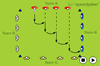
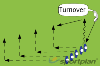
The realignment and depth hands drill is a quick drill to focus the players in sharpening their alignment and depth before a session. You can spend as long or as short on this drill as you need. The aim of the drill is to develop the speed at which players realign themselves, to support their early hand-catch, quick and accurate transfer of the ball to a support player.Set a 5 cones 1.5 meter apart in straight line. This will mark where the players will start the drill fromSet 4 cones at a diagonal in line with the starting cones from one edge. This will be the cones that the defending players need to retreat to before coming up to pressure the attacking players.The first attacking player needs to step back 1 meter and will receive the ball from the first defending player who has also stepped back 1 meter to his designated coneDivide the group into 4 attacking player and 5 defending players, there should be a free attacking playerThe ball starts with the defending playerOn the coaches call, all defending players need to work back to their designated cone and then come forward in a straight line to their opposite attacking playerThe attacking players set their own depth to ensure they have time to catch and pass effectivelyOn the coaches call, the first defending player will move back to their cone, once they get to the cone they pass the ball to the first attacking player, and then the first defending player tries to put pressure on the first attacking playerThe attacking players try to get the ball to the 5th player without being ‘touched’ by a defending player

General

Unfortunately there were no results for your search! Please try again
quick hands attacking space session DRILL CATEGORIES
View All

JOIN SPORTPLAN FOR FREE

  • search our library of 1100+ rugby drills
  • create your own professional coaching plans
  • or access our tried and tested plans

Sportplan App

Give it a try - it's better in the app

YOUR SESSION IS STARTING SOON... Join the growing community of rugby coaches plus 1100+ drills and pro tools to make coaching easy.
LET'S DO IT