Rugby: scrum pass

Rugby is a game of decisions. Every second, players choose: pass, carry, or kick? Blitz or drift? Jackal or get back in the line? The team that makes better decisions more consistently wins matches - not necessarily the team with more talent or better fitness.

Game management is the skill of making these decisions correctly under pressure, with fatigue setting in, with the crowd noise, with the stakes rising. It can be developed.

The Decision-Making Framework

Good decisions start with good information. Players need to see the game clearly before they can choose correctly.

The OODA loop in rugby:

  • Observe: What do I see? Defensive structure, space, support
  • Orient: What does this mean? Opportunity, threat, neutral
  • Decide: What's my best option? Pass, carry, kick, hold
  • Act: Execute with commitment

The faster and more accurately players cycle through this loop, the better their decisions. Training should develop each stage.

Developing Observation Skills

Many poor decisions come from poor observation. Players who don't see the full picture can't make informed choices.

Training observation:

  • Pre-scan: look before receiving the ball
  • Peripheral awareness: what's beside you, not just ahead
  • Key cues: what specifically to look for (defender's hips, space, numbers)

Drills for observation: Play games where the coach calls "freeze" and asks players to describe what they see. What options exist? Where's the space? Where's the threat?

Situational Awareness

Understanding the game situation frames decision-making. The right decision at 0-0 in the first minute differs from 3-0 down in the 79th minute.

Situation factors:

  • Score: leading, trailing, or level
  • Time: first half, second half, final minutes
  • Field position: own 22, midfield, attacking 22
  • Conditions: wind, rain, surface
  • Momentum: who's on top right now?

Players need to know the situation without thinking about it. Score, time, and field position should be automatic awareness.

Risk Management

Every rugby decision involves risk. The question is whether the potential reward justifies the risk in this specific situation.

High-risk decisions:

  • Running out of your own 22
  • Offloads under pressure
  • Speculative kicks without chase support
  • Committing extra players to the ruck

When high-risk is acceptable:

  • Trailing with time running out
  • Attacking in the opposition 22
  • Momentum strongly in your favour

When to play conservative:

  • Protecting a lead late in the game
  • Deep in your own half
  • Opposition on top and looking for turnovers

Pressure Moments

Certain moments in matches carry extra pressure. Decision-making under pressure deteriorates without specific training.

High-pressure scenarios:

  • Final play of the half or game
  • Penalty opportunity to win/draw the match
  • Defending a one-point lead in your 22
  • Restart after conceding a score

Training pressure: Create pressure in training through consequences, time limits, and competitive scenarios. Players who've experienced pressure in training cope better when it matters.

Communication in Decision-Making

Rugby decisions are rarely individual. Communication coordinates group decision-making and ensures everyone understands the plan.

Essential communications:

  • Ball carrier: "Carrying!" "Kicking!" "Looking left!"
  • Support: "With you!" "On your shoulder!"
  • Defence: "Up!" "Drift!" "Numbers!"
  • General: "Time!" "Space outside!" "Keep it!"

Leaders must take ownership of communication. The fly-half and captain should constantly talk, directing the team's decision-making.

Learning from Decisions

Post-match review should examine decisions as much as execution. Why did we make that choice? What did we see? What would we do differently?

Effective review questions:

  • "What was your thinking there?"
  • "What options did you see?"
  • "Given what you know now, what would you do?"
  • "What can we learn from this?"

Avoid blame. Focus on understanding and improvement. Players who fear judgment stop taking responsibility for decisions.

Developing Decision-Makers

Coaching approaches:

  • Guided discovery: ask questions rather than give answers
  • Constrained games: rules that force specific decisions
  • Decision overload: faster game speed to develop instinct
  • Post-play review: brief discussions about choices made

The goal is players who can read, decide, and act without waiting for coach instruction. Games move too fast for external direction - players must be autonomous decision-makers.

Key Coaching Points

  • Good decisions require good observation - train players to see
  • Situation awareness frames every choice
  • Risk must match the situation
  • Pressure can be trained - create it in practice
  • Communication coordinates group decisions

Drills to Develop Game Intelligence

VIEW ALL DECISION MAKING DRILLS

JOIN SPORTPLAN FOR FREE

  • search our library of 1100+ rugby drills
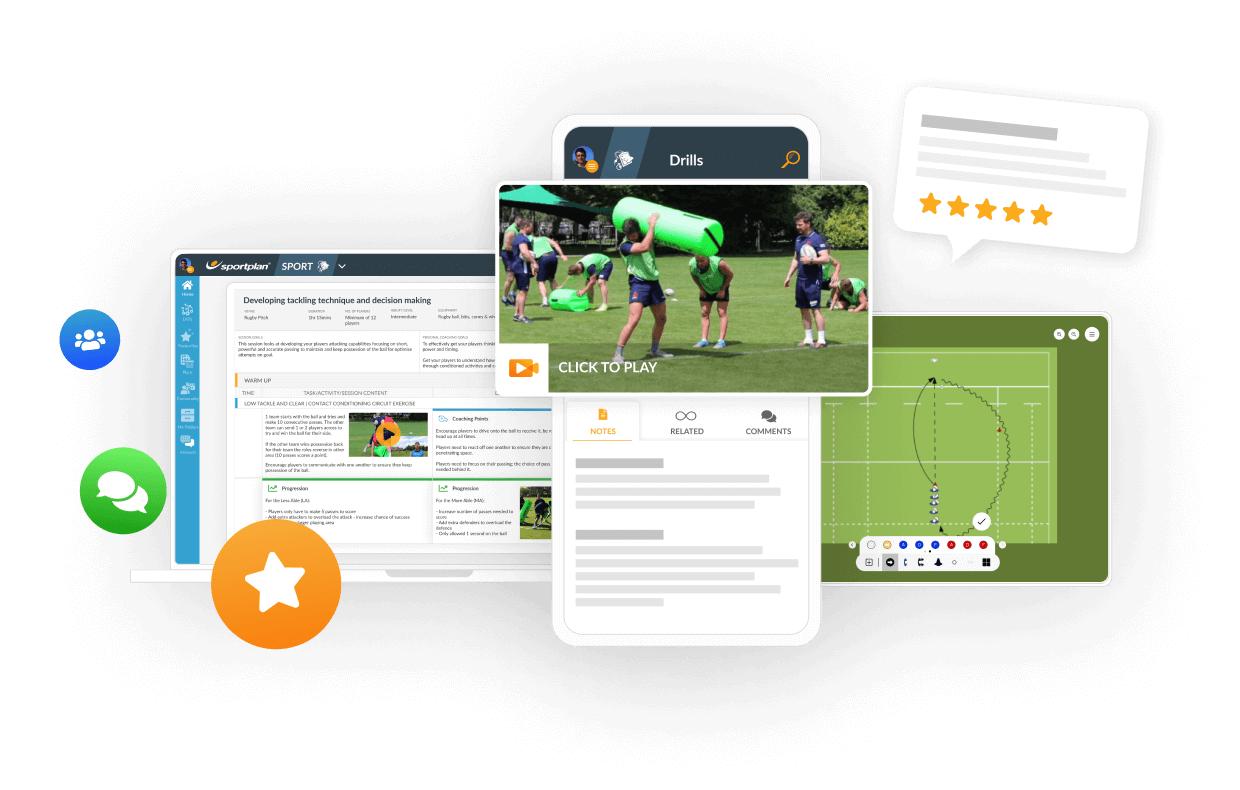
  • create your own professional coaching plans
  • or access our tried and tested plans
scrum pass DRILLS
View All

Attack Vs Defence Continuous D...

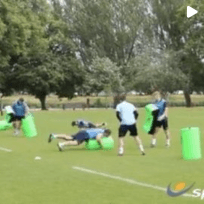
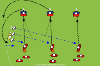
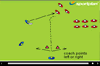
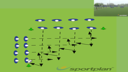
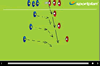
<span style=&quot;background-color: transparent;&quot;>Set a cone 2 meters from the defensive line. This will mark where the ball will passed from (feed) preferably from a scrum half.<span style=&quot;background-color: transparent;&quot;>Set a cone 0.5 meters each side from the mid point of the passing cone to simulate the sides of the ruck.<span style=&quot;background-color: transparent;&quot;>Set a cone a cone 5 meters from the ruck on the defensive line. 4 players start as attackers3 defenders start on their stomaches on the other side of the defensive cone (ruck) and 1 player on the defensive cone 5 metres from the ruck<span style=&quot;background-color: transparent;&quot;>The player on the 5 meter cone (defence) starts the drill by shouting ‘FOLD’ (or whatever call your team may use).<span style=&quot;background-color: transparent;&quot;>Defenders on their stomachs get up and fold around the ruck to take up a defence position. Players fold wide first, and ensure that 2 players are close to the ruck (Guard and Body Guard). <span style=&quot;background-color: transparent;&quot;>The player on the defensive cone bounces out (takes space in the defence line), the first player who folds takes up a position on the 5 meter defence cone (or inside the first attacking player)<span style=&quot;background-color: transparent;&quot;>Once the defence line is set the scrum half can pass the ball.<span style=&quot;background-color: transparent;&quot;>The attackers work to beat the defence, setting up a 'tip' (running a hard line) and 'pull back' option. They should read the defensive movements and make a decision to hit the tip option or pull out the back<br><br>

General

Unfortunately there were no results for your search! Please try again
scrum pass ANSWERS
View All

switch pass in rugby union

switch pass in rugby union

maria Coach, England

looking for the best drills to help a flyhalf move?

looking for the best drills to help a flyhalf move to scrumhalf the lad has pass a good pass and a sharp brain just some fine tuning needed and ideas please

Archived User Coach

Every scrum coach in the Uk will have kids passing?

Every scrum coach in the Uk will have kids passing the ball straight off the floor with no pull back, then when you watch the Lions play - the two scrum halves of Phillips and Ellis both lift the ball up and take a step before passing, as do most scrum halves in top flight rugby...(in Phillips case a double step shuffle!......why is this, there must be a reason? should we all be coaching kids to do the same ?

Archived User Coach

How can i teach 8 year old boys to spin pass

How can I teach 8 year old boys to spin pass

Mark Harris Coach, England

Flanker protecting the Scrum Half?How can a Flanker?

Flanker protecting the Scrum Half? How can a Flanker protect the Scrum-Half at a scrum without holding on to the oppositions Scrum Half? Also any advice for an Openside flanker on tackling the fly-half from scrums?

Archived User Coach

I am looking for drills / ideas on how to teach U6/U7?

I am looking for drills / ideas on how to teach U6/U7 about how to stay "onside" during a game.

Archived User Coach

How do i get more zip in my backline attack. At 16s?

How do i get more zip in my backline attack. At 16s level players seem to just go through the motions.

Paul cromack Coach, England

Teaching a player cues for a halfback pass,(passing?

What could you teach a player cues for the halfback pass,(passing from the ground)?

Archived User Coach

My number 10 has a habit of running across on first?

My number 10 has a habit of running across on first phase ball thus our backs lack any go foward ball most times. Any ideas how we can remedy this habit will be a great help.

Archived User Coach

Any tips / drills to teach my team to support the No. 8?

Any tips / drills as to what rest of team can do to support so No 8 doesn't charge ahead and get isolated.

Archived User Coach

Refereeeing an U10 ruck

As well as coaching U10 rugby, I also get to referee U10 games, under the New Rules Of Play. I feel that my refereeing of the ruck isn't as good as it could/should be. Has anyone got an easy to follow system to help them referee U10 rucks ?

Archived User Coach

U9s new laws for the loose ball?

Under the new U9's rules can they run with a loose ball after picking a ball up off the floor? Or do they have to pass to another player every time the ball goes to ground?

Archived User Coach

At u11 level can the scrum half run from the back of a scrum

I think a pass has to be made from the back of a maul or ruck but I am not clear about the rules at the scrum .

Mike Hancox Coach, England

How many tacklers are allowed in U10s rugby?

At under 10s I was under the impression that it is 1v1 tackling. Can someone clarify the laws on this please?

Aaron Lee Newson Coach, Wales

U9s swarming around the ball

We coach U9s and one of the biggest problems is that they all swarm around the ball like bees around honey. We are repeatedly trying to explain the value of not doing this and use of space but to no avail. What coaching techniques can we introduce to get the kids to spread out and not all commit to the breakdown?

Damien Coach, Ireland

U13s rules explained

I'm just after a little clarification regarding the current U13s rule changes as several teams we have played this season have different interpretations:0Can the scrum half scoot straight from the base of the scrum?Can 1st receiver on a free pass run with the ball once he's received it?What are rules around the movement of a scrum?I think we've got the rules right, i'd just like some confirmation.ANdrew

Andrew Wood Coach, England

At u11 level can the scrum hal...

I think a pass has to be made from the back of a maul or ruck but I am not clear about the rules at the scrum .

Mike Hancox Coach, England

Scrum half kicking in U13s rug...

are scrum halves allowed to kick from the scrum in U13s rugby, or do they have to pass/run?

John Stackelberg Coach, England

Openside flanker position afte...

My coach has put me at openside flanker and I'm confused of where i should be after the scrum. Should I be attacking the opposing scrum half or just trailing behind the backs waiting to clean up/ form a ruck? It would be great to know what I'm doing !

Archived User Coach

JOIN SPORTPLAN FOR FREE

  • search our library of 1100+ rugby drills
  • create your own professional coaching plans
  • or access our tried and tested plans

Sportplan App

Give it a try - it's better in the app

YOUR SESSION IS STARTING SOON... Join the growing community of rugby coaches plus 1100+ drills and pro tools to make coaching easy.
LET'S DO IT