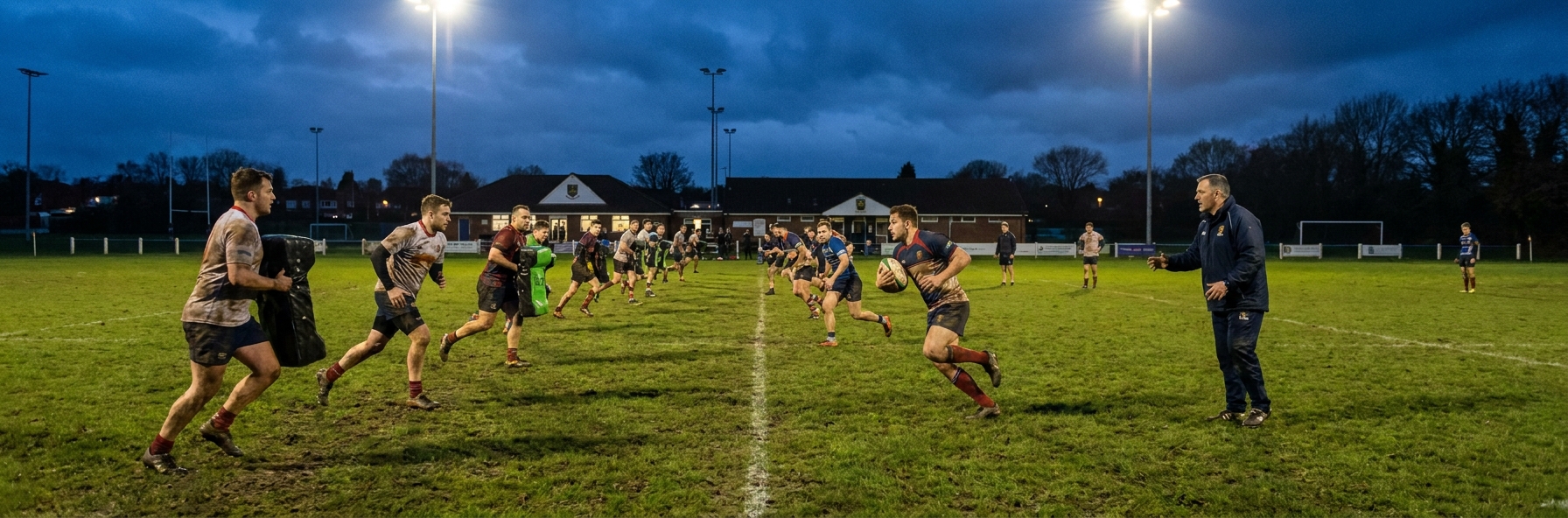
Rugby: training games

Rugby is a game of decisions. Every second, players choose: pass, carry, or kick? Blitz or drift? Jackal or get back in the line? The team that makes better decisions more consistently wins matches - not necessarily the team with more talent or better fitness.

Game management is the skill of making these decisions correctly under pressure, with fatigue setting in, with the crowd noise, with the stakes rising. It can be developed.

The Decision-Making Framework

Good decisions start with good information. Players need to see the game clearly before they can choose correctly.

The OODA loop in rugby:

  • Observe: What do I see? Defensive structure, space, support
  • Orient: What does this mean? Opportunity, threat, neutral
  • Decide: What's my best option? Pass, carry, kick, hold
  • Act: Execute with commitment

The faster and more accurately players cycle through this loop, the better their decisions. Training should develop each stage.

Developing Observation Skills

Many poor decisions come from poor observation. Players who don't see the full picture can't make informed choices.

Training observation:

  • Pre-scan: look before receiving the ball
  • Peripheral awareness: what's beside you, not just ahead
  • Key cues: what specifically to look for (defender's hips, space, numbers)

Drills for observation: Play games where the coach calls "freeze" and asks players to describe what they see. What options exist? Where's the space? Where's the threat?

Situational Awareness

Understanding the game situation frames decision-making. The right decision at 0-0 in the first minute differs from 3-0 down in the 79th minute.

Situation factors:

  • Score: leading, trailing, or level
  • Time: first half, second half, final minutes
  • Field position: own 22, midfield, attacking 22
  • Conditions: wind, rain, surface
  • Momentum: who's on top right now?

Players need to know the situation without thinking about it. Score, time, and field position should be automatic awareness.

Risk Management

Every rugby decision involves risk. The question is whether the potential reward justifies the risk in this specific situation.

High-risk decisions:

  • Running out of your own 22
  • Offloads under pressure
  • Speculative kicks without chase support
  • Committing extra players to the ruck

When high-risk is acceptable:

  • Trailing with time running out
  • Attacking in the opposition 22
  • Momentum strongly in your favour

When to play conservative:

  • Protecting a lead late in the game
  • Deep in your own half
  • Opposition on top and looking for turnovers

Pressure Moments

Certain moments in matches carry extra pressure. Decision-making under pressure deteriorates without specific training.

High-pressure scenarios:

  • Final play of the half or game
  • Penalty opportunity to win/draw the match
  • Defending a one-point lead in your 22
  • Restart after conceding a score

Training pressure: Create pressure in training through consequences, time limits, and competitive scenarios. Players who've experienced pressure in training cope better when it matters.

Communication in Decision-Making

Rugby decisions are rarely individual. Communication coordinates group decision-making and ensures everyone understands the plan.

Essential communications:

  • Ball carrier: "Carrying!" "Kicking!" "Looking left!"
  • Support: "With you!" "On your shoulder!"
  • Defence: "Up!" "Drift!" "Numbers!"
  • General: "Time!" "Space outside!" "Keep it!"

Leaders must take ownership of communication. The fly-half and captain should constantly talk, directing the team's decision-making.

Learning from Decisions

Post-match review should examine decisions as much as execution. Why did we make that choice? What did we see? What would we do differently?

Effective review questions:

  • "What was your thinking there?"
  • "What options did you see?"
  • "Given what you know now, what would you do?"
  • "What can we learn from this?"

Avoid blame. Focus on understanding and improvement. Players who fear judgment stop taking responsibility for decisions.

Developing Decision-Makers

Coaching approaches:

  • Guided discovery: ask questions rather than give answers
  • Constrained games: rules that force specific decisions
  • Decision overload: faster game speed to develop instinct
  • Post-play review: brief discussions about choices made

The goal is players who can read, decide, and act without waiting for coach instruction. Games move too fast for external direction - players must be autonomous decision-makers.

Key Coaching Points

  • Good decisions require good observation - train players to see
  • Situation awareness frames every choice
  • Risk must match the situation
  • Pressure can be trained - create it in practice
  • Communication coordinates group decisions

Drills to Develop Game Intelligence

VIEW ALL DECISION MAKING DRILLS

JOIN SPORTPLAN FOR FREE

  • search our library of 1100+ rugby drills
  • create your own professional coaching plans
  • or access our tried and tested plans
training games DRILLS
View All
Unfortunately there were no results for your search! Please try again
training games ANSWERS
View All

How can i keep my first and only rygby team in my country interesting for rugby?

Im coaching the first and only under 17 ( 13-16 ) team in Libya... and right now just i started building my second team ,,, I need some ideas to keep my first team active and interesting for rugby , so any advice for that please?

Archived User Coach

I would like to gather some simple stats during games?

I would like to gather some simple stats during games to give focus to training after, does anyone know of a computer packege,preferably free, that can do this

Chris Bulman Coach, Ireland

what psychological traits do you need to be a flanker?

what psychological traits do you need to be a flanker?

Archived User Coach

Mouthguards

Hi, I am a coach for the under 13’s at our club. Recently during one of our meetings I raised a concern about the possibility of players playing in full contact games, drills and training. I and my fellow coaches appear to disagree on whether a young player can still take part in full contact drills, training or game if he does not have his mouth guard with him. I’m informed that the club’s guidelines are that if his/her parent is present and gives permission or there is a letter stating that it is ok for that player to play without his/her mouth guard then we as club and coaches are able to play that player. I know that the RFU have also provided a guideline that mouth guards are recommended at all times but the position I am taking is that we, as club and as individuals, have a duty of care and if we knowingly allow anybody to play without the correct protection and an injury occurs we may be likely to be found guilty of negligence even if we have that prior permission. I do not believe that a letter or verbal permission abrogates us from our responsibility of caring for our players…especially the young. Maybe I am reading too much into this but the Health and Safety Act is an enabling act (possibly doesn’t cover sport- not sure about that) where the responsibility of safety is inherent in everybody not just nominated persons and with the litigation climate in this country becoming more like the USA I would hate for one of our parents to get "legal" if one of their little dears gets injured. Dentistry is not cheap. My approach is if the player does not have their gumshields then they cannot take part in any contact . Period…just in case. Do we have anybody who could clarify this point. Kind regards David

Simon Jones Coach, England

Our under tens when they go into a ruck situation often go straight over the ball leaving it in the open. A is this ball then available to be played by any player from both teams and B if this ball is out how can we teach them to secure the ball.

Ask a question and have it answered by Coaches from around the world and Sportplan's team of Experts.

Archived User Coach

my youth teams are seriously creative in attack but they lack ability to penetrate. how do i help them?

I coach both males and females. In training they seem to get it however in games they tend to pass the ball from side to side but they seldom go forward. They play pretty rugby with switches, loops and miss ones.

Archived User Coach

in p 4-5 rugby can kids play wearing safety sports glasses like davids from holland football player

Ask a question and have it answered by Coaches from around the world and Sportplan's team of Experts.

Archived User Coach

Does anyone know of an assessment for U10's

We have a large squad and need a transparent way to assess our players to justify the team selection - does anyone know of, or use an assessment tool to assess skills in this age group?

Archived User Coach

At u13 age group is it good to be playing a game every?

At u13 age group is it good to be playing a game every weekend or should it be staggered with training?

craig hamilton Coach, England

How to rebuild morale?

I have a new team of high school girls who exceeded expectations but have lost their confidence after a weekend of loses at a 7's tournament. How do I rebuild their morale so they can get back on track?

Mimi Coach, Canada

attitude issues with several players

Hello, I have a real issue with certain players in my team, they are lazy, undisciplined, don't respect the coach or trainner. What should I do? how can I try to get them back on track?The problem is that we are a small club, our team is only 11 members and they feel they have their own position earned no matter if they train or not.Thanks!!

Archived User Coach

First time coaching a rugby u15 team

It's my first time coaching a rugby team is there any tips and information of your experience in coaching ???

David Mitchell Coach, New Zealand

I need ideas for fun team buil...

I need ideas for fun team building activities and any fun games to help towards team building. Has anyone got any ideas on what to do? Anything to spice up rugby training sessions in the dark, cold winter nights.

Archived User Coach

First time coaching the U13s n...

I have just started helping our head coach with under12's team. He wants to retire and has put me forward to be head coach next season. I am a little worried on how i should aproach training with the boys, going to a full 15 a side team on a full pitch. Any ideas would be greatly appreciated.

Archived User Coach

Getting 9-10 year olds to spre...

Getting quite frustrated that my u10's are not using the space on the pitch and tend to bunch up. Despite various drills and game scenarios to force them to spread out and pass to someone in space they revert in any game to bunching up around the ball and taking it back into the thick of the opposition rather than looking left or right! Any ideas how to change their ways?

Ian G Coach, England

My U11's are a mixed bunch whe...

My U11's are a mixed bunch when it comes to tackling. Some very good, most OK, some ...hmmmm... enough said. Been through all the drills and when we break things down, go back to basics, everything appears OK, but it doesn't always transfer into the game. Any ideas on small group games that will allow me to combine technique with confidence?

Archived User Coach

How do I coach women the game ...

I just finished my collegiate rugby career. I feel inspired I would love to coach rugby to women in countries that have a lower popularity of women's rugby. How do I get started?

Archived User Coach

Improving game awareness. How ...

Improving game awareness. How can I improve players insight into "what happens next", besides by whatching (games)? Players tend to be fixed on the ball(situation) and seldom look at what is in front of them%3A how can I stimulated them to take time to quickly look around and assess the situation?

Yvonne Bouman Coach, Netherlands

U10s organisation in defence. ...

I have started an under 10s team up, and I would say about 8 from the 13 children I have , did not play rugby until about 6 months ago. Of these players, there seems to be a lot of potential, as we are scoring tries against teams, that very rarely concede tries.the problem I got with them, is that we are very poor at organising our selves in defense when the opposition has the ball, which does result in us conceding quite a few tries. We have some very good tacklers in the team. Can anyone offer some ideas on how I can get them to organise themselves? Thanks . Chris.

christopher jenkins Coach, Wales

Positional rotation at U9 leve...

Positional rotation at U9 level... I originally posted this as answer to a question about squad rotation, but thought I might get a better response if I posted it as a question in its own right... I have an 8 year old at the age level you are talking about - he isn't the best player at the club by any means, but has his good moments. He loves watching the game, he has a good understanding of the way it is played (to the extent that he has often shouted at the telly over recent weeks at some of our illustrious stars when they're out of position) and he has good handling skills - to be honest he's just not brave enough in the tackle yet, but I know it'll come so I'm not making a big thing of it. However, he and a couple of others are constantly stuck on the wing, and are getting fed up with the fact that they don't get the opportunity to get involved much. The coaches seem to have their "big names" and as you say seem more interested in the short term aims of winning each game rather than trying to keep the lads interested and challenged each week. I know my son's aware that I think they should move them all around, although I have made a point of not criticising the coaches at all - I think he heard me talking about it to someone else. The coaches have talked about moving players to different positions, but haven't done it, and aren't really receptive when they are asked about it. There are two coaches, and the one that seems to have the "casting vote" is pretty autocratic and doesn't seem to accept criticism or suggestions. My son has mentioned about moving to another club, where he may or may not get more of a chance to shine, but I am not sure this is the right move as it may teach him to give up rather than sticking with something. Any thoughts please?

Archived User Coach

JOIN SPORTPLAN FOR FREE

  • search our library of 1100+ rugby drills
  • create your own professional coaching plans
  • or access our tried and tested plans

Sportplan App

Give it a try - it's better in the app

YOUR SESSION IS STARTING SOON... Join the growing community of rugby coaches plus 1100+ drills and pro tools to make coaching easy.
LET'S DO IT