Rugby: up down

The 50:22 law, introduced as a trial and now a permanent fixture, has fundamentally changed how teams approach tactical kicking. A kick from your own half that bounces in-field, crosses the 22, and finds touch rewards the kicking team with the lineout throw-in. This single law change has altered both attacking and defensive strategies across the game.

Understanding the Law

The requirements:

  • Kick must originate from behind your own 10-metre line
  • Ball must bounce in the field of play (not direct to touch)
  • Ball must cross the opposition's 22-metre line
  • Ball must then go into touch
  • Kicking team retains the throw at the lineout

These requirements create specific technical demands. The kick must be long enough to reach the 22, accurate enough to hit the corner, and struck correctly to bounce in-field first.

Why 50:22 Matters

Before the 50:22, kicking from your own half that went to touch gave the throw to the opposition. The only benefit was territorial gain. Now, an accurate 50:22 delivers both territory AND possession - a game-changing combination.

The tactical impact:

  • Lineout attacking platform in the opposition 22
  • Defensive scramble if full-back fails to cover
  • Forces back three to position wider, creating space elsewhere
  • Punishes lazy defensive positioning

Executing the 50:22

The Grubber Option

A well-struck grubber can beat the full-back to the corner. The low trajectory keeps the ball in play, and end-over-end rotation makes the bounce predictable.

Grubber technique:

  • Strike through the middle of the ball, toe down
  • Generate end-over-end spin for predictable bounce
  • Aim for the gap between full-back and touchline
  • Follow up - if it doesn't reach touch, contest the chase

The Chip and Chase

A chip kick over the defensive line that bounces in the 22 and reaches touch. Higher risk - defenders can field it before it reaches touch - but effective against narrow defences.

Chip technique:

  • Get under the ball with angled foot
  • Enough height to clear defenders, not so much that chase time is lost
  • Backspin for controlled bounce toward touchline

The Cross-Field Kick

Against a defence shifted to one side, the cross-field kick to the far corner can find space. This is a longer kick requiring more accuracy but exploits defensive imbalance.

Defensive Adjustments

The 50:22 has forced defensive positioning changes. Full-backs can no longer sit narrow - they must cover the width. Wings must be aware of their touchline responsibilities.

Defending against 50:22:

  • Full-back positions wider to cover both corners
  • Wings drop deeper to provide secondary cover
  • Communication about kick threats: "Watch grubber!"
  • Quick identification and reaction to kicks

These defensive adjustments create space elsewhere. If the full-back is wide, the central channel opens. If wings drop deep, the defensive line loses numbers.

When to Attempt 50:22

Good opportunities:

  • Full-back positioned narrow or deep
  • Wide channel space visible
  • Defence rushed up, leaving back field exposed
  • Slow ball where running attack is risky

Poor opportunities:

  • Full-back already covering the corner
  • Quick ball with attacking momentum
  • Wind against making accurate kicking difficult
  • Kicker not in optimal position

Training 50:22 Execution

Individual kicking practice:

  • Set targets at the corner - grubber to specific zones
  • Practice both feet (advantage when on either side)
  • Vary distances - not every 50:22 opportunity is from the same position

Team practice:

  • Live scenarios with defence - read the full-back position
  • Decision-making: kick, run, or pass?
  • Chase organisation when the kick doesn't reach touch

Alternative Outcomes

Not every 50:22 attempt succeeds. But the threat creates secondary benefits:

If fielded before touch: You've still gained territory and forced the opposition to start from deep. Apply chase pressure and compete for their exit kick.

If it bounces out before 22: Opposition throw, but you've gained significant ground. Reset defensive line.

If full-back covers: Your threat has pulled them wide. Subsequent attacks may find more space centrally.

The Mental Game

The 50:22 threat changes how oppositions defend, even when you don't kick. Simply having players capable of executing the kick forces wider positioning and changes defensive dynamics.

Make sure your opposition knows you have this weapon. Execute it successfully early in matches, and they'll respect the threat throughout.

Key Coaching Points

  • The 50:22 rewards accurate kicking with possession AND territory
  • Grubbers are highest percentage - practise them
  • Read the full-back position before deciding
  • Even unsuccessful attempts gain territory
  • The threat changes defensive positioning

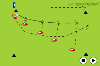
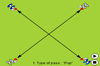
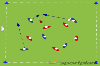
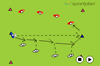
Drills to Master the 50:22

VIEW ALL KICKING DRILLS

JOIN SPORTPLAN FOR FREE

  • search our library of 1100+ rugby drills
  • create your own professional coaching plans
  • or access our tried and tested plans
up down DRILLS
View All

3 Touch Kick Warm Up - Rugby D...

Split your players into two teams, giving one group of players a set of coloured bibs to set them apart, and quickly tell your players the following laws: We will be playing a rugby league style touch. When touched: set the ball down, stand over the ball, allow the scum-half to move the ball away from the point of contact. The defenders should stay on side following a touch, and should not compete for the ball. Any infringements in defence should result in the defending team conceding 10 Meters or possibly giving 1 or more extra touches to the attacking team. I'll leave this to your judgement depending on your team's age, skill level, and your session target/s. The attacking team can sustain three touches before they have to kick. Their kick should be as it would be in the game: a kick to touch, a kick for territory, or a kick that can be regained e.g. a grubber kick. The defenders should behave as they would in a real game. Quick put in's from the touchlines replace lineouts. Defenders who take the ball from an attacking kick should counter attack. A forth touch results in a turn over. The Scrum Half has a maxium of 5 seconds to move the ball from the point of touch. A ball kicked directly to touch from outside the attacking teams 22, or where the ball has been taken into the 22 by the attacking team and then kicked into touch - will result in a turn over with play starting on the five meter line closest to where the kick was made. The defence should be 10 meters back. A ball kicked from inside the attacking teams 22 can go directly to touch, as long as the attacking team did not carry the ball into their own 22 before the kick. The resulting put in will be to the opposition from where the ball has went into touch. Quick put-in's are enoucraged, if not possible the ball is played from the 5 meter line with the defence 10 meters back. Give points for quick put ins that work. Feel free to play with any of noted laws, let us know the law variations that work for you!

General

Unfortunately there were no results for your search! Please try again
up down ANSWERS
View All

Does any body have any thoughts /plan on player rotaion between A,B,C teams. U9's

Does any body have a plan on how and why Squad rotation works when you are running 3 teams, A,B,C to ensure that the best players from the lower teams get to move up and down through the other teams. It is not expected that the C team players will rotate to the a team but we want to try and capture the better players from B and C and rotate them up to the team above.

Archived User Coach

I need help with defensive sets and communication?

I need help with defensive sets and communication. I coach U13 and I am having trouble devising a dril which gets them communicating but mostly helps get them more aware of their own defensive line. I still have boys who are very ball focussed and I need them to start looking up and down their line and the other teams to make sure they are numbered up and there are no holes. Any ideas?

Archived User Coach

Big Hit or Step Up tackle

Describe a 'step-up' or 'big hit' tackle. How would you coach it, what is the technique and what are the key factors technically?

Archived User Coach

HOW CAN I IMPROVE PLAYERS ABILITY TO PERFORM THE LATERAL?

HOW CAN I IMPROVE PLAYERS ABILITY TO PERFORM THE LATERAL PASS ?

dean Coach, England

how to get a 6ft+ player low in tackles

how to get a 6ft+ player low in tackles

Archived User Coach

My son has played all season U9's on the wing and has?

My son has played all season U9's on the wing and has now be brought into a inside centre role. What are the key differences he needs to make to be successful in his new position

Archived User Coach

I need some drills to improve a centre's hand speed?

I need some drills to improve a centre's hand speed in tight situations as well as some backline moves that i can use off a lineout where there is a cut back move as well as a wide move.

Archived User Coach

Scoring tries - habit?

Why is it important to get players to score the try when completing a handling/running drill?

Archived User Coach

I am training a back row forward in rugby union need?

I am training a back row forward in rugby union need to improve his speed off the mark any suggestions

francis11 Coach, Wales

Comments- Dear sir, I played for 35 yr.s mostly hooker,?

I was asked a question  by email recently and I thought it would be good to put it here as a question for anyone else to comment on%3A Dear sir, I played for 35 yr.s mostly hooker, some back line play. I was tutored in 1972 by former US Eagle hooker Jessie Lopez. We need to stabilize modern era scrums, specifically the front row. The way it's been done forever is wrong. Currently two pressure points come together head to head; and ofcourse the front rows twist amp; turn, left and right, up and down. Thus we are having more injuries with increased focus on scrum strength. FRONT ROWS SHOULD COME TOGETHER CONCAVE AS OPPOSED TO CONVEX. The hookers need to take the under bind on the props instead of the traditional over the top.This technique works much better by dispersing/spreading the impact.Also the hooker being set back about 6 inches is less at risk. If you don't think I know what I am talking about then ask some professionals who serve as the battering ram to try it. Their is a thin line separating safety from serious injury my friend. The way it's done now is time proven to be dangerous. You sir are probably not a hooker or tight head, so go inquire. It might not seem like a noticeable difference, but if it saves a couple people from getting thier necks broke next year - THEN IT BECOMES A BIG DIFFERENCE !! Thanks, Tim Nicodemus Fort Wayne Rugby Club

Simon Jones Coach, England

What are the main qualities fullbacks should have

What are the main qualities fullbacks should have?

Archived User Coach

(U11 Rugby) - How to referee the 'big lad'

I'm coaching and reffing U11 rugby and one of my players is the definitive 'big lad'. His 'strength' is his size and his power, but last weekend he didn't seem to get reffed fairly. The opposition couldn't tackle him down, one on one and when another two joined in to make a mini maul, that didn't slow him down much either. The ref then let other people join in the (one sided) struggle to tackle him down, which seemed very unfair as A) it's outside the laws of U11 rugby,, B) it makes it nigh on impossible for him to offload, C) when he is brought to ground, he has 4-5 players all over him and he got pinged for 'holding on'. He is a recent arrival to rugby and it was our first game for a couple of months, so the situation hadn't reared his head before. We are keen that he learns all of the core skills of rugby and doesn't get used as a battering ram, but after seeing a pack of hyenas trying to pull down the big fella, something just didn't seem right to me.I'd be grateful for any thoughts and opinions.

Archived User Coach

Warm up ideas before a game

What are the best warm up drills to do before a game Asked using Sportplan Mobile App

Liam Manley Coach, England

Changing a plans activity order

I have created a plan with 5 activities but they are in the wrong order. How do I change the order of the plan without starting again Asked using Sportplan on Mobile

Anthony Frewer Coach, England

add a drill to a plan

How do I add a drill I like to my existing plan

Tom Vyles Coach, United States of America

Tackling progression plan to improve confidence in tackles

I need to put together a progressive tackling session for an U16 girls 10-a-side team, who are tackling at an U14s boys level. They have done a tonne of basic technique but cant deliver the agression come game time. I need to help them building confidence and technique.Thanks, Coach from Australia.

Raphael Wood Coach, Australia

(U11 Rugby) - How to referee t...

I'm coaching and reffing U11 rugby and one of my players is the definitive 'big lad'. His 'strength' is his size and his power, but last weekend he didn't seem to get reffed fairly. The opposition couldn't tackle him down, one on one and when another two joined in to make a mini maul, that didn't slow him down much either. The ref then let other people join in the (one sided) struggle to tackle him down, which seemed very unfair as A) it's outside the laws of U11 rugby,, B) it makes it nigh on impossible for him to offload, C) when he is brought to ground, he has 4-5 players all over him and he got pinged for 'holding on'. He is a recent arrival to rugby and it was our first game for a couple of months, so the situation hadn't reared his head before. We are keen that he learns all of the core skills of rugby and doesn't get used as a battering ram, but after seeing a pack of hyenas trying to pull down the big fella, something just didn't seem right to me.I'd be grateful for any thoughts and opinions.

Archived User Coach

Rugby warm up for girls? | Spo...

Archived User Coach

How can I improve my tackling?...

How can I improve my tackling? I'm new to the game this year, and I had a couple of injuries to my shoulder and ribs early on which held me back somewhat. I was diving in and making good hits before- now as I approach being fully fit again I have found if I hit a player running at me with my shoulder around hip-height, I make good contact, but fail to get the wrap with the arms, and often don't bring the man down. On bigger lads I've tried hitting as low as possible, but often end up with one leg, sometimes two, and very low, still not getting the desired effect.... So, depending on the size of the opponent, where should I be hitting with the shoulder? Hips, knees, or other? And any tips on getting the wrap right? Thanks

Archived User Coach

Can you pull a ball carrier do...

Can you pull a ball carrier down by the jersey? If all you can get ahold of is the players shirt tail can you hold on and drag them down to the ground?

Archived User Coach

JOIN SPORTPLAN FOR FREE

  • search our library of 1100+ rugby drills
  • create your own professional coaching plans
  • or access our tried and tested plans

Sportplan App

Give it a try - it's better in the app

YOUR SESSION IS STARTING SOON... Join the growing community of rugby coaches plus 1100+ drills and pro tools to make coaching easy.
LET'S DO IT