

The Data Revolution Has Reached Club Hockey
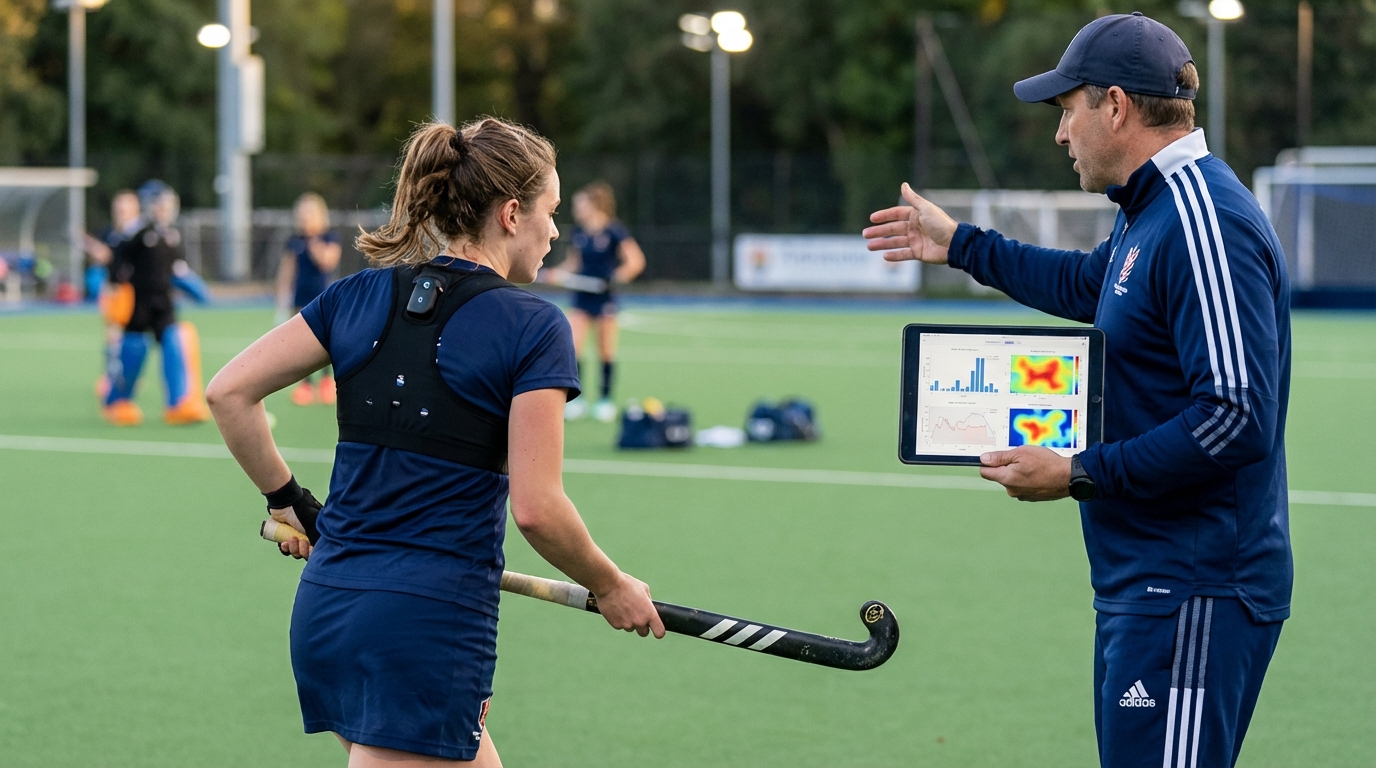
Five years ago, GPS tracking was reserved for international and premier league sides with six-figure budgets. Today, affordable wearable devices have made performance data accessible to clubs at every level. The question is no longer whether you can track your players - it's whether you know what to do with the numbers.
The danger for club coaches is information overload. Elite teams employ full-time performance analysts to interpret data. You're probably juggling coaching with a full-time job and don't have hours to spend analysing spreadsheets. The good news? You don't need to. Three key metrics can tell you almost everything you need to know.
What GPS Wearables Actually Measure
Modern hockey wearables typically capture a range of metrics: total distance covered, high-speed running distance (above 19 km/h), sprint count and distance (above 23 km/h), acceleration and deceleration counts, heart rate zones, and player load (a measure of overall physical stress).
That's a lot of data. And for most club coaches, most of it is noise. The trick is knowing which numbers actually matter for your team and ignoring the rest.
The 3 Metrics That Matter for Club Coaches
1. Total Distance Covered
This is your baseline. A typical outfield hockey player covers between 7 and 10 kilometres in a match, depending on position and playing time. Midfielders cover the most, with strikers and defenders slightly less. In training, you want your game-related sessions to be hitting 70-80% of match-day distances.
Why it matters: if a player's total distance drops significantly from one week to the next, it's an early warning sign. They could be fatigued, carrying a niggle, or losing motivation. It's the simplest metric and often the most useful.
2. High-Speed Running Distance
This measures how much running your players do above 19 km/h. In hockey, these are the moments that win and lose matches - the recovery run to get back into the press, the burst down the wing to create an overlap, the sprint to cover a penalty corner runner.
Track this across a season and you'll see patterns. If high-speed running drops in the second half of matches, your players are tiring. If it drops across consecutive weeks, you may be overloading them in training.

3. Sprint Count
Rather than total sprint distance, focus on the number of sprints. Hockey is a repeated-sprint sport - short, sharp efforts with brief recovery periods. A typical match might involve 30-50 sprints per player. If your training sessions only produce 10-15 sprints, your players aren't being physically prepared for match demands.
Use this metric to evaluate your session design. Drills with queues and long rest periods produce low sprint counts. Conditioned games with transitions and overloads produce much higher numbers.
Managing Training Load Across a Week
This is where GPS data becomes genuinely powerful for club coaches. If you train twice a week and play on Saturdays, your two sessions need to serve different purposes.
Tuesday (48 hours post-match): This should be your higher-intensity session. Players have had time to recover, and you can push physical output. Focus on game-related drills, conditioned games, and pressing work. Expect total distances of 5-7 km and high-speed running comparable to 60-70% of match demands.
Thursday (48 hours pre-match): Reduce the physical load. Focus on tactical work, set pieces, and technical sessions that keep the ball moving without demanding repeated sprints. Total distance should be lower - 3-5 km - with minimal high-speed running. You want players arriving on Saturday fresh, not fatigued.

Using Data to Prevent Injuries
The most valuable use of wearable data at club level isn't improving performance - it's preventing injuries. Soft tissue injuries (hamstrings, groins, calves) typically occur when players do significantly more high-intensity work than they're accustomed to.
The acute-to-chronic workload ratio is the key concept. Compare what a player has done this week to their average over the past four weeks. If this week's load is more than 130% of the four-week average, injury risk increases sharply. If it drops below 80%, the player is deconditioned and also at greater risk when they return to full intensity.
For club coaches, the practical application is straightforward: don't spike training loads. If players have had two weeks off for a holiday break, don't come back with a full-intensity session on day one. Build back gradually over 7-10 days.
Budget-Friendly Options
You don't need to spend thousands. Here's what's available at different price points:
- Smartphone GPS apps (free - minimal cost): Apps like Strava or MapMyRun give basic distance and pace data. Not hockey-specific, but useful for tracking total distance. Players carry phones in arm pouches or GPS-enabled watches.
- Consumer sports watches (around 150-300 per unit): Garmin, Polar, and COROS offer watches with GPS, heart rate, and basic sprint detection. Players wear them during training and matches. Data syncs to phone apps for easy review.
- Team GPS systems (around 50-100 per player per season): Devices like Playertek, STATSports Apex, and Catapult One are designed specifically for team sports. They provide the most relevant metrics and team-wide dashboards. Many offer club packages with reduced per-player costs.
When Data Helps vs When It Distracts
Data is a tool, not a replacement for coaching instinct. If a player looks tired but the numbers say they're fine, trust your eyes. If a player says they feel great but the data shows a significant drop in output, have the conversation.
The biggest trap is spending so long analysing data that it eats into your planning time. Set a rule: no more than 15 minutes reviewing data after each session. Look at your three key metrics, note anything unusual, and move on. The data should inform your coaching, not consume it.
Remember: the best coaches in the world used nothing but their eyes and experience for decades. Data enhances those skills - it doesn't replace them.
Frequently Asked Questions
Can players wear GPS devices during matches?
Most leagues and competitions allow small GPS units worn in a vest under the playing shirt. Check your specific league regulations, but the trend is towards permitting them. The devices must be small, lightweight, and pose no risk to other players.
How accurate are budget GPS devices compared to elite systems?
Consumer-grade GPS is typically accurate to within 3-5% for distance, which is perfectly adequate for tracking trends over time. Elite systems using 10Hz GPS are more precise for short sprints and changes of direction, but the difference matters less at club level where you're looking at week-to-week patterns rather than precise biomechanical data.
What if players don't want to wear trackers?
Frame it positively - the data is there to keep them fit and prevent injuries, not to judge their effort. Some players love seeing their stats and find it motivating. Make it optional initially and let the early adopters champion it. Most resistance fades once players see how the data benefits them.
How many players do I need to track to make it worthwhile?
Even tracking just your key players (centre midfield, inside forwards) gives you useful data for managing training load. Ideally, you'd track the whole squad to compare positions and identify fatigue across the team, but starting with 4-6 units is a practical first step for most clubs.
 sportplan_hockey