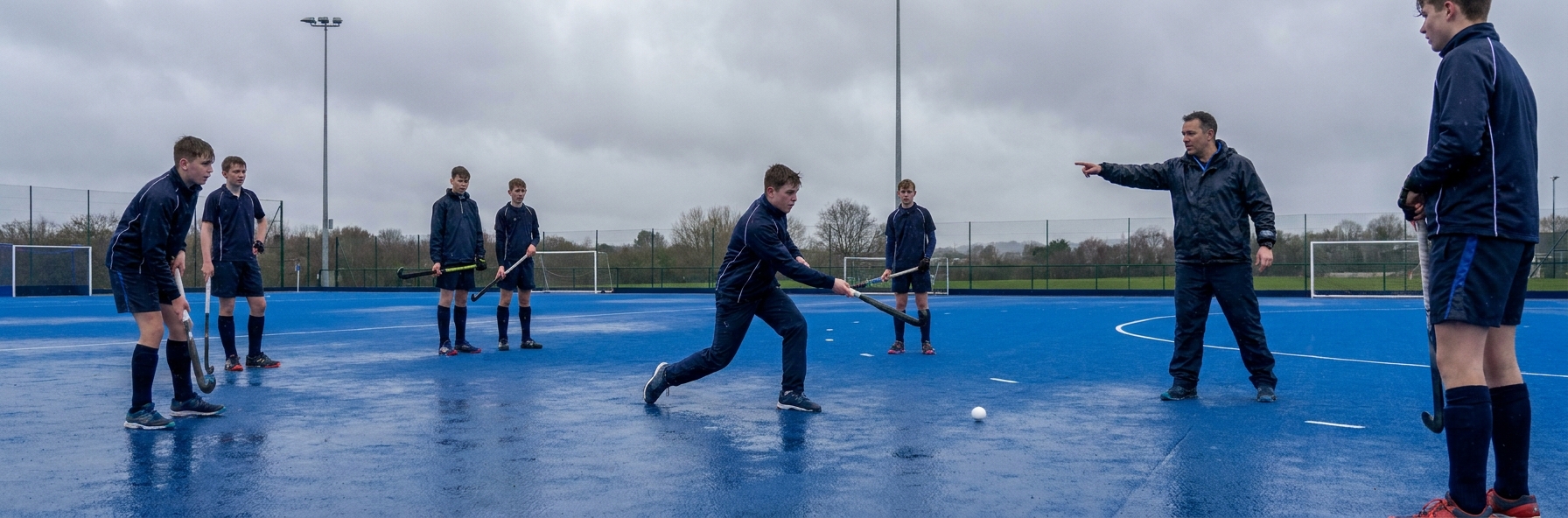
By late November most clubs have played at least one match in driving rain, with water sitting in sheets across the D and down the touchline. The fixture list does not pause for the weather, so teams either learn to cope with a slick, fast pitch or they spend the whole afternoon giving the ball away.
A wet pitch is not just an inconvenience. It changes how the ball travels, how safely players can tackle, and how realistic your normal game plan actually is. Coaches who adjust technique and tactics for the conditions keep possession and keep players safe; those who do not spend the match chasing a ball that keeps running away from them.
Why Wet Pitches Change the Game
Water on the surface reduces friction, so the ball skids rather than sits up. A pass that would normally slow and stop near a player's stick can run straight through, especially if the first touch is late or the stick face is not angled to cushion it.
Grip underfoot drops too, which makes sharp changes of direction riskier. And any raised or aerial ball that lands on standing water can skid unpredictably at speed, which is as much a safety issue for defenders and goalkeepers as it is a technical one.
Four Adjustments for a Wet Pitch
Step One: Prioritise control over speed. Encourage players to let the ball come to them and cushion it earlier than they would on a dry surface, rather than meeting it hard. A touch that is half a beat early on a wet pitch is often perfectly timed.
Step Two: Keep the ball on the turf. Favour disguised ground passes over lofted or aerial balls. A raised ball that lands on water can bounce or skid away from the receiver, and it is far harder to judge than on a dry pitch, so save it for moments with real space rather than routine distribution.
Step Three: Adjust body shape and footwork. Lower the centre of gravity, shorten the stride when accelerating or decelerating, and stay side-on through turns rather than planting a foot square. This keeps players balanced when grip is reduced.
Step Four: Simplify the game plan. One clean, unhurried pass beats three ambitious ones in the wet. Encourage patient build-up, slower combination play through midfield, and tackles that stay low and controlled rather than committed jabs that can be beaten by a skidding ball.
How to Train It: A Wet-Weather Session Plan
Warm-up: movement and balance work on the actual playing surface before intensity rises, so players feel the grip (or lack of it) and adjust their footing early rather than discovering it in a match-speed sprint.
Technical: repetition first-touch and trapping practice, deliberately feeding a flatter, faster-moving ball so players learn to cushion it rather than let it run on.
Decision-making: small-sided possession games with a simple constraint, such as the ball must stay below knee height, to force ground-based solutions under pressure.
Game: a conditioned match that rewards clean, patient build-up play and penalises needless aerial balls, so the habits transfer straight into Saturday's fixture.
Key Coaching Points
- Expect the ball to arrive faster and sit up less; cushion the first touch earlier than usual.
- Favour ground passes over aerial balls, which skid unpredictably once they land on a wet surface.
- Lower the centre of gravity and shorten strides to stay balanced through turns and sprints.
- Tackle with patience and a low, controlled stick; a flat approach can let a skidding ball through.
- Simplify combination play; one unhurried pass beats several risky ones in the rain.
- Check studs and footwear before kick-off, since grip matters as much as tactics on the day.
Recommended Drills
 First Touch
 Reverse Stick Trap - Hook Shape Run
 Push Pass: Give and Receive
 Distribution under Pressure
VIEW ALL PASSING AND RECEIVING DRILLS
Frequently Asked Questions
Should we move training indoors when the pitch is waterlogged?
If the surface is unsafe or the club has an indoor option, use it. But if the pitch is simply wet rather than dangerous, training on it is valuable: players need to practise the exact conditions they will face on matchday, not just a dry-pitch version of the same skills.
Why do raised balls feel more dangerous in the wet?
Once a lofted or aerial ball lands on standing water, it can skid or bounce at an angle that is hard to predict, and it arrives faster than a receiver expects. That makes it harder to control safely and riskier for whoever is closing it down, which is why many coaches ask players to keep the ball down in poor conditions.
How do we stop our passing game falling apart in the rain?
Simplify it. Cut out the low-value aerial and cross-field balls, focus on shorter, disguised ground passes, and spend extra time on first-touch cushioning in training. Patience beats ambition on a slick pitch, and a team that accepts this usually keeps the ball far longer than one that tries to play exactly as it would in the dry.

 sportplan_hockey