Rugby's tackle laws have evolved significantly, driven by World Rugby's commitment to player welfare. High tackles are penalised more strictly than ever. Head contact can result in red cards and bans. For coaches, this means tackling technique isn't optional - it's essential for both effectiveness and legality.
The good news: proper tackle technique is also safer for the tackler. Lower body position, ring of steel around the legs, controlled contact - these fundamentals protect both players while completing the tackle effectively.
The Legal Framework
Understanding what's legal shapes how we coach tackling:
High tackle threshold: Contact above the line of the shoulders risks penalty or card. Even if the ball carrier dips, responsibility remains with the tackler to adjust.
Head contact framework: Any contact with the head - by arm, shoulder, or head - is assessed for degree of danger. High force to the head is typically a red card offence.
Neck roll/dangerous tackle: Tackling techniques that put the ball carrier's neck at risk are illegal regardless of tackle height.
Coaches must teach technique that keeps tackles legal while remaining effective. There's no trade-off between safety and success - good technique achieves both.
The Fundamentals
Body Position
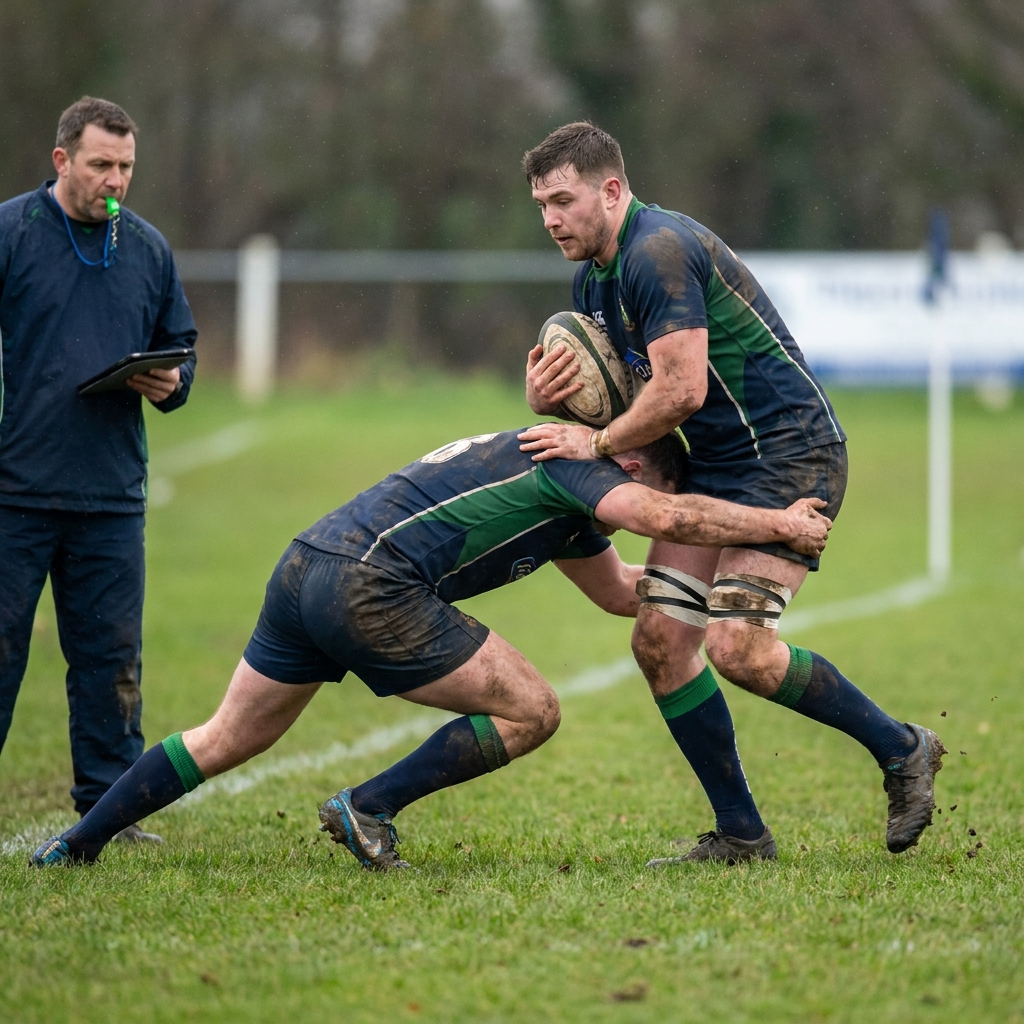
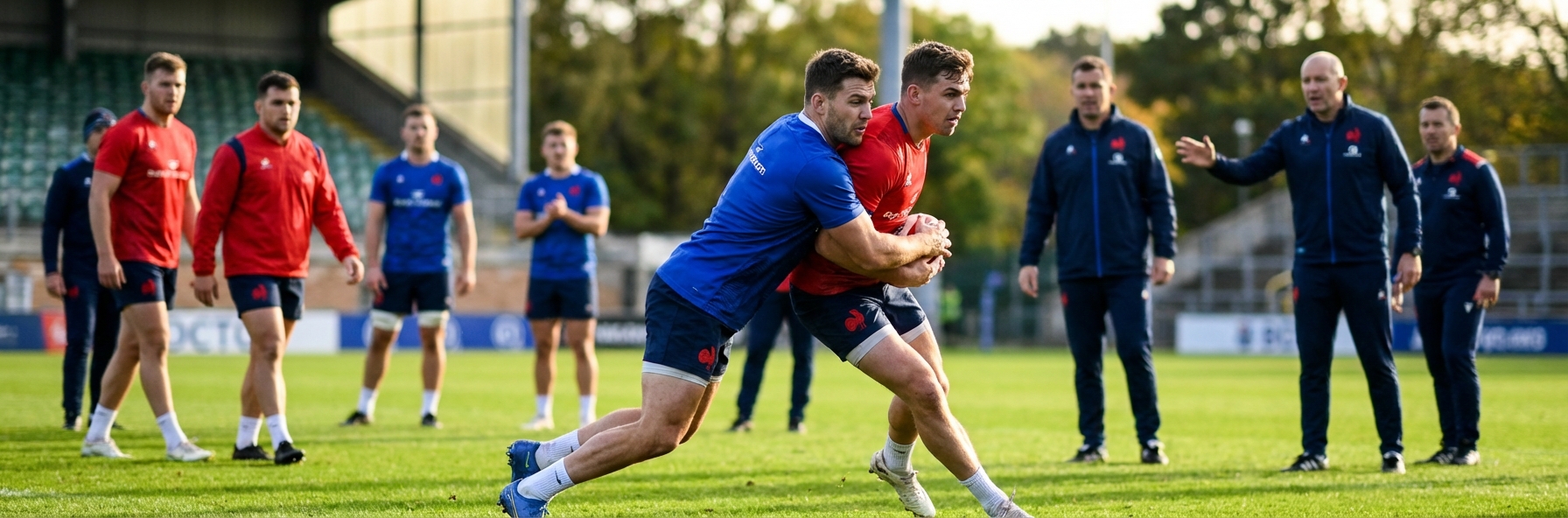
Low body position is the foundation of safe, effective tackling. Tacklers who stand upright make high tackles. Tacklers who get low complete legal, dominant tackles.
Key checkpoints:
- Feet shoulder-width apart, knees bent
- Hips below shoulders
- Back straight, not rounded
- Head up, eyes on target
- Arms ready to wrap
Target Area
The target zone for legal, effective tackles is the midriff to upper thigh area. This zone:
- Stays below the shoulder line
- Controls the ball carrier's centre of gravity
- Allows wrap and completion
- Protects both players' heads
Train your players to "aim low, finish low." Even if the ball carrier dips, a low initial target keeps the tackle legal.
Head Placement
The tackler's head must stay to the side of the ball carrier, never in front. "Cheek to cheek" is the traditional coaching cue - the tackler's cheek should end up against the ball carrier's hip/thigh area.
Correct head placement:
- Head behind the ball carrier's body
- Face turned away from the impact
- Neck in neutral, not extended
The Ring of Steel
The "ring of steel" - wrapping both arms tightly around the ball carrier's legs - is what completes the tackle. Contact without wrap often results in the ball carrier staying on their feet or bouncing off.
Wrap technique:
- Punch arms through to grasp your own wrist
- Lock the ball carrier's legs together
- Squeeze and drive
- Control the fall
Tackling Progressions
Build tackling skill through careful progression:
Stage 1: Shape only (static)
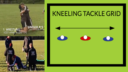
Kneeling exercises focusing on body position, head placement, and wrap. No impact.
Stage 2: Walk-through
Walking pace tackles. Focus on footwork, tracking, and timing.
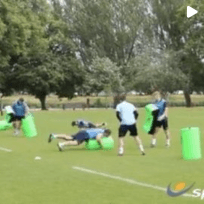
Stage 3: Controlled live
Ball carrier at 50% pace with limited evasion. Tackler makes full contact with correct technique.
Stage 4: Live tackling
Game-realistic situations. Full intensity, multiple scenarios.
Never skip progressions. Even experienced players benefit from revisiting fundamentals before increasing intensity.
Common Errors and Corrections
Standing up before contact: Usually caused by anxiety. Drill the body position until it's automatic.
Head in front: "Wrong side" head placement puts the tackler at risk. Emphasise "cheek to cheek" positioning.
Arms not wrapping: "Shoulder only" tackles rely on collision rather than technique. Stress the ring of steel in every drill.
Not tracking the hips: Players who watch the ball or upper body get stepped. Train eyes on hips - where the hips go, the body follows.
One-on-One Tackling Scenarios
Different situations demand different approaches:
Front-on: Classic tackle position. Low body, drive shoulder into midriff, wrap legs, drive through.
Side-on: Target the near hip and thigh. Roll the ball carrier away from their direction of travel.
Chaser tackle (from behind): Target the legs. Wrap and drag down. Never dive at the upper body from behind.
Key Coaching Points
- Low body position keeps tackles legal and effective
- Target the midriff to upper thigh
- Head to the side - "cheek to cheek"
- Ring of steel wrap to complete the tackle
- Progress from static to live through clear stages



 sportplan_rugby