Field Hockey: 23

England Hockey's "25 in 2025" initiative has been touring the country, bringing two-hour on-pitch workshops to 25 locations. The focus: practical practice ideas that coaches can take straight back to their clubs. Here's a summary of the key concepts being shared.

The Philosophy

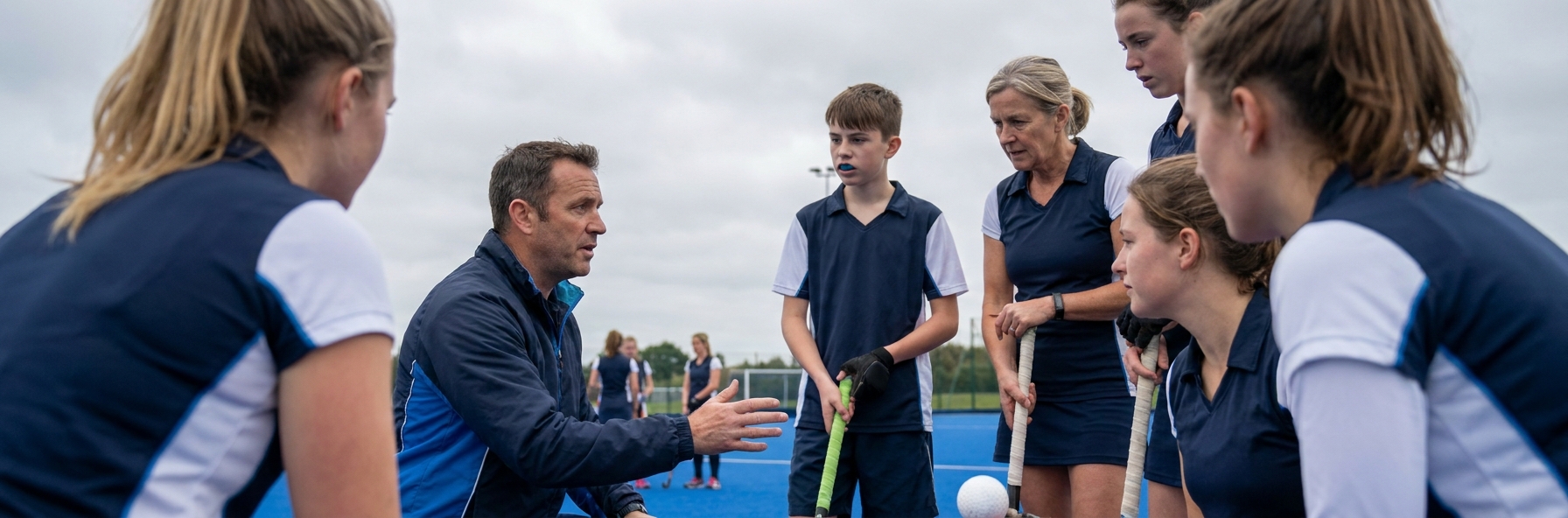
The workshops are designed for everyone involved in delivering hockey, from experienced coaches to volunteers just starting out. The emphasis is on fun, engaging sessions that keep players coming back - because player retention depends on the quality of the experience we create.

Each workshop covers arrival activities, carrying and passing progressions, and game-based learning. Participants leave with a bank of ideas they can implement immediately.

Arrival Activities That Work

The first few minutes of any session set the tone. Arrival activities should be:

Self-managing: Players can start without detailed instruction. This lets the coach focus on organisation while early arrivals get active.

Engaging: Not just standing in lines. Movement, decision-making, maybe a competitive element.

Scalable: Works with 2 players or 20. As more arrive, they join seamlessly.

Examples include: grid-based possession games where players can join any team, skill stations with clear visual instructions, and small-sided games that expand as numbers grow.

Carrying and Moving with Purpose

A significant portion of the workshops focuses on ball carrying. The key insight: carrying isn't just about technique, it's about purpose. Why are you carrying? Where are you taking the ball? What's your next action?

Practices progress from technique-focused (head up, ball position, change of pace) to decision-focused (when to carry vs pass, reading space, timing runs with teammates).

The workshops emphasise "game-realistic" carrying - not just running through cones, but carrying with pressure, carrying to eliminate, carrying to create passing angles.

Passing as Communication

The workshops reframe passing as communication between players. A good pass says "here's where I want you to receive." A great pass also says "here's what I want you to do next."

Practices focus on:

  • Weight of pass - firm enough to arrive quickly, soft enough to control
  • Timing - not too early (intercepted), not too late (receiver can't use it)
  • Receiver's next action - passing to the correct foot/side for what follows

Games-Based Learning

Perhaps the biggest takeaway from the workshops is the shift toward games-based learning. Instead of isolated drills, players learn through modified games that naturally develop the required skills.

The coach's role becomes designing games that create the learning outcomes, then facilitating rather than instructing. Questions replace commands: "What did you notice there?" "Why did that work?" "What could you try differently?"

This approach develops players who can problem-solve, adapt, and transfer learning to match situations.

Making Sessions Engaging

The workshops share specific techniques for keeping energy high:

Quick transitions: Minimise time between activities. Have the next game ready before the current one finishes.

Appropriate challenge: Too easy is boring, too hard is frustrating. Find the "just right" level for your group.

Variety within structure: Keep the same game framework but change small elements - scoring methods, playing areas, team compositions.

Player voice: Give players choices. "Do you want to play again or try something new?" This builds ownership.

Video Support

All workshop practices are available on YouTube, allowing coaches to revisit and refine after attending. This resource bank is growing as the roadshow continues.

Who Should Attend?

The workshops are pitched at all levels. Experienced coaches report learning new ideas and getting reinforcement of good practice. New coaches gain confidence and practical tools. The shared experience of learning together builds community within the sport.

If a workshop is coming to your area, it's worth attending. The time investment is small; the return in practical ideas is significant.

Key Coaching Points

  • Arrival activities set the tone - make them engaging
  • Carrying with purpose, not just technique
  • Passing is communication between players
  • Games-based learning develops problem-solvers
  • Keep sessions varied and appropriately challenging

Drills to Build Your Practice Bank

VIEW ALL WARM-UP DRILLS

JOIN SPORTPLAN FOR FREE

  • search our library of 1000+ hockey drills
  • create your own professional coaching plans
  • or access our tried and tested plans
23 DRILLS
View All
Unfortunately there were no results for your search! Please try again
23 ANSWERS
View All

Can you give me your ideas of a one test only assessment to split a large mixed ability group of players (20 to 60) into the right ability groups in less than 2 hours?

Here is one example I use.I put out this slalom as the test whenever confronted with a large group of mixed ability players that need to be put into equal ability groups to play a game or to be coached. The slalom incorporates lots of the aspects of the techniques required by the individual players to play the game of hockey. I.e. running with the ball, fast and controlled, changing direction with the ball pivoting, stopping the ball etc.I normally set up 2 - 4 identical slaloms, see attachment, and have 4 coaches or helpers with a stopwatch (mobile phones are great for this).To record the score I normally put a label on the stick of each player so they can write down their time. Once all players have recorded a time, ask the players to stand in time order on the sideline. Once the players are in order you can put the 10 fastest times to play a 5 aside game across 23 meter area and the next 10 in the next 23 meter area and so on up to 40 players playing on one full pitch. The last few changes you might now need to make are the players that perform better or weaker on any particular pitch (should not be to many).

Bram van Asselt Coach, England

finishing

I have done numerous exercises on goalscoring but my girls cant seem to finish. Any suggestions?

Archived User Coach

Looking for drills/ games- Attacking within defending?

Looking for drills/ games%3A Attacking within defending 23m

Ryde School Coach, England

self pass rule confusion

Hi everyone, I have been hunting for a more detailed explanation on the self pass rule for hockey. My under standing of it is that a self pass must involve the ball moving five meters before it is hit by the player or it must be hit from a dead positon (not moving) I have umpired many games where the players 'tap and hit' the ball, often with another player rushing in to tackle just as the 'tap' is played. This seems dangerous but im not sure if the tackler is playing dangerously or if the 'tap and hit' player is dangerous? I have read the rule book but this rule is not explicit enough. Any interpretaions welcome. Thanks

Archived User Coach

New 23 yard hit rules

Has anyone got any set plays for the new rule involving the 23 yard hit?

Paul Staines Coach, Australia

How to play against a team with a strong centre half?

The teams currently in our league all seem to have vastly different playing styles. It's obviously not possible to fully coach strategies for each of these teams, but i was wondering if people had any tips about how you can tweak your team tactics without moving too far away from the default mentality e.g playing against a team with a particularly strong centre half?

Archived User Coach

Break through a team that is playing half court press?

How can you train to break through a team that starts half court and your team starts with the ball? Four players in the defence start maybe playing the ball first to the left wing and this player hits the ball back to the free defence player who passes the ball to the right defence player who is over the 23 meter line... I like to understand the different tactical approaches. Can you share some ideas with me?

R.P. Witkamp Coach, Netherlands

How do i get the right timing for a Jab

How do I get the right timing for a jab im trying to step up my defensive skills and i just cant get the right timing and technique for it Asked using Sportplan Mobile App

Archived User Coach

How teach defense match-up zone roles to U13?

Hi, I have a complicated set of questions which shows my limited understanding of field hockey. I’m coaching a U13 team of 22 girls in the U.S., and each player has at least one year of experience. I’ve played FH only with my kids though I have a basic understanding of the game and its concepts from playing soccer and basketball, and watching games for many years. I've coached kids in other sports, this is my first year coaching field hockey. (If you’re wondering why I’m coaching, no parent in my community with playing experience would step up and my daughter loves the game.)A warming: This is a long set of interrelated questions but your taking the time will be greatly appreciated. Problem: The core problem is responsibility conflicts on defense. My players understand concepts of zone and marking separately. I don’t know enough to explain how they should manage the two responsibilities in field hockey. I “get it” by playing other sports for so long and therefore am able to see how they aren’t “getting it.” For clarity, I have in mind two kinds of offense players: OP1 (has the ball); OP2 (doesn’t). The girls understand that zone means each has a certain area to protect; and marking, how to position themselves in relation to offensive player without the ball (OP2), and when to mark tight vs. loose, and to what it means to follow her mark. Situation 1 (Off-ball play): if one OP2 (OP2-A) enter zone of Left Midfield (LM), for example, how LM apply marking principles (a) when OP2-A enters zone; (b) a second OP2 (OP-B) enters zone; (c) if OP2-A leaves zone, LM should (i) release OP2-A and stay on OP2-B or (ii) follow OP1-A and leave OP2-B. How resolve these zone/marking conflicts for other positions: CM/RM? For RD/LD/CD? (We play a basic 3-3-1-3.)Situation 2 (Support teammate pressuring ball (D1). The girls understand basics of channeling, approaching OP1 to tackle, and how D2 should support D1 (e.g., D2 is cover for D2). We’ve done drills (1v2), but transferring into game situations is difficult. How explain D2 maintain zone responsibilities (a) if supporting D1 means D2 (a) vacates assigned zone and/or (b) or OP2 in zone). Situation 3 (Forwards). They are having trouble with changing defensive responsibilities from within the opposing team’s quarter of the field, the middle quarters, and our quarter of the field nearest to our goal. I’ve thought about just making the defense solely marking but that creates its own chaos and tires out the girls. Without these basic concepts, the result is a joyless scrum: players are bunched up on defense, so if there’s a turnover, the players are too close together for a counterattack. This is unfortunate because the speed of field hockey games should appeal to kids in the U.S. Thanks
Brandon Cowart Coach, United States of America

Defence

how to play defending 3V2

Lakhindra Pahan Coach, United Kingdom

rules of free hit

rules of free hit

Coach, United Kingdom

set play inside the 23 meter area

set play inside the 23 meter area

sudeesh kumar Coach, India

To man mark or zone? | Sportpl...

My Girls team I coach get caught a lot between man marking and zonal marking in the 23 yard area and sometimes end up with half the team doing one and the rest the other. Suggestions on the ideal defensive set up inside the 23?

Archived User Coach

5-yard rule in hockey? | Sport...

could someone comment on the 5 yard rule when entering the scoring area? There always seams to be a lot of wrong information regarding this rule.

Gaby Coach, United States of America

Long corners (attacking and de...

Dear all, what are best practices for playing long corners? Please advice for playing long corners while attacking and defending long corners.

Marco Koudijs Coach, Netherlands

How to coach school team with ...

Hi,I perhaps naively, expected to have most of our team from last year carry over and only have a few new comers to integrate and get up to speed with the rest. However meeting the team at our first practice last night i find I have five players still at school from last year and the rest all new comers, most of whom had not held a hockey stick at all till practice.This being only my second season coaching (year 9 to year 13 boys) has left me feeling a little blindsided, and feeling quite unsure how to prepare practices that target both groups of boys. Do i lump them both groups together, keep them separate? What drills/exercises to best bring the new comers up to speed.I don't want to neglect either group, keep practice worthwhile for the experienced boys, but also bringing the new comers up to a level were they can mix in with the others and learn organically from them while practicing as a team. David
David Smith Coach, New Zealand

Base line defence - How to pre...

Baseline defence: How to prevent teams from Scoring goals from the left and Right baseline.Do I tell my left and Right half to channel player outwards ,protect feet,frontal pressure and allow other defenders to tuck infield.Or do I opt to tell defenders to go man to man inside 23 and then apply frontal pressure ,channel player outwards ,watch angle of engagment.As recently we only conceded through attack on our baseline

Jason Adams Coach, South Africa

JOIN SPORTPLAN FOR FREE

  • search our library of 1000+ hockey drills
  • create your own professional coaching plans
  • or access our tried and tested plans

Sportplan App

Give it a try - it's better in the app

YOUR SESSION IS STARTING SOON... Join the worlds largest hockey coaching resource for 1000+ drills and pro tools to make coaching easy.
LET'S DO IT