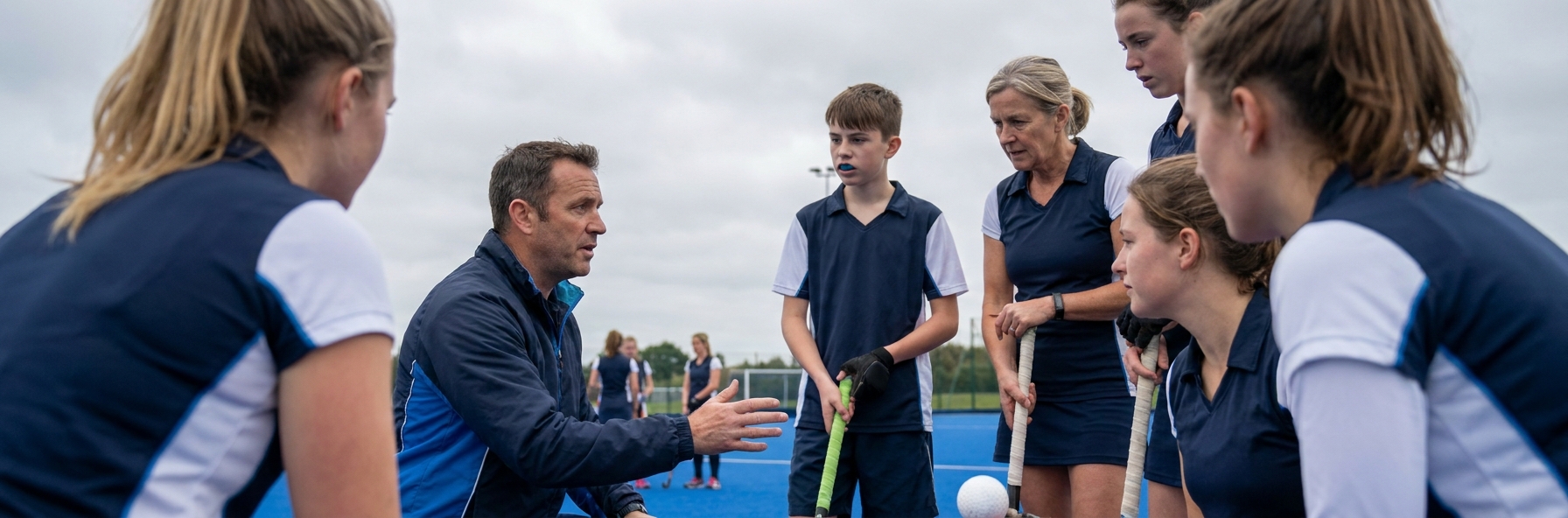
Field Hockey: attacking circle

August 2026

New rule guidance lands every season and most of it never touches a Saturday. This year is a little different. England Hockey's guidance for 2026/27, following the latest revisions to the FIH Rules of Hockey, includes a change that has been running as a trial and is now permanent, plus a handful of clarifications that will catch out any squad that has not been told about them.

The changes apply from 1 September and cover both adult and junior competitions. Some leagues and clubs choose to adopt them early in pre-season friendlies, which is a sensible way to get everyone familiar before the points start counting.

The Aerial Ball Rule Becomes Permanent

The headline change is that the aerial ball rule has been permanently adopted across all England Hockey competitions. Under it, a defender may approach once the receiver has touched the ball, rather than having to wait until the receiver has controlled it and brought it to the ground, provided the initial five metres of safe space were respected.

That sounds like a small distinction and it is not. The window in which a receiver is protected is now shorter, and the moment the contest becomes live is earlier and easier for umpires to see. Receivers who were used to taking a comfortable extra second to settle the ball will find an opponent arriving sooner than they expect.

Penalty Corner Equipment and the Yellow Card

There is revised guidance on the disposal of penalty corner protective equipment. If a person is hit on or above the knee in a normal stance by discarded equipment, the player who threw it receives a yellow card.

This is worth ten minutes of your pre-season time, because it is a purely behavioural change. Defenders coming out of a corner have historically flung masks and gloves aside without much thought. Teach the squad to place equipment down and to the side rather than throwing it, and you will never have to think about the rule again.

Goalkeeper Equipment and Other Clarifications

The maximum permitted size of a goalkeeper's left-hand protector has increased to 365mm, which allows manufacturers to produce larger gloves that remain legal under FIH regulations. If your keeper is due new kit, this is useful to know before they buy.

Alongside these, the guidance includes clearer sanctions for having too many players on the pitch, and further clarifications for goalkeepers and umpires. None of these should change how you play, but a squad that knows about them is a squad that does not argue with the umpire in week one.

How to Brief Your Squad

Step One: Cover it once, properly, in a pre-season session rather than drip-feeding it. Ten focused minutes with everyone present beats five separate conversations.

Step Two: Coach the aerial change with the ball, not the whiteboard. Set up receipts under a falling ball with an approaching defender and let players feel how much less time they have.

Step Three: Rehearse the equipment habit at your first penalty corner practice, so placing kit down becomes automatic before anyone is under pressure.

Step Four: Tell your umpires and your captains what you have briefed. A captain who understands the change is far more useful than one who reacts to it.

Step Five: Use any early-adopting pre-season fixtures as live rehearsal, and review what actually happened rather than what you expected.

Key Coaching Points

  • The aerial rule is now permanent: defenders may approach once the receiver has touched the ball.
  • The five metres of initial safe space still has to be respected before any approach.
  • Receivers have less settling time, so first touch under a falling ball matters more than ever.
  • Place penalty corner equipment down and to the side; throwing it can now earn a yellow card.
  • Goalkeeper left-hand protectors may now be up to 365mm, useful before buying new kit.
  • Brief the whole squad once in pre-season rather than correcting individuals in September.

Recommended Drills

VIEW ALL PASSING DRILLS

Frequently Asked Questions

When exactly do the 2026/27 rules apply?

From 1 September 2026, across both adult and junior competitions. Leagues, clubs and organisers may adopt them earlier in pre-season or summer competitions, which many do specifically to help everyone get familiar before the league campaign starts.

Does the aerial change mean the five metre rule has gone?

No. The initial five metres of safe space still has to be respected. What has changed is when a defender may approach after that: once the receiver has touched the ball, rather than once they have controlled it and brought it to the ground.

Do I need to change how we train aerials?

Only in emphasis. Spend more time on a clean, decisive first touch under a falling ball and on what the receiver does immediately afterwards, because the contest now arrives sooner. The receiving technique itself is unchanged.

attacking circle DRILLS
View All
Unfortunately there were no results for your search! Please try again
attacking circle ANSWERS
View All

The new rules - what will UK coaches be focussing on?

The new rules - what will UK coaches be focussing on most? (Living in NZ, we're playing them now!)

sue shelswell Coach, New Zealand

New rules, the attacking 5 yard hit outside the D -?

New rules, the attacking 5 yard hit outside the D - has anyone got any great ideas for set plays?

sue shelswell Coach, New Zealand

Is a goal scored when the attacking team hasnt touched?

Is a goal scored when the attacking team hasnt touched the ball within the circle yet the ball goes in the goal after touching a defender in the circle? An attacker hit the ball into the circle today, the goalie fudged it and it bounced over her foot into the goal. Twice. I thought the attacker would have to have touched it within the circle? I am new coach of young girls.

Archived User Coach

self pass rule confusion

Hi everyone, I have been hunting for a more detailed explanation on the self pass rule for hockey. My under standing of it is that a self pass must involve the ball moving five meters before it is hit by the player or it must be hit from a dead positon (not moving) I have umpired many games where the players 'tap and hit' the ball, often with another player rushing in to tackle just as the 'tap' is played. This seems dangerous but im not sure if the tackler is playing dangerously or if the 'tap and hit' player is dangerous? I have read the rule book but this rule is not explicit enough. Any interpretaions welcome. Thanks

Archived User Coach

Re involving GKs in junior coaching sessions.

I really struggle to make practice fun and useful for the GKs. My attention is naturally focussed on the outfield players, meaning most of the time I simply have drills finishing with a shot on goal to keep the GK involved. Pretty boring for them. Any ideas how I can involve them more? Thanks, Charlie

Carol Ridge Coach, England

overloading in the circle?

how do you stop your team over crowding in the circle? what drills or game situations could i use at training?

Archived User Coach

How do you keep your team motivated - drill ideas?

we started the season 5-1 and now mid-way it seems we are fading? we have lost our last 3 games - what are some good drills to get them focused again and pumped for the rest of the season and to get them over the hump -to the next level. thanks

Brenda Strohmer Coach, United States of America

How can I get my midfielders' mentality right so they defend and attack in a game?

So I'm having trouble getting my young and inexperienced group of midfielders to flip the switch from defense to offense, and back, as we move up and down the field. They will often hang back and leave my forwards stranded rather than rush in to attack. Naturally, we are not scoring. Advice and drill ideas would be most welcome! J.G. Coach, Maryland USA

j gimpel Coach, United States of America

What hits can be used to insert on Penalty Corners?

What kind of hit can be used by the player passing the ball in?

Don Riley Coach, United States of America

Who marks the player with the ball when marker is beaten?

A player beats their defender. Do I leave my player to defend as I am nearest to the ball, or should I stay and hold my position?

Archived User Coach

Circle Entry coaching plan.

For an assessment I need to develop a coaching plan for two groups of 8 juniors on circle entry. Any ideas please! I am concerned about keeping the players all active attacking one circle. Can I use another part of the pitch for one group of 8 whilst the others use the D?

Archived User Coach

5-yard rule in hockey?

could someone comment on the 5 yard rule when entering the scoring area? There always seams to be a lot of wrong information regarding this rule.

Gaby Coach, United States of America

I am a new coach and need pointers!

I just became the head coach of a middle school field hockey team and would like some pointers on how to coach. I have experience with goal keeping and defensive drills, I was a keeper, so I would like to learn more about offense as well. Any help is appreciated!!

Amanda Emerich Coach, United States of America

Midfield Counterattack Control

How does a midfielder control a counterattack in hockey?

Coach, Kenya

Drills for beginners age 9-10?

HI, I'm an inexperienced hockey coach about to coach 9-10 year old kids at school. It's been 20 years since I played myself, so not always familiar with the drills I read here. Anyone has some tips for basic drills for kids to learn the basics? Thanks!

Judikje Coach, New Zealand

Counter Attacking

Have any other coaches got tips, advice or drill ideas on how i can improve my team's ability to counter attack?

Jack Grundy Coach, England

How to improve the ball transf...

Dear colleagues, I am coaching a 1st women team (Argentina) and the system that is working for us very well is 3-1-3-3. Given the quality players we've got in the midfield and attack we try to emphasize our offensive game all the time. The problem I am struggling to resolve is that the forwards do not get involved in chances to score inside the circle very often. The few chances the forwards have they are able to score but it is our midfielders who most of the time get to the circle in possession with the ball. I would like to see a quick transfer of the ball from the midfielders to the forwards who need to be in touch with the ball more often during the game and have the midfielders supporting the attack rather than being the leaders of the attack.Is there any drill or way to improve this aspect of the game? Thanks for your time. Martin

Martin Vila-Aiub Coach, Argentina

5-yard rule in hockey? - Sport...

could someone comment on the 5 yard rule when entering the scoring area? There always seams to be a lot of wrong information regarding this rule.

Gaby Coach, United States of America

Long corners (attacking and de...

Dear all, what are best practices for playing long corners? Please advice for playing long corners while attacking and defending long corners.

Marco Koudijs Coach, Netherlands

teaching presses on free hits ...

Hi allI am looking for advice on how to implement processes in my girls school hockey team. processes of setting up presses, defensive structures and counter attacking thinking. I have 14 players in the team from 15 years old to 18. we train twice a week. only a few play club hockey as well. We either play a 3-1-4-2 or a 3-1-3-3.I find it difficult for example, when you want to teach a press on the opposition 16, to simulate gameplay with only 14 players (if they are all at training). I can have my halves setup for taking the 16 and then get my strikers and links to setup, but then I still want defenders to see things from the back but they are taking the 16? Also when taking the 16 they then don't have any support in the drill because everyone else is setting up a press?I know we need to work on our basics in order for the other tactics and skills and game plans to work. However I find it frustrating with this team that on counter attacks for a few reasons which I am struggling to mend;- they only head forward. No one holds up the ball to wait for support.- they run straight and don't use angles- they pass too late and get tackled - they don't have the vision to see an early pass or pass into space- players without the ball do not run into useful positions and angles and get caught out by the person with the ball who then makes a pass to no one and it runs out of play.So suggestions please for;- open, creative but simple counter attacking- teaching processes for presses on free hits and 16s- coaching how to take 16s and work your way out- coaching vision and expecting your players to be in support. RegardsMatt


Matthew Lydall Coach, South Africa

JOIN SPORTPLAN FOR FREE

  • search our library of 1000+ hockey drills
  • create your own professional coaching plans
  • or access our tried and tested plans

Sportplan App

Give it a try - it's better in the app

YOUR SESSION IS STARTING SOON... Join the worlds largest hockey coaching resource for 1000+ drills and pro tools to make coaching easy.
LET'S DO IT