Field Hockey: basic

England Hockey's "25 in 2025" initiative has been touring the country, bringing two-hour on-pitch workshops to 25 locations. The focus: practical practice ideas that coaches can take straight back to their clubs. Here's a summary of the key concepts being shared.

The Philosophy

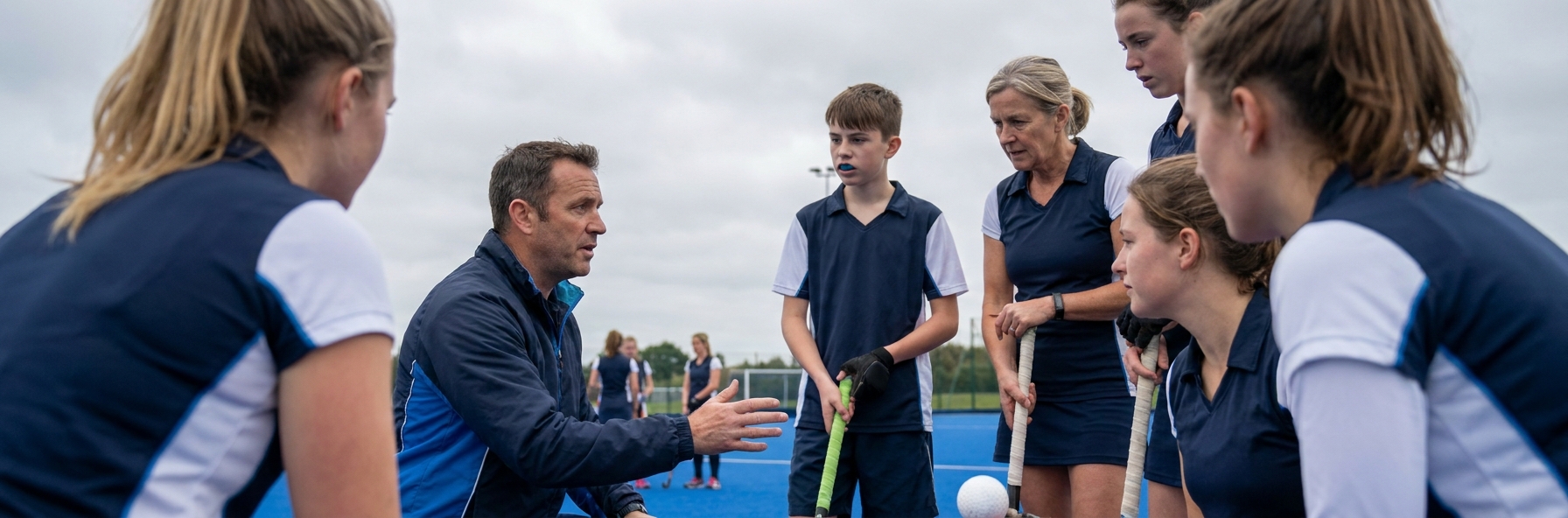
The workshops are designed for everyone involved in delivering hockey, from experienced coaches to volunteers just starting out. The emphasis is on fun, engaging sessions that keep players coming back - because player retention depends on the quality of the experience we create.

Each workshop covers arrival activities, carrying and passing progressions, and game-based learning. Participants leave with a bank of ideas they can implement immediately.

Arrival Activities That Work

The first few minutes of any session set the tone. Arrival activities should be:

Self-managing: Players can start without detailed instruction. This lets the coach focus on organisation while early arrivals get active.

Engaging: Not just standing in lines. Movement, decision-making, maybe a competitive element.

Scalable: Works with 2 players or 20. As more arrive, they join seamlessly.

Examples include: grid-based possession games where players can join any team, skill stations with clear visual instructions, and small-sided games that expand as numbers grow.

Carrying and Moving with Purpose

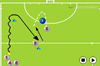
A significant portion of the workshops focuses on ball carrying. The key insight: carrying isn't just about technique, it's about purpose. Why are you carrying? Where are you taking the ball? What's your next action?

Practices progress from technique-focused (head up, ball position, change of pace) to decision-focused (when to carry vs pass, reading space, timing runs with teammates).

The workshops emphasise "game-realistic" carrying - not just running through cones, but carrying with pressure, carrying to eliminate, carrying to create passing angles.

Passing as Communication

The workshops reframe passing as communication between players. A good pass says "here's where I want you to receive." A great pass also says "here's what I want you to do next."

Practices focus on:

  • Weight of pass - firm enough to arrive quickly, soft enough to control
  • Timing - not too early (intercepted), not too late (receiver can't use it)
  • Receiver's next action - passing to the correct foot/side for what follows

Games-Based Learning

Perhaps the biggest takeaway from the workshops is the shift toward games-based learning. Instead of isolated drills, players learn through modified games that naturally develop the required skills.

The coach's role becomes designing games that create the learning outcomes, then facilitating rather than instructing. Questions replace commands: "What did you notice there?" "Why did that work?" "What could you try differently?"

This approach develops players who can problem-solve, adapt, and transfer learning to match situations.

Making Sessions Engaging

The workshops share specific techniques for keeping energy high:

Quick transitions: Minimise time between activities. Have the next game ready before the current one finishes.

Appropriate challenge: Too easy is boring, too hard is frustrating. Find the "just right" level for your group.

Variety within structure: Keep the same game framework but change small elements - scoring methods, playing areas, team compositions.

Player voice: Give players choices. "Do you want to play again or try something new?" This builds ownership.

Video Support

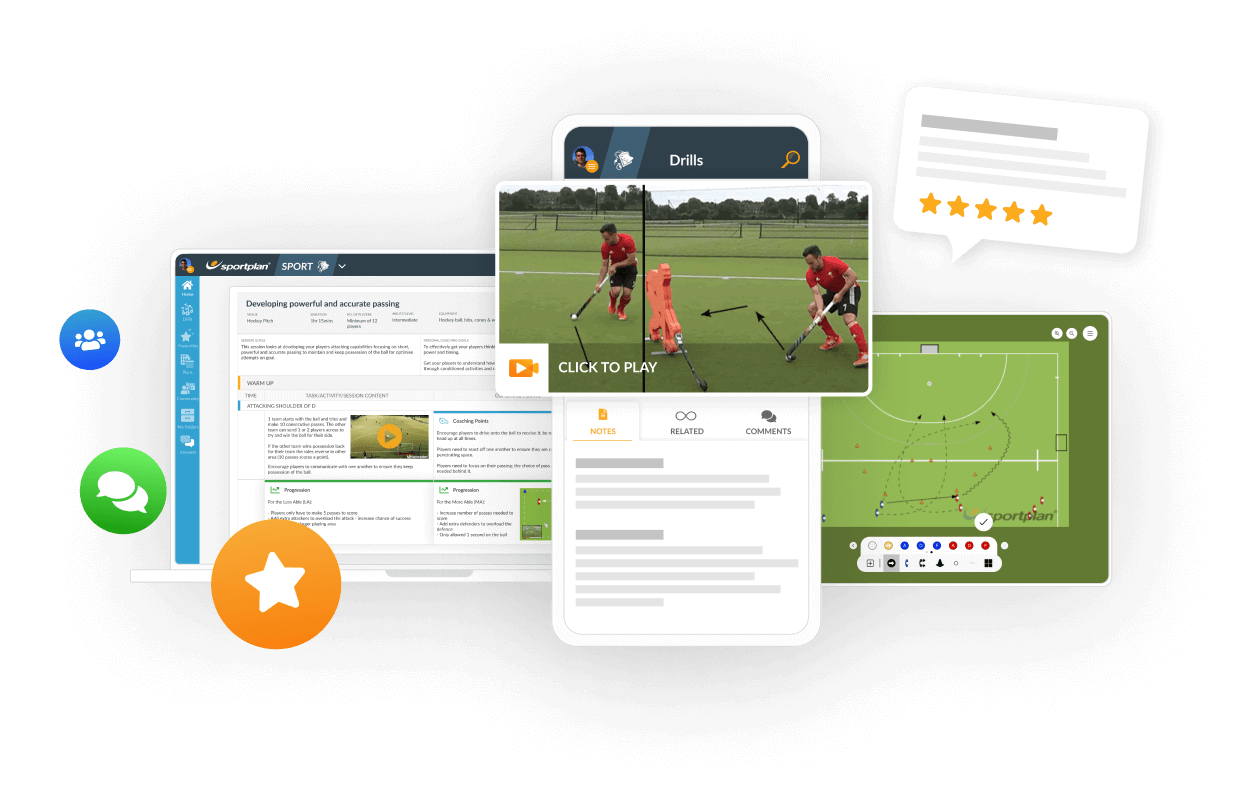
All workshop practices are available on YouTube, allowing coaches to revisit and refine after attending. This resource bank is growing as the roadshow continues.

Who Should Attend?

The workshops are pitched at all levels. Experienced coaches report learning new ideas and getting reinforcement of good practice. New coaches gain confidence and practical tools. The shared experience of learning together builds community within the sport.

If a workshop is coming to your area, it's worth attending. The time investment is small; the return in practical ideas is significant.

Key Coaching Points

  • Arrival activities set the tone - make them engaging
  • Carrying with purpose, not just technique
  • Passing is communication between players
  • Games-based learning develops problem-solvers
  • Keep sessions varied and appropriately challenging

Drills to Build Your Practice Bank

VIEW ALL WARM-UP DRILLS

JOIN SPORTPLAN FOR FREE

  • search our library of 1000+ field hockey drills
  • create your own professional coaching plans
  • or access our tried and tested plans
basic DRILLS
View All
Unfortunately there were no results for your search! Please try again
basic DRILL CATEGORIES
View All
basic SESSIONS
View All
basic ANSWERS
View All

Drills for beginners age 9-10?...

HI, I'm an inexperienced hockey coach about to coach 9-10 year old kids at school. It's been 20 years since I played myself, so not always familiar with the drills I read here. Anyone has some tips for basic drills for kids to learn the basics? Thanks!

Judikje Coach, New Zealand

1st ever training Session Stru...

I have been given my first team ever!! They are 11 year old girls and I wanted guide/ recommendation on how I should structure my one hour sessions? E.g. how long should I spend on a warm up, drill etc. .Cheers,Freya

Archived User Coach

Typical session for Juniors | ...

Why wont this session open for me when i log in its not there ??

Onny Gajadhar Coach, New Zealand

What's the best way to teach c...

I'm looking for a simple and basic way to teach and encourage children to press. Asked using Sportplan Mobile App

Ryan Schutte Coach, South Africa

Problems Clearing the Circle |...

I'm in the U.S., coaching a team of 11-12 year olds, with 1-2 years of experience. Defending the circle, when the ball is loose, my players are not getting control of the ball to hit out of the circle. It's congested with opponent and my team's players. If my players get control, they lose it quickly. If the opponent has control, my players aren't very good at taking the ball or stopping the opponent from taking a shot. Luckily we have a good goalie but she can only do so much. (Full disclosure: I didn't play FH but have a decent understanding of the game. No one else in my community would step up to coach so it's fallen to me.)

Brandon Cowart Coach, United States of America

Is there some basic info (DVD, video or manuals) that?

Is there some basic info (DVD, video or manuals) that outline basic positional play and roles for new players to the game. I have entered a school team (15-16 yr old girls) into a weekend comp. They are coming up against strong club teams who have been playing for several years. It has been difficult getting them to maintain some structure in their play - possession is a big problem. Also, hitting the ball is an issue - a skill that I have taken for granted as it has never been a problem with all the boys teams I have coached (even 7 amp; 8 yr olds) Any advice greatly appreciated.

Archived User Coach

Need basic tips on coaching 14 year old girls how to?

Need basic tips on coaching 14 year old girls how to hit a ball.(placement of your hands, hitting the ball from your front/back foot..) Need as much info on training beginners everything they need to know, with fun exercises.

Archived User Coach

I am teaching 7 weeks of Hockey to a Mixed set of about?

I am teaching 7 weeks of Hockey to a Mixed set of about twenty 14/15 year olds. I'm unsure of what to teach them each week i.e. week one attacking, week two defending etc. Any ideas for a seven week overview?

Archived User Coach

What drills can I use to help my right post

What drills can I use to help my right post, she keeps missing the ball

Archived User Coach

Level 2 Practical Assessment - Help needed!

Hi all,I've got my level 2 assessment coming up on Sunday and I just wanted to quickly check whether there's a 'recommended' structure to the session plan.Btw, this is a level 2 practical assessment and is with juniors (U14s).One coach has suggested a 3 part approach:1) techniques and skills required2) unopposed 3) opposedThe theme I'm choosing, which is a bit of a generic one, is defending in a channel (as I'm a defender and it's pretty straight forward).I'm not really looking for info on what exactly to include (i.e. theme specific) but rather general structure or whether E.H. have an approved structure to sessions?My session's on Sunday, so a quick reply would be awesome.Thanks,Gary

Gary Thompson Coach, England

How do you do a good hockey warm up with just ball and stick

hockey warm up basic equipment 5 mins

Ellie Coach, England

Alternate / complementary formation suggestions to 4-3-3?

Hi, last season after asking here, we played the 4-3-3 formation. We took the field in this formation and played the whole game this way. This worked really well for us last season, we got promoted and finished 3rd in our new grade. However we came unstuck in the semi finals where the team we were playing identified what we were doing and played the same formation against us in the second half, leaving us unable to make any inroads for the remainder of the game.Our team is from a small school, made up of year 7-13 boys playing against larger schools of year 9-13 boys, though i would guess we played against teams at the older end of the range. We can't match others teams in age & size or depth of experience yet, so we must play smarter.What are possible alternative formations and how would the team identify the need to switch between formations?David Smith

David Smith Coach, New Zealand

How do you do a session plan

Can’t work it out how you do a session plan Asked using Sportplan Mobile App

paul Coach, England

Beginner Coach NEED HELP PLEASE

I'm new to coaching and i'm coaching a team that barely knows how to even hold a stick properly. Where can i start with improving there skills and hockey kowledge ?

Liancke Laureti Coach, South Africa

Adding Drills to My Folder

Hi, how do I add a practice from the Drills section to My Folders - e.g. a hockey passing drill into a Hockey folder in My Folders? Thank you.

Andy Kenward Coach, England

How teach defense match-up zone roles to U13?

Hi, I have a complicated set of questions which shows my limited understanding of field hockey. I’m coaching a U13 team of 22 girls in the U.S., and each player has at least one year of experience. I’ve played FH only with my kids though I have a basic understanding of the game and its concepts from playing soccer and basketball, and watching games for many years. I've coached kids in other sports, this is my first year coaching field hockey. (If you’re wondering why I’m coaching, no parent in my community with playing experience would step up and my daughter loves the game.)A warming: This is a long set of interrelated questions but your taking the time will be greatly appreciated. Problem: The core problem is responsibility conflicts on defense. My players understand concepts of zone and marking separately. I don’t know enough to explain how they should manage the two responsibilities in field hockey. I “get it” by playing other sports for so long and therefore am able to see how they aren’t “getting it.” For clarity, I have in mind two kinds of offense players: OP1 (has the ball); OP2 (doesn’t). The girls understand that zone means each has a certain area to protect; and marking, how to position themselves in relation to offensive player without the ball (OP2), and when to mark tight vs. loose, and to what it means to follow her mark. Situation 1 (Off-ball play): if one OP2 (OP2-A) enter zone of Left Midfield (LM), for example, how LM apply marking principles (a) when OP2-A enters zone; (b) a second OP2 (OP-B) enters zone; (c) if OP2-A leaves zone, LM should (i) release OP2-A and stay on OP2-B or (ii) follow OP1-A and leave OP2-B. How resolve these zone/marking conflicts for other positions: CM/RM? For RD/LD/CD? (We play a basic 3-3-1-3.)Situation 2 (Support teammate pressuring ball (D1). The girls understand basics of channeling, approaching OP1 to tackle, and how D2 should support D1 (e.g., D2 is cover for D2). We’ve done drills (1v2), but transferring into game situations is difficult. How explain D2 maintain zone responsibilities (a) if supporting D1 means D2 (a) vacates assigned zone and/or (b) or OP2 in zone). Situation 3 (Forwards). They are having trouble with changing defensive responsibilities from within the opposing team’s quarter of the field, the middle quarters, and our quarter of the field nearest to our goal. I’ve thought about just making the defense solely marking but that creates its own chaos and tires out the girls. Without these basic concepts, the result is a joyless scrum: players are bunched up on defense, so if there’s a turnover, the players are too close together for a counterattack. This is unfortunate because the speed of field hockey games should appeal to kids in the U.S. Thanks

Brandon Cowart Coach, United States of America

Tournament prep -building fitn...

I have just returned from coaching my first high school hockey tournament. It was great fun but the girls really felt it by the end of the tournament. I want to offer guidance in the form of a fitness build up to the girls for next season but am not sure what my expectations should be. How fit should you be looking to get if you are preparing to play 7 50min games over 5 days? And what types of fitness should I be suggesting? Sprinting and Intervals along with Swimming are things I feel that could be introduced. Ideally it needs to be accessable (not expensive or require special equipment), self managed (to an extent) and let it fit in with their daily rountine as best possible to give them the best chance to commit (i.e. I feel like suggesting they power walk to school rather than get dropped off will work better than asking them to join a gym to do the pelaton classes) Any ideas? Or things that have worked in the past?

Archived User Coach

Is it too late for me to get i...

I'm a junior and really wanna play. Is it too late? Also, how do I get started? Thanks!

Archived User Coach

How to coach school team with ...

Hi,I perhaps naively, expected to have most of our team from last year carry over and only have a few new comers to integrate and get up to speed with the rest. However meeting the team at our first practice last night i find I have five players still at school from last year and the rest all new comers, most of whom had not held a hockey stick at all till practice.This being only my second season coaching (year 9 to year 13 boys) has left me feeling a little blindsided, and feeling quite unsure how to prepare practices that target both groups of boys. Do i lump them both groups together, keep them separate? What drills/exercises to best bring the new comers up to speed.I don't want to neglect either group, keep practice worthwhile for the experienced boys, but also bringing the new comers up to a level were they can mix in with the others and learn organically from them while practicing as a team. David

David Smith Coach, New Zealand

JOIN SPORTPLAN FOR FREE

  • search our library of 1000+ field hockey drills
  • create your own professional coaching plans
  • or access our tried and tested plans

Sportplan App

Give it a try - it's better in the app

YOUR SESSION IS STARTING SOON... Join the growing community of field hockey coaches plus 1000+ drills and pro tools to make coaching easy.
LET'S DO IT