Field Hockey: break hockey

June 2026

Until recently, video analysis in hockey meant Hudl Sportscode, a paid analyst and an elite budget. That world still exists at international level - Belgium's Red Lions and Red Panthers run sophisticated tagging workflows that feed directly into their tactical reviews. But in 2026 the same fundamental approach has trickled down to club hockey, and it doesn't need any of that infrastructure.

A phone on a tripod, a free cloud folder and a thirty-minute weekly review meeting is now enough to give your club team a meaningful edge. The teams using it well aren't doing complex statistical analysis; they are simply showing players what happened, what was good, and what could be different. That is enough.

Why Most Clubs Get Video Wrong

The classic failure mode is the recorded match that nobody ever watches. The phone goes on the tripod, the game gets filmed in one long take, and the file sits in a Google Drive folder for the rest of the season. Nothing changes because nothing is reviewed.

The second failure mode is the marathon team meeting where the coach plays forty minutes of footage and gives a monologue. Players switch off after five minutes, the message is lost, and the habit doesn't survive past the third week of the season.

The teams that benefit do two things differently. They edit ruthlessly, and they involve the players. Three minutes of clips that the players themselves help select is worth ten meetings of unedited match footage.

The 3-Clip Rule

Pick a single theme for each weekly review - press triggers, circle entries, set piece execution, whatever the previous match exposed. Then find three clips that show it: one that worked, one that didn't, and one ambiguous moment that prompts discussion.

Three clips is the magic number for club hockey. It is short enough to hold attention, long enough to make a point, and small enough that you can actually edit it in twenty minutes on a Sunday evening. The temptation is always to show ten clips; resist it. The brain only retains the first two or three anyway, so make those count.

Pro tip: Let players nominate one clip each week. The clip they choose tells you what they care about, and they pay attention to footage they have selected themselves.

A Practical Weekly Workflow

Here is the rhythm that works for a typical club coach with a full-time day job.

Saturday match day. Phone on a tripod at the halfway line, slightly elevated if possible. Wide angle covers most of the pitch. Hit record at the warm-up, hit stop at full time. Upload the raw file to a shared cloud folder before you leave the venue. Total time investment: thirty seconds either side of the game.

Sunday clip selection. Open the recording on your laptop. Use a free tool like Clipchamp, iMovie or DaVinci Resolve. Pick your theme based on the match - if the press fell apart, pick press; if you couldn't break the defensive line, pick circle entries. Find three moments, trim them to 10-15 seconds each, save the clip pack. Total time: 30 minutes.

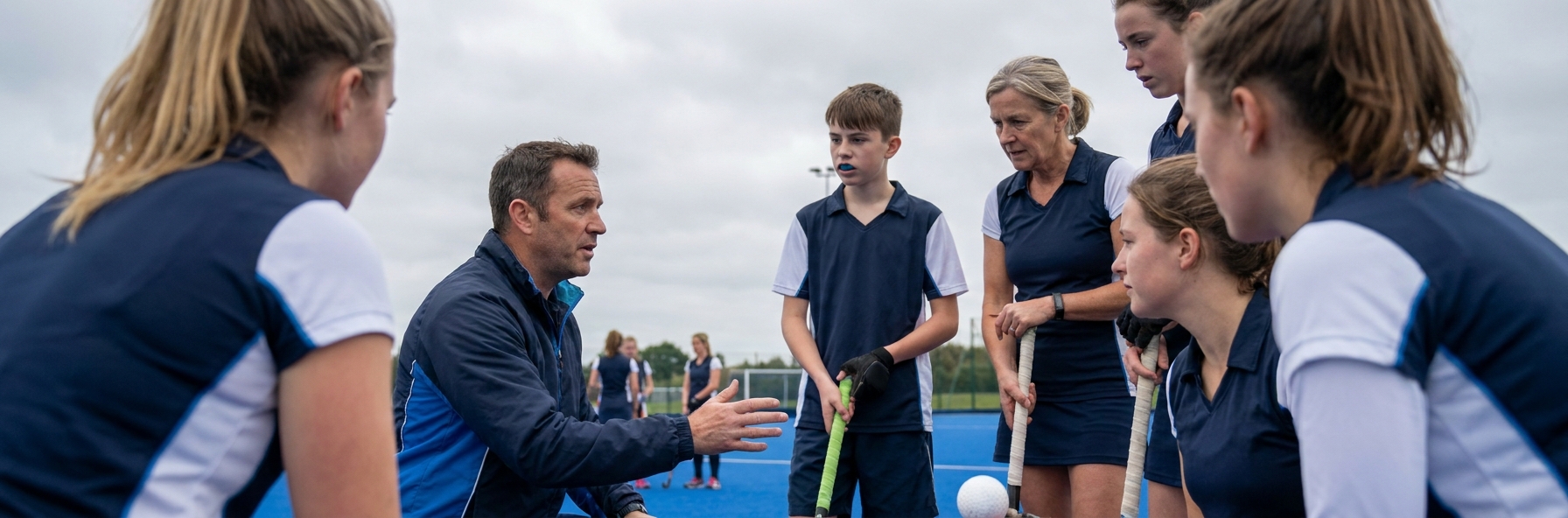
Tuesday training. Show the clips on a tablet or laptop in the changing room before the warm-up. Spend ten minutes - no more - on three questions: what did you see, what should have happened, what will we work on tonight? Then walk straight onto the pitch and train that exact thing.

Wednesday or Thursday follow-up. Share the clip pack to a private team channel with a short text caption. Players who couldn't attend Tuesday can catch up. Players who were there get the reinforcement.

What to Look For

If you don't know what to film for, default to these four categories that almost always reward closer inspection.

The first ten seconds after every turnover. Counter-pressing only succeeds or fails in this window, and it is the most coachable moment in modern hockey.

Every entry into the attacking 25. Did the team build it, did they run it down the wing, did they cross it in? Patterns become visible after three or four matches of footage.

Every conceded goal and shot on target. Painful to watch and uncomfortable to share, but the most direct route to defensive improvement.

Every penalty corner you defended. Run them back at half speed. The body position of the first runner alone will tell you whether your defensive structure is working.

Key Coaching Points

  • Film every match, even with a single phone on a tripod
  • Pick one theme per week, not ten
  • Three clips, three minutes - never more
  • Players nominate one clip each week
  • Train the theme the same day you review it

Recommended Drills

VIEW ALL TACTICS DRILLS

break hockey DRILLS
View All
Unfortunately there were no results for your search! Please try again
break hockey ANSWERS
View All

Indoor Hockey Situations for Russel Garcia- Solutions to tactical situations

2 Indoor Hockey situations%3A 1.)Could Sportsplan have Russel lay out how to defend a free hit/push into your circle from the left,center and right? More importantly show how the team moves/shifts when a pass is made from that area of the court to another in this situation. 2.) How to play against a 1/2 court system defense. What should the team be looking to do to find space and be successful.

Archived User Coach

Field Hockey - Half field press. - Help

Can anyone provide me ideas on how to combat a half field press in hockey?

Archived User Coach

Is there a drill to assist in a "Hit on the run?"?

Is there a drill to assist in a "Hit on the run?" I am coming back to hockey after a long break and can't quite get it right, especially in front of goals. I am also coaching my daughters minkey team. Please help? Kind Regards Teresa

Archived User Coach

Does anyone have a link to a few GOOD Hockey Specific fitness tests?

Does anyone have a link to a few GOOD Hockey Specific fitness tests. And I'm not looking for bleep tests which is somewhat out of date. Many thanks

Grant Hunt Coach, United Kingdom

Does anyone have a good field hockey drill for transitioning out of the defensive end after a steal or goalie clear?

Does anyone have a good field hockey drill for transitioning out of the defensive end after a goalie clear or a steal?

Archived User Coach

New indoor rules: What will be the new layout/formation?

G'day guys. I just read the new rules for indoor hockey and I am wondering what peoples thoughts are on the reduction to 5 players. Will the norm become playing with only one forward, or no center, or only one back? It seems this will now make the game more dynamic, teams will have to adapt on the run and change their strategies for pressing and for beating the press. A great center (or three) will become like gold. Cheers

Mick Mason Coach, Australia

How do you keep your team motivated - drill ideas?

we started the season 5-1 and now mid-way it seems we are fading? we have lost our last 3 games - what are some good drills to get them focused again and pumped for the rest of the season and to get them over the hump -to the next level. thanks

Brenda Strohmer Coach, United States of America

Midfield positioning on 16yd hits and presses when using 4-4-2?

hi there I'm using 4-4-2 and on sometimes 3-1-4-2 with a lower level hockey team.I've chosen this over other formations, simply because the hockey experience and ability of my players is not of a high level (and most people have an approximate understanding of 442). Also, I believe that one must choose a formation based on players traits and what they can deliver. For example, I'd ideally prefer to have 3 forwards, to help with more height and width but then would have to either play 3 in the middle or 3 at the back... and my player strengths don't permit this. In short, I simply don't believe I have a strong enough CH / CM to handle 3 in the middle and I'm not convinced that the off-the-ball support from other players is strong enough to allow 3 in the middle. OFFENSIVE PLAYS Anyway, I'm not 100% where to get my centre mids to stand when we have a 16 yd hit to take (i.e. our possession). Obviously one of the CMs comes deep to offer a potential direct outlet from the centre backs or offer an overload option if the ball goes out to the sides (which is more likely, since I've pretty much banned the high risk play of releasing up the middle - we've had far too many turnovers in our final third or quarter because we tried to play up the middle). My players are 'aware' of posting up and leading runs. However, I'm not sure about the 2nd CM. On the one hand I'd ideally like the 2nd CM to come deep as well, in order to potentially help break up the opposition press but by doing so, I distort the midfield and if we do manage to get the ball to one of the CMs, he won't have the 2nd CM in a higher position to release to, etc. DEFENSIVE POSITIONING Can someone suggest, again, about midfield positioning using 4-4-2 or 3-1-4-2, when we are setting up a general press? I have traditionally encouraged man marking, simply because our general positional awareness is weak (which makes zonal play a no-no IMO) + our tracking and attitude to committed defending (i.e. you don’t give up if one tackle fails) could be better! However, looking at suggested presses on Sportplan, some zonal positioning seems a necessity and I think if I can help my players make the step, success will come because they've been forced to become more aware of their pitch positioning, etc. Also, looking at some of the presses, it looks like the midfield can go 'flat' to create a barrier... and as I encourage a diamond shape in midfield, I need to explain to my players what to do and when. Sorry for the wordy question. I hope this all makes sense. Regards, Gary

Gary Thompson Coach, England

1st ever training Session Structure?

I have been given my first team ever!! They are 11 year old girls and I wanted guide/ recommendation on how I should structure my one hour sessions? E.g. how long should I spend on a warm up, drill etc. .Cheers,Freya

Archived User Coach

Transfering the ball

Please could someone tell me the principles of transferring the ball. I can use the drills on here and some I have already used. However I would like my players to be "able to create own" if they know the princimples

Wendy Russell Coach, England

How to coach school team with novices and experienced players?

Hi,I perhaps naively, expected to have most of our team from last year carry over and only have a few new comers to integrate and get up to speed with the rest. However meeting the team at our first practice last night i find I have five players still at school from last year and the rest all new comers, most of whom had not held a hockey stick at all till practice.This being only my second season coaching (year 9 to year 13 boys) has left me feeling a little blindsided, and feeling quite unsure how to prepare practices that target both groups of boys. Do i lump them both groups together, keep them separate? What drills/exercises to best bring the new comers up to speed.I don't want to neglect either group, keep practice worthwhile for the experienced boys, but also bringing the new comers up to a level were they can mix in with the others and learn organically from them while practicing as a team. David

David Smith Coach, New Zealand

7 sides hockey

What is the best formation and game play for 7 sides tournament in defending and attacking?

Ameer Shazwan Coach, Malaysia

1st ever training Session Stru...

I have been given my first team ever!! They are 11 year old girls and I wanted guide/ recommendation on how I should structure my one hour sessions? E.g. how long should I spend on a warm up, drill etc. .Cheers,Freya

Archived User Coach

ball hogging habits ? | Sportp...

What's the best way to break ball hogging habits

Archived User Coach

Difference between full and ha...

Please can you explain the difference in the full court press press and the half court press

Carole Quill Coach, England

JOIN SPORTPLAN FOR FREE

  • search our library of 1000+ hockey drills
  • create your own professional coaching plans
  • or access our tried and tested plans

Sportplan App

Give it a try - it's better in the app

YOUR SESSION IS STARTING SOON... Join the worlds largest hockey coaching resource for 1000+ drills and pro tools to make coaching easy.
LET'S DO IT