Field Hockey: defending one on one

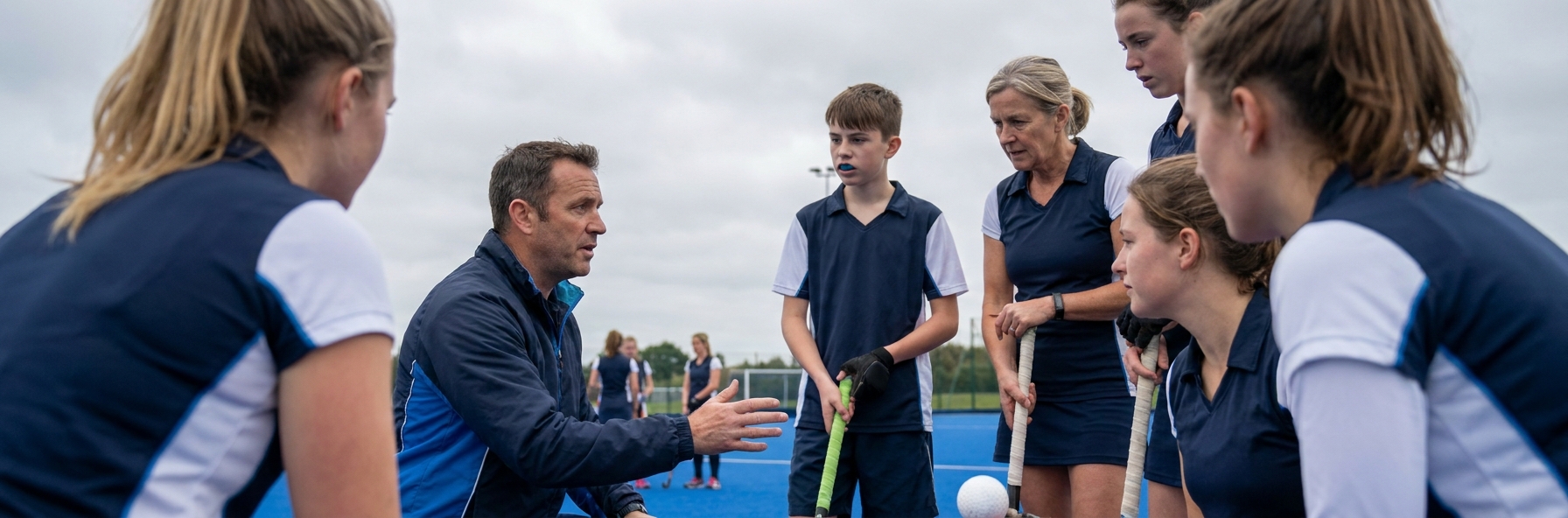
Connection-Based Coaching has emerged as a significant movement in hockey coaching. The core idea is simple but powerful: the relationship between coach and player is the foundation upon which all development is built. Without trust, without genuine connection, coaching effectiveness is limited.

This isn't soft philosophy. Research consistently shows that athletes who feel psychologically safe, who trust their coach, who believe their coach genuinely cares about them, perform better and develop faster.

What is Psychological Safety?

Psychological safety is the belief that you can take risks without being punished or humiliated. In a hockey context, it means players who feel safe to:
  • Try new skills without fear of criticism for failure
  • Ask questions without being made to feel stupid
  • Offer ideas without being dismissed
  • Make mistakes in matches without losing their place
  • Express concerns without negative consequences

When psychological safety exists, players are more creative, more willing to stretch themselves, and more honest about their development needs.

Building Connection

Know Your Players

Do you know what motivates each player? Their life outside hockey? Their hopes and concerns? Connection requires knowledge, and knowledge requires investment in getting to know people.

This doesn't mean becoming best friends. It means showing genuine interest, remembering what players tell you, and demonstrating that you see them as people, not just performers.

Listen More Than You Speak

Many coaches do too much telling. Connection-based coaching emphasises listening. When players speak, give them full attention. Ask follow-up questions. Reflect back what you've heard to show understanding.

Listening builds trust because it demonstrates respect. When players feel heard, they're more receptive to coaching.

Consistency and Reliability

Trust is built through consistent behaviour over time. If you say you'll do something, do it. If you have standards, apply them equally to everyone. Inconsistency destroys trust faster than almost anything else.

Appropriate Vulnerability

Coaches who admit mistakes, acknowledge what they don't know, and share their own development journey build stronger connections than those who project infallibility. Appropriate vulnerability models the openness you want from players.

Connection in Practice

Individual Check-Ins

Brief one-to-one conversations build connection over time. Not always about hockey - sometimes just "How are you?" delivered with genuine interest. These small interactions accumulate into strong relationships.

Personalised Feedback

Generic feedback shows you're not paying attention. Specific, personalised feedback shows you see the individual. "Good work" is less powerful than "I noticed you recovered really quickly after that turnover - that's the response we need."

Celebrating Progress

Connection-based coaches celebrate development, not just outcomes. The player who improves from poor to average has achieved as much as the player who was always excellent. Recognition should reflect effort and progress.

Managing Difficult Conversations

Strong connections make difficult conversations possible. When players trust you, they can hear hard truths. When they don't, the same truths are rejected as unfair criticism. Build the connection first; the honest feedback can follow.

Team-Level Application

Connection isn't just coach-to-player. Teams with strong player-to-player connections perform better. The coach's role includes creating conditions for these connections:

  • Team-building activities that build genuine relationships
  • Training structures that encourage collaboration
  • Addressing behaviours that damage team connection
  • Celebrating collective achievements

Common Barriers

"I don't have time": Connection doesn't require separate time - it's embedded in how you do everything. A two-minute conversation while setting up equipment still counts.

"It's soft": The evidence says otherwise. High-performance environments increasingly recognise that connection underpins performance, not detracts from it.

"Not all players want it": Different players need different levels and types of connection. Read what each individual needs and adjust accordingly.

Key Coaching Points

  • Psychological safety enables risk-taking and growth
  • Know your players as people, not just performers
  • Listen more, tell less
  • Be consistent and reliable
  • Personalise your interactions and feedback
  • Create conditions for player-to-player connection

Drills That Build Team Connection

VIEW ALL SMALL-SIDED GAMES

JOIN SPORTPLAN FOR FREE

  • search our library of 1000+ field hockey drills
  • create your own professional coaching plans
  • or access our tried and tested plans
defending one on one DRILLS
View All
Unfortunately there were no results for your search! Please try again
defending one on one ANSWERS
View All

What is your best advice to a boy playing sweeper in a team with a poor defense

My son has been given the role of sweeper in a team that has only won  twice in two years.  He is probably the weakest player in the team.  What advice can I give him to think about when playing, so that he can improve and enjoy a personal sense of achievement. In training sessions I have never seen any drills designed to organise the defence which is amazing since the teams ambition is usually to keep the goals against to single figures! Are there standard apporoaches as to how close to be  to the player you are marking or which side to stand to stop the attacker getting free with the ball on his open stick?.

Archived User Coach

Defending with slow players

I coach a ladies two side, our defesive players are all rather slow on their feet due to age, injuries etc, this isn't to bad against slow attacking teams however we are now playing very fast forwards, how can my slower defensive players combat this.

Archived User Coach

Best method to teach junior aside players positions and responsibilities?

What are the best methods to teach Junior 8 aside hockey players their positional roles and responsibilities?

Archived User Coach

Looking for a 6-a good side hockey formation?

I am looking for 6 a side hockey formations. We have been playing 3-1-1-1. Worked very well, however sweeper was so good, goalie never touched the ball. I want to move sweeper to goalie/ sweeper but our mid field player is too good to just play right. What to do? 2-2-1-1 or 1-3-1-1?     

Archived User Coach

How to encourage positional play (spreading out) to U9 players?

How do you encourage positional play and spreading out on hockey field U9 girls level?

Archived User Coach

What are the key skills in individual defending?

What are the key skills in individual defending and what are the best ways to practise them?

Jayson Hood Coach, England

How can we coach key defending skills?

How can we coach young players (U18) to get better at individual defending skills such as closing down, tackling, marking and covering? I'm looking at all these areas and I'm coaching at the JRPC in Leeds this season and one of our sessions needs to be on individual defending. What I want to do is ensure that I am providing a training session (or set of training sessions) which cover the key skills involved in being a good defender and then build drills or constrained games around these key skills. Any advice much appreciated! Best wishes, Jayson

Jayson Hood Coach, England

Midfield positioning on 16yd hits and presses when using 4-4-2?

hi there I'm using 4-4-2 and on sometimes 3-1-4-2 with a lower level hockey team.I've chosen this over other formations, simply because the hockey experience and ability of my players is not of a high level (and most people have an approximate understanding of 442). Also, I believe that one must choose a formation based on players traits and what they can deliver. For example, I'd ideally prefer to have 3 forwards, to help with more height and width but then would have to either play 3 in the middle or 3 at the back... and my player strengths don't permit this. In short, I simply don't believe I have a strong enough CH / CM to handle 3 in the middle and I'm not convinced that the off-the-ball support from other players is strong enough to allow 3 in the middle. OFFENSIVE PLAYS Anyway, I'm not 100% where to get my centre mids to stand when we have a 16 yd hit to take (i.e. our possession). Obviously one of the CMs comes deep to offer a potential direct outlet from the centre backs or offer an overload option if the ball goes out to the sides (which is more likely, since I've pretty much banned the high risk play of releasing up the middle - we've had far too many turnovers in our final third or quarter because we tried to play up the middle). My players are 'aware' of posting up and leading runs. However, I'm not sure about the 2nd CM. On the one hand I'd ideally like the 2nd CM to come deep as well, in order to potentially help break up the opposition press but by doing so, I distort the midfield and if we do manage to get the ball to one of the CMs, he won't have the 2nd CM in a higher position to release to, etc. DEFENSIVE POSITIONING Can someone suggest, again, about midfield positioning using 4-4-2 or 3-1-4-2, when we are setting up a general press? I have traditionally encouraged man marking, simply because our general positional awareness is weak (which makes zonal play a no-no IMO) + our tracking and attitude to committed defending (i.e. you don’t give up if one tackle fails) could be better! However, looking at suggested presses on Sportplan, some zonal positioning seems a necessity and I think if I can help my players make the step, success will come because they've been forced to become more aware of their pitch positioning, etc. Also, looking at some of the presses, it looks like the midfield can go 'flat' to create a barrier... and as I encourage a diamond shape in midfield, I need to explain to my players what to do and when. Sorry for the wordy question. I hope this all makes sense. Regards, Gary

Gary Thompson Coach, England

How can I help my U12 girls to attack?

How can I help my u/12 girls to attack? At the moment they are running beside the opponent but not attacking the players.

carien Coach, South Africa

How can I get my midfielders' mentality right so they defend and attack in a game?

So I'm having trouble getting my young and inexperienced group of midfielders to flip the switch from defense to offense, and back, as we move up and down the field. They will often hang back and leave my forwards stranded rather than rush in to attack. Naturally, we are not scoring. Advice and drill ideas would be most welcome! J.G. Coach, Maryland USA

j gimpel Coach, United States of America

Defending lifts on free hits

I am a high school coach in the USA. We played a team this past weekend who had a defender who lifted on a free hit 30-40 yards. That was pretty much their only offense. All of their forwards were ready to receive the long balls. How do we defend that? Should I have almost everyone drop back 30-40 yards?

Archived User Coach

I'm a new Varsity head coach and don't know what I'm doing

Hi all- I am 37 years old. I played field hockey for 3 years only (in high school). As you can imagine, I'm not very good/experienced. I was a competitive soccer player which made me good enough athletically to play field hockey but anyway, the point is: I never played field hockey at a high level.I now find myself in a head coaching position. (Long story-I did coach some field hockey some years ago and had a blast but it was a while back). Anyway, I have three assistant coaches who aren't much more experienced than I am. Our high school program is VERY weak and so nobody really steps up to coach there.Basically, my question is: what do I do? I have some girls who have played but not much. Then I have girls who literally don't know how to hold their stick and are quite I athletic. We barely have enough girls to field a team. As for drills, I'm trying to use this site but if you were in my position, what specifically would you be doing with these girls so they don't lose 7-0 every game? Right now, I'm focusing on body control and comfort with the ball- (we are playing possession and they are so uncomfortable they just hit the ball away because they don't have the skills to hold). Any help you can give is greatly appreciated!Brooke Asked using Sportplan Mobile App

Archived User Coach

Break through a team that is playing half court press?

How can you train to break through a team that starts half court and your team starts with the ball? Four players in the defence start maybe playing the ball first to the left wing and this player hits the ball back to the free defence player who passes the ball to the right defence player who is over the 23 meter line... I like to understand the different tactical approaches. Can you share some ideas with me?

R.P. Witkamp Coach, Netherlands

I am a new coach and need pointers!

I just became the head coach of a middle school field hockey team and would like some pointers on how to coach. I have experience with goal keeping and defensive drills, I was a keeper, so I would like to learn more about offense as well. Any help is appreciated!!

Amanda Emerich Coach, United States of America

Base line defence - How to prevent teams scoring?

Baseline defence: How to prevent teams from Scoring goals from the left and Right baseline.Do I tell my left and Right half to channel player outwards ,protect feet,frontal pressure and allow other defenders to tuck infield.Or do I opt to tell defenders to go man to man inside 23 and then apply frontal pressure ,channel player outwards ,watch angle of engagment.As recently we only conceded through attack on our baseline

Jason Adams Coach, South Africa

7 sides hockey

What is the best formation and game play for 7 sides tournament in defending and attacking?

Ameer Shazwan Coach, Malaysia

teaching presses on free hits ...

Hi allI am looking for advice on how to implement processes in my girls school hockey team. processes of setting up presses, defensive structures and counter attacking thinking. I have 14 players in the team from 15 years old to 18. we train twice a week. only a few play club hockey as well. We either play a 3-1-4-2 or a 3-1-3-3.I find it difficult for example, when you want to teach a press on the opposition 16, to simulate gameplay with only 14 players (if they are all at training). I can have my halves setup for taking the 16 and then get my strikers and links to setup, but then I still want defenders to see things from the back but they are taking the 16? Also when taking the 16 they then don't have any support in the drill because everyone else is setting up a press?I know we need to work on our basics in order for the other tactics and skills and game plans to work. However I find it frustrating with this team that on counter attacks for a few reasons which I am struggling to mend;- they only head forward. No one holds up the ball to wait for support.- they run straight and don't use angles- they pass too late and get tackled - they don't have the vision to see an early pass or pass into space- players without the ball do not run into useful positions and angles and get caught out by the person with the ball who then makes a pass to no one and it runs out of play.So suggestions please for;- open, creative but simple counter attacking- teaching processes for presses on free hits and 16s- coaching how to take 16s and work your way out- coaching vision and expecting your players to be in support. RegardsMatt

Matthew Lydall Coach, South Africa

Any ideas for defending 3d ski...

I have a midfielder that wants to practice defending against lifted balls in a 1-2-1 situation, any ideas for drills that will assist with this?

Steve Ashdown Coach, England

To man mark or zone? | Sportpl...

My Girls team I coach get caught a lot between man marking and zonal marking in the 23 yard area and sometimes end up with half the team doing one and the rest the other. Suggestions on the ideal defensive set up inside the 23?

Archived User Coach

How can I stop my team from di...

I am coaching my first season as head coach. I am confident that my team has improved on alot of skills (mostly due to sportplan.net, thank you!). The only thing that is driving me crazy that my team has not improved on is the over committing block tackle. When an opponent is coming down the field on a breakway, my defense runs up and block tackles, and the opponent shoots right past them. This will happen two or three times in a row, one defender after the other. I've told them to keep their feet moving and to keep off their toes, keeping their momentum with the opponent. I don't know how to practice this with them. We only have 9 players (this is a high school varsity team) so we can't scrimmage full field during practice. Please help! I'm desperate for a solution.

Archived User Coach

JOIN SPORTPLAN FOR FREE

  • search our library of 1000+ field hockey drills
  • create your own professional coaching plans
  • or access our tried and tested plans

Sportplan App

Give it a try - it's better in the app

YOUR SESSION IS STARTING SOON... Join the growing community of field hockey coaches plus 1000+ drills and pro tools to make coaching easy.
LET'S DO IT