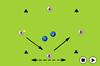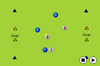
Field Hockey: finding space

The 2025 Netball Super League season has introduced a rule that will change close games forever: no match can end in a draw. If scores are level after 60 minutes, two 5-minute periods of extra time will be played, with a one-minute break between them. If still tied, play continues until one team establishes a two-goal lead.

This is high-stakes netball. Are your players ready for it?

Understanding the Rules

The structure is straightforward:

  • Regulation: 60 minutes (4 x 15-minute quarters)
  • Extra time (if tied): Two 5-minute periods with 1-minute half-time
  • Extended extra time (if still tied): Play continues until a team leads by 2 goals

The Super Shot rule applies during extra time, adding another layer of tactical complexity. Centre passes alternate as normal. The team that wins gets 3 points; the loser gets 0.

The New Points System

The NSL has also changed the points allocation:

  • Win: 3 points
  • Loss by 5 goals or fewer: 1 point
  • Loss by more than 5 goals: 0 points

This means extra time carries enormous weight. A draw that would have given both teams 1 point now produces a winner with 3 points and a loser with 0 (unless it was already close). The stakes are higher than ever.

Physical Preparation

Extra time demands fitness. Players must maintain execution quality in potentially the 70th or 75th minute of play. Traditional 60-minute conditioning isn't enough.

Extend training games. Run scrimmages that go beyond normal match length. Players need to experience decision-making and skill execution when genuinely fatigued.

Interval conditioning. Extra time is high-intensity bursts separated by brief recovery. Design fitness work that replicates this pattern - repeated efforts with incomplete rest.

Simulation sessions. Occasionally simulate extra time scenarios in training. After a full scrimmage, announce "scores are level" and play on. This normalises the experience.

Related Drills: Build your team's endurance with our Fitness Drills for extended play conditioning.

Tactical Preparation

Substitution Strategy

You can't save substitutions for extra time if you haven't won regulation. The balance is keeping your best players fresh enough to perform in extra time while not losing the game in the fourth quarter.

Consider which players are best suited to high-pressure, fatigued conditions. Mental resilience and composure may matter more than pure skill in extra time.

Super Shot Strategy

The Super Shot applies in extra time. A single two-goal conversion can swing a game. Have a clear plan for Super Shot usage during these periods - and ensure your best long-range shooter is on court.

Extended Extra Time Awareness

If the game reaches "next two goals wins" territory, tactics simplify. Every possession is sudden death. Turnovers become catastrophic. Train your team to play with maximum care and composure in these moments.

Psychological Preparation

Extra time is as much mental as physical. Players who've never experienced it can freeze. Players who've practiced it perform.

Visualisation. Have players mentally rehearse extra time scenarios. What does it feel like to take a shot with the game on the line? To defend knowing one mistake could end it?

Positive framing. Extra time isn't a crisis - it's an opportunity. You've earned the chance to win a game that was on the edge. The team that sees extra time as exciting rather than terrifying has an advantage.

Process focus. In pressure moments, outcome focus ("we must score") creates tension. Process focus ("see the target, trust the technique") creates flow. Train your players to narrow attention to the next action, not the consequences.

Managing the One-Minute Break

Between extra time periods, you have one minute. This isn't long enough for complex tactical changes. Use it wisely:

  • Hydration and physical recovery
  • One or two key messages maximum
  • Energy and encouragement
  • Reminder of process focus

What you don't want is panicked tactical reinvention. Keep it simple, keep it positive, keep it short.

Learning from Experience

As the season progresses, some teams will accumulate extra time experience. Each situation is a learning opportunity:

  • What worked? What didn't?
  • Which players performed under pressure?
  • What would you do differently?

Document these lessons. They'll inform future preparation and give your team an edge in subsequent close games.

The Competitive Advantage

Many teams will neglect extra time preparation, focusing only on 60-minute netball. The teams that practice extra time scenarios, condition for extended play, and psychologically prepare their players will win more close games.

In a competition where points are precious, turning potential draws into wins could be the difference between finals and missing out. Prepare accordingly.

Where to Go Next

Prepare your team for the demands of extra time with these resources:

JOIN SPORTPLAN FOR FREE

  • search our library of 1000+ hockey drills
  • create your own professional coaching plans
  • or access our tried and tested plans
finding space DRILLS
View All
Unfortunately there were no results for your search! Please try again
finding space ANSWERS
View All

Field Hockey - Half field press. - Help

Can anyone provide me ideas on how to combat a half field press in hockey?

Archived User Coach

Any Fun Drills to do ?

Anyone know some Fun Hockey Drills to do ? not working on anything in particular

Archived User Coach

Why can't I share my drill? The system seems to hang?

Why can't I share my drill? The system seems to hang when I click on the share button? I also don't seem to be able to create a pdf?

v wheeldon Coach, England

How to coach school team with novices and experienced players?

Hi,I perhaps naively, expected to have most of our team from last year carry over and only have a few new comers to integrate and get up to speed with the rest. However meeting the team at our first practice last night i find I have five players still at school from last year and the rest all new comers, most of whom had not held a hockey stick at all till practice.This being only my second season coaching (year 9 to year 13 boys) has left me feeling a little blindsided, and feeling quite unsure how to prepare practices that target both groups of boys. Do i lump them both groups together, keep them separate? What drills/exercises to best bring the new comers up to speed.I don't want to neglect either group, keep practice worthwhile for the experienced boys, but also bringing the new comers up to a level were they can mix in with the others and learn organically from them while practicing as a team. David

David Smith Coach, New Zealand

How do i get the right timing for a Jab

How do I get the right timing for a jab im trying to step up my defensive skills and i just cant get the right timing and technique for it Asked using Sportplan Mobile App

Archived User Coach

Outletting against a half cour...

overlapping outside halves ? or drop Midfield in hole?

Archived User Coach

teaching presses on free hits ...

Hi allI am looking for advice on how to implement processes in my girls school hockey team. processes of setting up presses, defensive structures and counter attacking thinking. I have 14 players in the team from 15 years old to 18. we train twice a week. only a few play club hockey as well. We either play a 3-1-4-2 or a 3-1-3-3.I find it difficult for example, when you want to teach a press on the opposition 16, to simulate gameplay with only 14 players (if they are all at training). I can have my halves setup for taking the 16 and then get my strikers and links to setup, but then I still want defenders to see things from the back but they are taking the 16? Also when taking the 16 they then don't have any support in the drill because everyone else is setting up a press?I know we need to work on our basics in order for the other tactics and skills and game plans to work. However I find it frustrating with this team that on counter attacks for a few reasons which I am struggling to mend;- they only head forward. No one holds up the ball to wait for support.- they run straight and don't use angles- they pass too late and get tackled - they don't have the vision to see an early pass or pass into space- players without the ball do not run into useful positions and angles and get caught out by the person with the ball who then makes a pass to no one and it runs out of play.So suggestions please for;- open, creative but simple counter attacking- teaching processes for presses on free hits and 16s- coaching how to take 16s and work your way out- coaching vision and expecting your players to be in support. RegardsMatt

Matthew Lydall Coach, South Africa

How to coach school team with ...

Hi,I perhaps naively, expected to have most of our team from last year carry over and only have a few new comers to integrate and get up to speed with the rest. However meeting the team at our first practice last night i find I have five players still at school from last year and the rest all new comers, most of whom had not held a hockey stick at all till practice.This being only my second season coaching (year 9 to year 13 boys) has left me feeling a little blindsided, and feeling quite unsure how to prepare practices that target both groups of boys. Do i lump them both groups together, keep them separate? What drills/exercises to best bring the new comers up to speed.I don't want to neglect either group, keep practice worthwhile for the experienced boys, but also bringing the new comers up to a level were they can mix in with the others and learn organically from them while practicing as a team. David

David Smith Coach, New Zealand

I'm looking for suggestions on...

I'm looking for suggestions on set plays for free hits going into the circle. High school rules in the US now state that all players (attack/defense) must be 7 yards from the ball. What plans will work for drawing corners and goal scoring opportunities?

Ali Collins Coach, United States of America

I'm a new Varsity head coach a...

Hi all- I am 37 years old. I played field hockey for 3 years only (in high school). As you can imagine, I'm not very good/experienced. I was a competitive soccer player which made me good enough athletically to play field hockey but anyway, the point is: I never played field hockey at a high level.I now find myself in a head coaching position. (Long story-I did coach some field hockey some years ago and had a blast but it was a while back). Anyway, I have three assistant coaches who aren't much more experienced than I am. Our high school program is VERY weak and so nobody really steps up to coach there.Basically, my question is: what do I do? I have some girls who have played but not much. Then I have girls who literally don't know how to hold their stick and are quite I athletic. We barely have enough girls to field a team. As for drills, I'm trying to use this site but if you were in my position, what specifically would you be doing with these girls so they don't lose 7-0 every game? Right now, I'm focusing on body control and comfort with the ball- (we are playing possession and they are so uncomfortable they just hit the ball away because they don't have the skills to hold). Any help you can give is greatly appreciated!Brooke Asked using Sportplan Mobile App

Archived User Coach

How to keep kids from getting ...

Hi all just wondering if there are any coach's that have any good tip for a new coach like me. I am coaching under 6/8yr olds and find they get bored very easy. How do you keep them from getting bored and what fun drills do you use? Cheer James first time coach

James Batt Coach, New Zealand

Difference between full and ha...

Please can you explain the difference in the full court press press and the half court press

Carole Quill Coach, England

JOIN SPORTPLAN FOR FREE

  • search our library of 700+ netball drills
  • create your own professional coaching plans
  • or access our tried and tested plans

Sportplan App

Give it a try - it's better in the app

YOUR SESSION IS STARTING SOON... Join the worlds largest hockey coaching resource for 1000+ drills and pro tools to make coaching easy.
LET'S DO IT