Field Hockey: head up

England Hockey's "25 in 2025" initiative has been touring the country, bringing two-hour on-pitch workshops to 25 locations. The focus: practical practice ideas that coaches can take straight back to their clubs. Here's a summary of the key concepts being shared.

The Philosophy

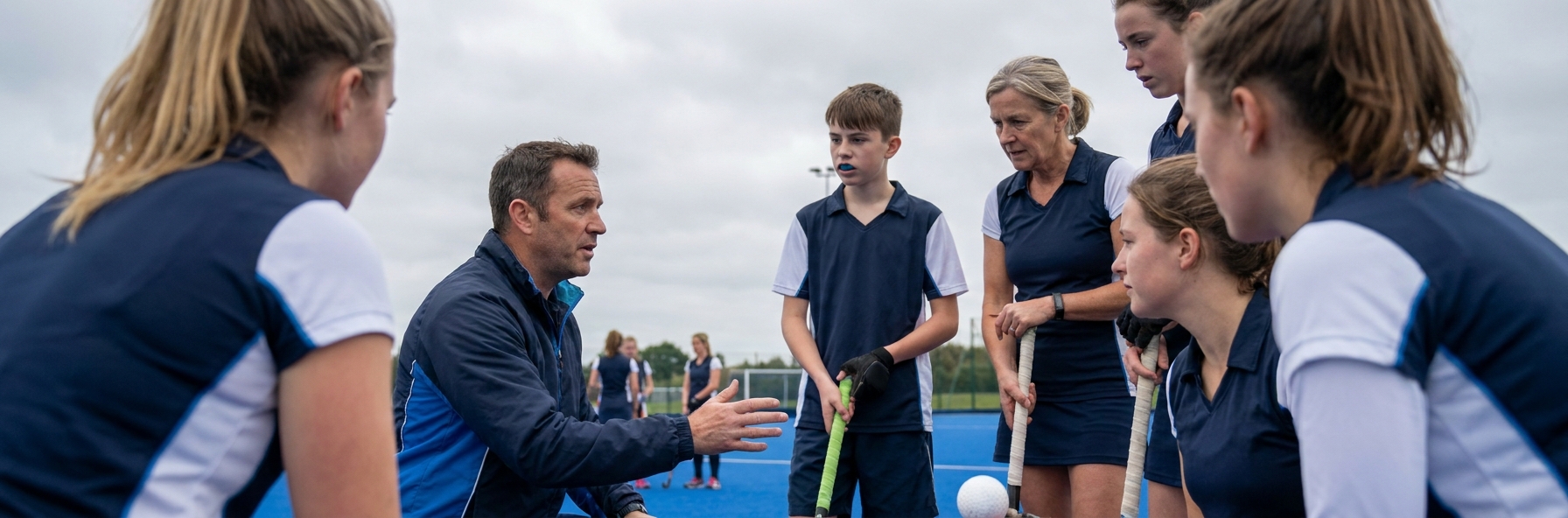
The workshops are designed for everyone involved in delivering hockey, from experienced coaches to volunteers just starting out. The emphasis is on fun, engaging sessions that keep players coming back - because player retention depends on the quality of the experience we create.

Each workshop covers arrival activities, carrying and passing progressions, and game-based learning. Participants leave with a bank of ideas they can implement immediately.

Arrival Activities That Work

The first few minutes of any session set the tone. Arrival activities should be:

Self-managing: Players can start without detailed instruction. This lets the coach focus on organisation while early arrivals get active.

Engaging: Not just standing in lines. Movement, decision-making, maybe a competitive element.

Scalable: Works with 2 players or 20. As more arrive, they join seamlessly.

Examples include: grid-based possession games where players can join any team, skill stations with clear visual instructions, and small-sided games that expand as numbers grow.

Carrying and Moving with Purpose

A significant portion of the workshops focuses on ball carrying. The key insight: carrying isn't just about technique, it's about purpose. Why are you carrying? Where are you taking the ball? What's your next action?

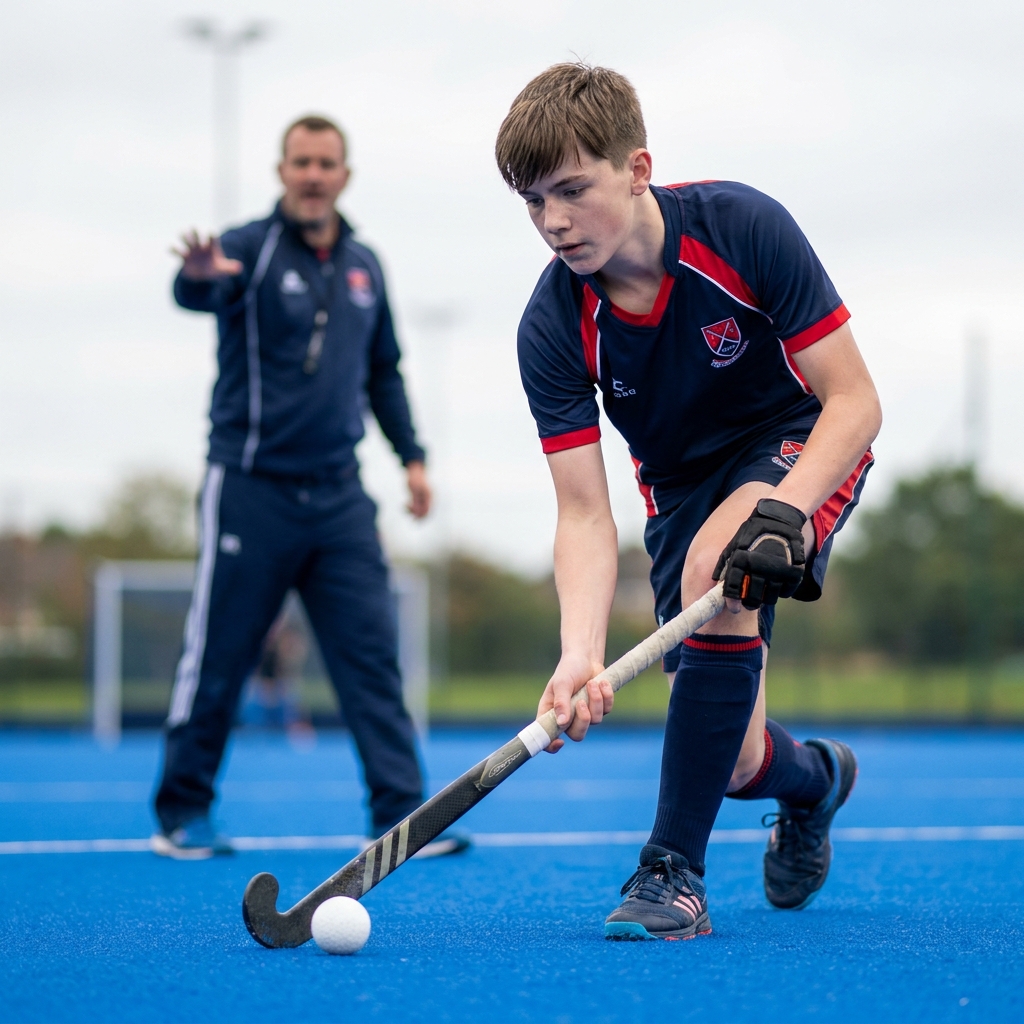
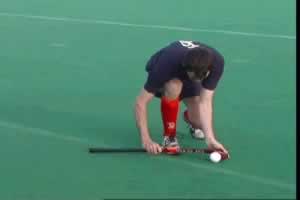
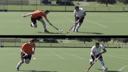
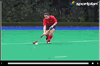
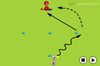
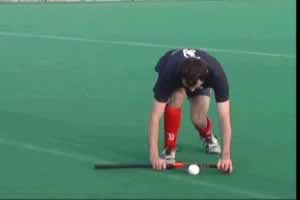
Practices progress from technique-focused (head up, ball position, change of pace) to decision-focused (when to carry vs pass, reading space, timing runs with teammates).

The workshops emphasise "game-realistic" carrying - not just running through cones, but carrying with pressure, carrying to eliminate, carrying to create passing angles.

Passing as Communication

The workshops reframe passing as communication between players. A good pass says "here's where I want you to receive." A great pass also says "here's what I want you to do next."

Practices focus on:

  • Weight of pass - firm enough to arrive quickly, soft enough to control
  • Timing - not too early (intercepted), not too late (receiver can't use it)
  • Receiver's next action - passing to the correct foot/side for what follows

Games-Based Learning

Perhaps the biggest takeaway from the workshops is the shift toward games-based learning. Instead of isolated drills, players learn through modified games that naturally develop the required skills.

The coach's role becomes designing games that create the learning outcomes, then facilitating rather than instructing. Questions replace commands: "What did you notice there?" "Why did that work?" "What could you try differently?"

This approach develops players who can problem-solve, adapt, and transfer learning to match situations.

Making Sessions Engaging

The workshops share specific techniques for keeping energy high:

Quick transitions: Minimise time between activities. Have the next game ready before the current one finishes.

Appropriate challenge: Too easy is boring, too hard is frustrating. Find the "just right" level for your group.

Variety within structure: Keep the same game framework but change small elements - scoring methods, playing areas, team compositions.

Player voice: Give players choices. "Do you want to play again or try something new?" This builds ownership.

Video Support

All workshop practices are available on YouTube, allowing coaches to revisit and refine after attending. This resource bank is growing as the roadshow continues.

Who Should Attend?

The workshops are pitched at all levels. Experienced coaches report learning new ideas and getting reinforcement of good practice. New coaches gain confidence and practical tools. The shared experience of learning together builds community within the sport.

If a workshop is coming to your area, it's worth attending. The time investment is small; the return in practical ideas is significant.

Key Coaching Points

  • Arrival activities set the tone - make them engaging
  • Carrying with purpose, not just technique
  • Passing is communication between players
  • Games-based learning develops problem-solvers
  • Keep sessions varied and appropriately challenging

Drills to Build Your Practice Bank

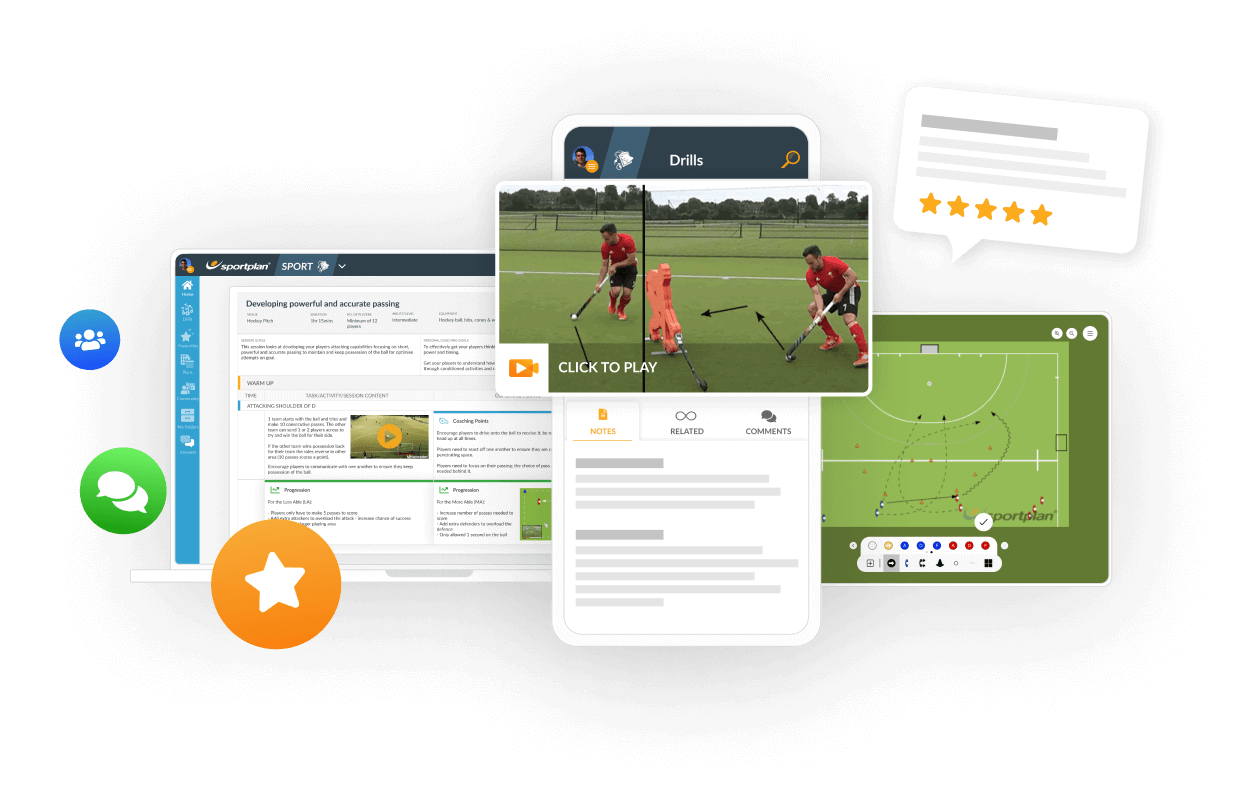
VIEW ALL WARM-UP DRILLS

JOIN SPORTPLAN FOR FREE

  • search our library of 1000+ field hockey drills
  • create your own professional coaching plans
  • or access our tried and tested plans
head up DRILLS
View All
Unfortunately there were no results for your search! Please try again
head up ANSWERS
View All

I'm a new Varsity head coach a...

Hi all- I am 37 years old. I played field hockey for 3 years only (in high school). As you can imagine, I'm not very good/experienced. I was a competitive soccer player which made me good enough athletically to play field hockey but anyway, the point is: I never played field hockey at a high level.I now find myself in a head coaching position. (Long story-I did coach some field hockey some years ago and had a blast but it was a while back). Anyway, I have three assistant coaches who aren't much more experienced than I am. Our high school program is VERY weak and so nobody really steps up to coach there.Basically, my question is: what do I do? I have some girls who have played but not much. Then I have girls who literally don't know how to hold their stick and are quite I athletic. We barely have enough girls to field a team. As for drills, I'm trying to use this site but if you were in my position, what specifically would you be doing with these girls so they don't lose 7-0 every game? Right now, I'm focusing on body control and comfort with the ball- (we are playing possession and they are so uncomfortable they just hit the ball away because they don't have the skills to hold). Any help you can give is greatly appreciated!Brooke Asked using Sportplan Mobile App

Archived User Coach

How can I stop my team from di...

I am coaching my first season as head coach. I am confident that my team has improved on alot of skills (mostly due to sportplan.net, thank you!). The only thing that is driving me crazy that my team has not improved on is the over committing block tackle. When an opponent is coming down the field on a breakway, my defense runs up and block tackles, and the opponent shoots right past them. This will happen two or three times in a row, one defender after the other. I've told them to keep their feet moving and to keep off their toes, keeping their momentum with the opponent. I don't know how to practice this with them. We only have 9 players (this is a high school varsity team) so we can't scrimmage full field during practice. Please help! I'm desperate for a solution.

Archived User Coach

teaching presses on free hits ...

Hi allI am looking for advice on how to implement processes in my girls school hockey team. processes of setting up presses, defensive structures and counter attacking thinking. I have 14 players in the team from 15 years old to 18. we train twice a week. only a few play club hockey as well. We either play a 3-1-4-2 or a 3-1-3-3.I find it difficult for example, when you want to teach a press on the opposition 16, to simulate gameplay with only 14 players (if they are all at training). I can have my halves setup for taking the 16 and then get my strikers and links to setup, but then I still want defenders to see things from the back but they are taking the 16? Also when taking the 16 they then don't have any support in the drill because everyone else is setting up a press?I know we need to work on our basics in order for the other tactics and skills and game plans to work. However I find it frustrating with this team that on counter attacks for a few reasons which I am struggling to mend;- they only head forward. No one holds up the ball to wait for support.- they run straight and don't use angles- they pass too late and get tackled - they don't have the vision to see an early pass or pass into space- players without the ball do not run into useful positions and angles and get caught out by the person with the ball who then makes a pass to no one and it runs out of play.So suggestions please for;- open, creative but simple counter attacking- teaching processes for presses on free hits and 16s- coaching how to take 16s and work your way out- coaching vision and expecting your players to be in support. RegardsMatt

Matthew Lydall Coach, South Africa

I am a new coach and need poin...

I just became the head coach of a middle school field hockey team and would like some pointers on how to coach. I have experience with goal keeping and defensive drills, I was a keeper, so I would like to learn more about offense as well. Any help is appreciated!!

Amanda Emerich Coach, United States of America

What should I do? Team Captain...

I have taken over a club as head coach this year and inherited a captain. She is a good player but is not my ideal captain and is used to communicating almost exclusively by email. I had a successful meeting setting objectives for the 1st team last weekend and following that meeting received lots of feedback for how well it was received. My captain yesterday sent a long email about her thoughts on the meeting and where we are and what the players should be doing in order to progress from her perspective. It is a long rambling email that I think has no objective or point to it that I think is completely inappropriate, now I know her heart is in the right place but this is really stepping on my toes as a coach as it is my place to do these type of emails. I am looking for advice on how I should be dealing with this, I am happy to pull her up but as she is very unconfident about herself I feel this might push her back into her shell even more and then she might do something daft like send another email apologising to the team! I am not sure if I should just ignore it as I wonder if it undermines me? Thoughts?

Ian Hardingham Coach, England

Fun Warm ups with 7-11 year ol...

What fun warm ups can I use with a group of 7-11 year olds with and without hockey sticks? Many thanks xx

Natty Coach, England

Coaching for six a side u9 gir...

We need to talk about the basics of hockey but any advice re coaching them on not bunching and drills to help with this would be much appreciated. Thank you.

Kathryn Hallock Coach, South Africa

Midfield positioning on 16yd h...

hi there I'm using 4-4-2 and on sometimes 3-1-4-2 with a lower level hockey team.I've chosen this over other formations, simply because the hockey experience and ability of my players is not of a high level (and most people have an approximate understanding of 442). Also, I believe that one must choose a formation based on players traits and what they can deliver. For example, I'd ideally prefer to have 3 forwards, to help with more height and width but then would have to either play 3 in the middle or 3 at the back... and my player strengths don't permit this. In short, I simply don't believe I have a strong enough CH / CM to handle 3 in the middle and I'm not convinced that the off-the-ball support from other players is strong enough to allow 3 in the middle. OFFENSIVE PLAYS Anyway, I'm not 100% where to get my centre mids to stand when we have a 16 yd hit to take (i.e. our possession). Obviously one of the CMs comes deep to offer a potential direct outlet from the centre backs or offer an overload option if the ball goes out to the sides (which is more likely, since I've pretty much banned the high risk play of releasing up the middle - we've had far too many turnovers in our final third or quarter because we tried to play up the middle). My players are 'aware' of posting up and leading runs. However, I'm not sure about the 2nd CM. On the one hand I'd ideally like the 2nd CM to come deep as well, in order to potentially help break up the opposition press but by doing so, I distort the midfield and if we do manage to get the ball to one of the CMs, he won't have the 2nd CM in a higher position to release to, etc. DEFENSIVE POSITIONING Can someone suggest, again, about midfield positioning using 4-4-2 or 3-1-4-2, when we are setting up a general press? I have traditionally encouraged man marking, simply because our general positional awareness is weak (which makes zonal play a no-no IMO) + our tracking and attitude to committed defending (i.e. you don’t give up if one tackle fails) could be better! However, looking at suggested presses on Sportplan, some zonal positioning seems a necessity and I think if I can help my players make the step, success will come because they've been forced to become more aware of their pitch positioning, etc. Also, looking at some of the presses, it looks like the midfield can go 'flat' to create a barrier... and as I encourage a diamond shape in midfield, I need to explain to my players what to do and when. Sorry for the wordy question. I hope this all makes sense. Regards, Gary

Gary Thompson Coach, England

My hockey team is still playing on uneven fields

My U19 boys hockey team is still playing on very uneven bumpy grass fields. What are the best ball stopping technique and drills

Archived User Coach

head up in possession

whats the best way to get my team to keep there heads up when they have the ball

luke connolly Coach, Ireland

how do i do a really good reverse hit?!

how do i do a really good reverse hit?!

Coach, Scotland

Right-Wing Position

My daughter plays U13 hockey in the position of right wing.She gets different advice from her school coach and her club coach.I want to make sure that she is getting the right advice as she is passionate about her hockey. Firstly, exactly what is the full function of a right wing at this level of hockey (she will be going to U15 club hockey and U14 school hockey next season) She has a good understanding of the game and appears to me to read it well (I only played school level many years ago and things change) When her team is in the offensive position in the “D” she mostly waits at goal post to deflect ball into goal.  She appears to not be involved.  Comments from spectators have been made as to why she just stands there. There is a very skilled player in her team who hits the ball EXTREMELY hard.  I believe that at this level of hockey these extremely hard hits/passes do not achieve anything, they just keep going out. However, please can you advise on how to stop and control these very hard passes (that is if one can get to them) in order to move on with the game. Lastly, can you send some drills/exercises to get her eye in as well as positioning her body correctly for goal shooting.  The “hard hitter” and my daughter seem to be the main goal shooters of the team. Many thanks Lynne

Archived User Coach

overloading in the circle?

how do you stop your team over crowding in the circle? what drills or game situations could i use at training?

Archived User Coach

Good drill to get girls to move to the ball faster?

I need a good drill to help the girls move to the ball faster? we arw slow to the ball need a drill thanks

Brenda Strohmer Coach, United States of America

Level 2 Practical Assessment - Help needed!

Hi all,I've got my level 2 assessment coming up on Sunday and I just wanted to quickly check whether there's a 'recommended' structure to the session plan.Btw, this is a level 2 practical assessment and is with juniors (U14s).One coach has suggested a 3 part approach:1) techniques and skills required2) unopposed 3) opposedThe theme I'm choosing, which is a bit of a generic one, is defending in a channel (as I'm a defender and it's pretty straight forward).I'm not really looking for info on what exactly to include (i.e. theme specific) but rather general structure or whether E.H. have an approved structure to sessions?My session's on Sunday, so a quick reply would be awesome.Thanks,Gary

Gary Thompson Coach, England

How can I improve my stick and ball skills at home?

At home, inside my small basement, I don't have a huge space to practice field hockey. I have cones, an equipment ladder (for agility), and a rebounding board. I have basically been practicing dribbling, passing against the rebounding board, and dodging "defenders" (cones). After a little while, I run out of creativity for drills, and I feel that I may not be getting the most out of practicing. Do you have any drills that will improve my ball skills greatly that are okay for one person?

Archived User Coach

help! A divided U14 girls team. Tips to bring them together?

I've got some girls aged 11-14, basically made up from two different clubs. We're playing 7 a side and have a squad of 12. One club dominates in terms of numbers (75% of the squad) and although they are not doing anything 'wrong' at all, the 9 players are accustomed to their own company and there's a bit of a divide that has emerged. I can't understand why the players aren't just getting on with things but I'm getting some reactionary behaviour from some players, because of this 2 camp scenario. Any tips?Thanks.

Gary Thompson Coach, England

How to trap penalty corners like the Spanish?

I wanted to learn how to trap pc's like the the Spanish team i.e with the stick upright. Does any have any tips?

Archived User Coach

hockey indian dribble

Indian dribble coaching point

ashalee Coach, Jamaica

Billing

hello, is it possible to get an invoice for the membership that we just paid by credit card ? We will need this for our accounting.Thanks a lot in advance,

Ligue Francophone Hockey Coach, Belgique

JOIN SPORTPLAN FOR FREE

  • search our library of 1000+ field hockey drills
  • create your own professional coaching plans
  • or access our tried and tested plans

Sportplan App

Give it a try - it's better in the app

YOUR SESSION IS STARTING SOON... Join the growing community of field hockey coaches plus 1000+ drills and pro tools to make coaching easy.
LET'S DO IT