Field Hockey: hockey conditioning

September 2026

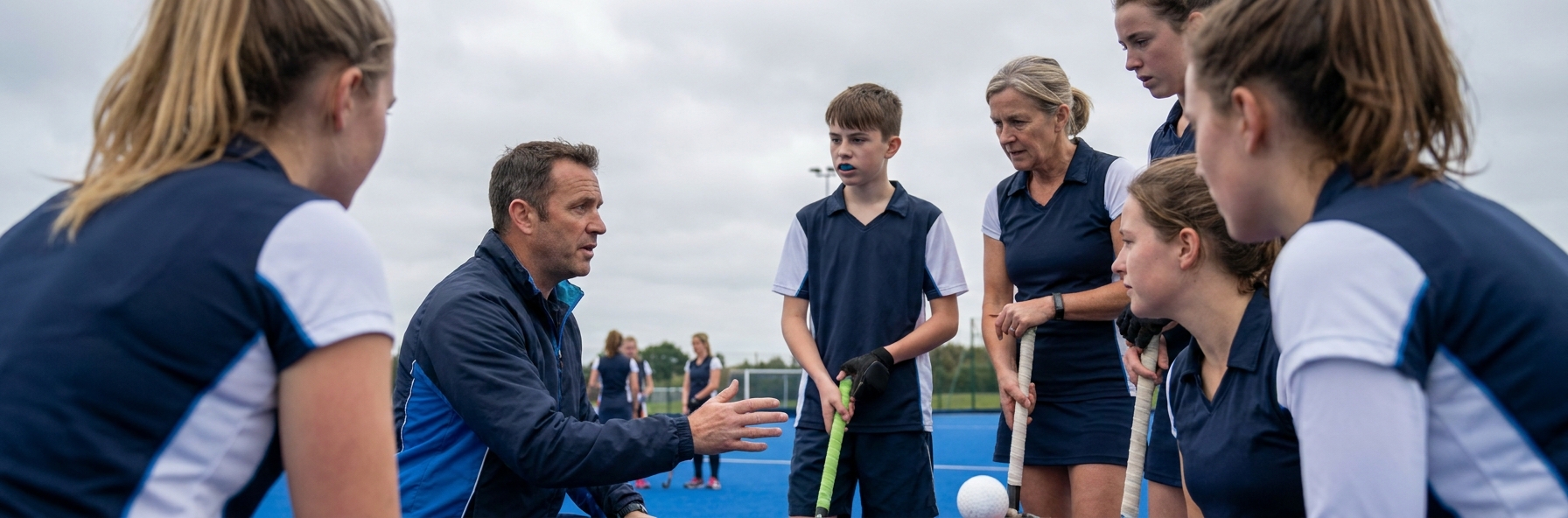
September is when club hockey changes shape. Juniors step up into the lower adult teams, returning players dust off their sticks and new members turn up having not played since school. For a captain or coach, those first few Saturdays are some of the most important of the whole season.

Get it right and you gain players who will be in your first team in three years' time. Get it wrong, and a nervous fifteen-year-old who spent the game chasing shadows quietly stops coming. The difference is rarely about talent. It is about how well the team welcomes them.

What New Players Are Actually Worried About

Most juniors are not worried about skill. They are worried about the pace, the physicality, getting shouted at and letting the team down. New adult players often share the same fears, plus the awkwardness of not knowing anyone.

Safety comes first. Make sure every junior has a mouthguard and shin pads, and that your club's welfare officer and captains know the current England Hockey regulations and club policy on juniors playing adult matches. Once the basics are covered, confidence becomes the thing you are really coaching.

A Five-Step Framework for the First Month

Step One: Give them one clear job. "Play left half" is not a job. "Stay goal-side of their right forward and give the ball to our centre-back when you win it" is. A single, simple responsibility lets a new player contribute without needing to understand the whole system on day one.

Step Two: Pair them with a buddy. Pick an experienced, calm player who plays near them on the pitch. The buddy talks them through restarts, reminds them of their job and is the first voice of encouragement after a mistake.

Step Three: Keep team principles short. Three is plenty: get goal-side when we lose the ball, give an option when we have it, and talk. Adults benefit from this as much as juniors, and it stops mixed-experience teams pulling in different directions.

Step Four: Manage minutes deliberately. Use rolling substitutions to give newcomers short, regular spells rather than one long, exhausting block. Try to bring them on at calmer moments, not in the last five minutes of a tight game while defending a penalty corner.

Step Five: Talk to parents early. A quick message before the first match explaining who the captain is, what position their child might play and how substitutions work removes a lot of anxiety on the sideline. Keep feedback to parents positive and specific.

How to Train It

If your club trains mixed groups midweek, use small-sided games where juniors and adults play together in the same units they will play in on Saturday. A newcomer who has practised tracking back alongside their buddy on Tuesday will do it far more naturally at the weekend.

Build in short positional sessions too. Walk through where a defender or midfielder stands when the ball is in different areas, then play it at half pace before adding full pressure. Understanding where to be is the fastest route to confidence.

Key Coaching Points

  • Check kit, mouthguards and club policy before anything else; safety is not negotiable.
  • Give each new player one specific, achievable job rather than a position name.
  • Buddy them with a calm, experienced teammate who plays nearby on the pitch.
  • Keep team principles to three simple, repeatable ideas everyone can follow.
  • Use short, regular substitution spells and choose calmer moments to bring newcomers on.
  • Praise effort and good decisions loudly, and keep corrections quiet and private.

Recommended Drills
VIEW ALL ROLES AND RESPONSIBILITIES DRILLS

Frequently Asked Questions

Where should I play a junior in their first adult match?

Somewhere with clear reference points and support around them. A wide midfield or wing role with a buddy close by often works well, as the job is easy to explain. Avoid putting a nervous newcomer at centre-back, where one mistake is very visible and very costly.

How do I stop experienced players shouting at newcomers?

Set the standard before the first game. Tell the team that instructions are welcome but criticism is not, and that the captain handles any corrections. If one player keeps doing it, have a quiet word afterwards. The culture of a lower team is set by its senior players.

Should juniors get the same minutes as adults?

Not necessarily the same, but they should get meaningful time every week. Short, regular spells are better than a full game one week and ten minutes the next. Consistency helps them settle, and it shows them they are a real part of the team.
hockey conditioning DRILLS
View All
Unfortunately there were no results for your search! Please try again
hockey conditioning ANSWERS
View All

Does anyone have a link to a few GOOD Hockey Specific fitness tests?

Does anyone have a link to a few GOOD Hockey Specific fitness tests. And I'm not looking for bleep tests which is somewhat out of date. Many thanks

Grant Hunt Coach, United Kingdom

What is a good fitness programme for hockey?

What is a good fitness programme for hockey?

Archived User Coach

Looking for information on 1442 and 11333 systems...

information on 1442 and 11333 systems. I am fairly new to sportplan so hopefully someone can point me in the right direction. I am from Australia so know the GK-2-3-5 set up well. I would like to possibly employ a GK-4-4-2 / GK -1-3-4-2 set up or a GK-1-3-3-3. What I need is information on How players are set up, Forward press set ups, defencive zone set ups and attacking methods. For a bonus it would be great to know how they set up against a GK-2-3-5 as most of our oposition teams play this or a gk-2-3-3-2 Cheers 

Keith Coach, Australia

Player accountability

How can I get my players to be accountable for their skills? During drills, they mistrap balls next to the sideline, bounces over, poor passing etc, and it doesn't seem to bother them. I instigate the team accountability, where the team calls them on it, but no one seems to do it.Any suggestions would be great.Cheers,Brent

Archived User Coach

Good evaluation drills for new team

Hello! We are looking for good drills for our new U14 team evaluation practices. We will have three practices of evaluations before team placements and want to make sure we measure conditioning, stick skills, field sense, shooting, position knowledge, etc. Any drills you may have could you send them my way, I would greatly appreciate it! - Kelly, Maximum Velocity Field Hockey Club Director

Kelly Lacoste Coach, United States of America

Tournament prep -building fitn...

I have just returned from coaching my first high school hockey tournament. It was great fun but the girls really felt it by the end of the tournament. I want to offer guidance in the form of a fitness build up to the girls for next season but am not sure what my expectations should be. How fit should you be looking to get if you are preparing to play 7 50min games over 5 days? And what types of fitness should I be suggesting? Sprinting and Intervals along with Swimming are things I feel that could be introduced. Ideally it needs to be accessable (not expensive or require special equipment), self managed (to an extent) and let it fit in with their daily rountine as best possible to give them the best chance to commit (i.e. I feel like suggesting they power walk to school rather than get dropped off will work better than asking them to join a gym to do the pelaton classes) Any ideas? Or things that have worked in the past?

Archived User Coach

1st ever training Session Stru...

I have been given my first team ever!! They are 11 year old girls and I wanted guide/ recommendation on how I should structure my one hour sessions? E.g. how long should I spend on a warm up, drill etc. .Cheers,Freya

Archived User Coach

tips for training sessions wit...

Hi allI'm running a session on friday night (21 April 2017) and was hoping to move beyond stuff like deflection goals only, to compensate for not having any goalkeepers.Session theme is unfortunately on goalscoring too.Any tips/suggestions?I have some rebound nets (crazy catch), which might actually work brilliantly to simulate saves but any other ideas would be welcomed.Regards,Gary

Gary Thompson Coach, England

teaching presses on free hits ...

Hi allI am looking for advice on how to implement processes in my girls school hockey team. processes of setting up presses, defensive structures and counter attacking thinking. I have 14 players in the team from 15 years old to 18. we train twice a week. only a few play club hockey as well. We either play a 3-1-4-2 or a 3-1-3-3.I find it difficult for example, when you want to teach a press on the opposition 16, to simulate gameplay with only 14 players (if they are all at training). I can have my halves setup for taking the 16 and then get my strikers and links to setup, but then I still want defenders to see things from the back but they are taking the 16? Also when taking the 16 they then don't have any support in the drill because everyone else is setting up a press?I know we need to work on our basics in order for the other tactics and skills and game plans to work. However I find it frustrating with this team that on counter attacks for a few reasons which I am struggling to mend;- they only head forward. No one holds up the ball to wait for support.- they run straight and don't use angles- they pass too late and get tackled - they don't have the vision to see an early pass or pass into space- players without the ball do not run into useful positions and angles and get caught out by the person with the ball who then makes a pass to no one and it runs out of play.So suggestions please for;- open, creative but simple counter attacking- teaching processes for presses on free hits and 16s- coaching how to take 16s and work your way out- coaching vision and expecting your players to be in support. RegardsMatt

Matthew Lydall Coach, South Africa

Training program for mini hock...

Can anyone please help me with a full training program for mini hockey for 6 weeks. The kidz are in Grade 2(8 yrs old), practise 2 a week for 45 min and play league games 1 a week.

NANINE Coach, South Africa

JOIN SPORTPLAN FOR FREE

  • search our library of 1000+ field hockey drills
  • create your own professional coaching plans
  • or access our tried and tested plans

Sportplan App

Give it a try - it's better in the app

YOUR SESSION IS STARTING SOON... Join the growing community of field hockey coaches plus 1000+ drills and pro tools to make coaching easy.
LET'S DO IT