Field Hockey: line to goal

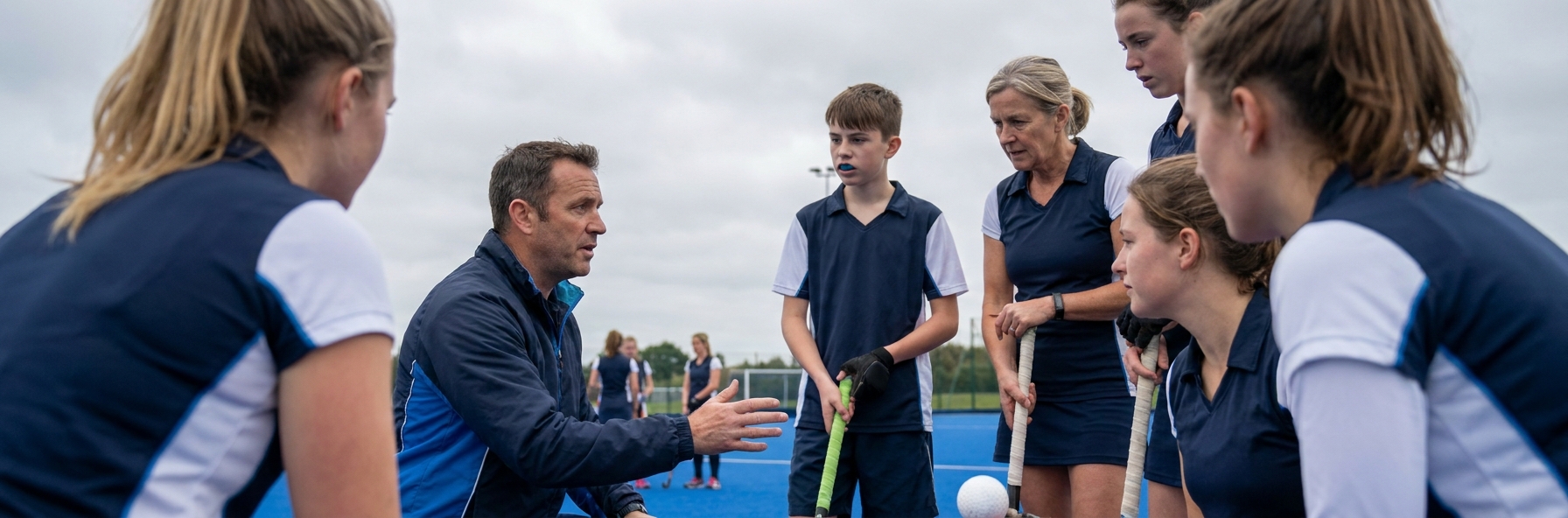
Connection-Based Coaching has emerged as a significant movement in hockey coaching. The core idea is simple but powerful: the relationship between coach and player is the foundation upon which all development is built. Without trust, without genuine connection, coaching effectiveness is limited.

This isn't soft philosophy. Research consistently shows that athletes who feel psychologically safe, who trust their coach, who believe their coach genuinely cares about them, perform better and develop faster.

What is Psychological Safety?

Psychological safety is the belief that you can take risks without being punished or humiliated. In a hockey context, it means players who feel safe to:

  • Try new skills without fear of criticism for failure
  • Ask questions without being made to feel stupid
  • Offer ideas without being dismissed
  • Make mistakes in matches without losing their place
  • Express concerns without negative consequences

When psychological safety exists, players are more creative, more willing to stretch themselves, and more honest about their development needs.

Building Connection

Know Your Players

Do you know what motivates each player? Their life outside hockey? Their hopes and concerns? Connection requires knowledge, and knowledge requires investment in getting to know people.

This doesn't mean becoming best friends. It means showing genuine interest, remembering what players tell you, and demonstrating that you see them as people, not just performers.

Listen More Than You Speak

Many coaches do too much telling. Connection-based coaching emphasises listening. When players speak, give them full attention. Ask follow-up questions. Reflect back what you've heard to show understanding.

Listening builds trust because it demonstrates respect. When players feel heard, they're more receptive to coaching.

Consistency and Reliability

Trust is built through consistent behaviour over time. If you say you'll do something, do it. If you have standards, apply them equally to everyone. Inconsistency destroys trust faster than almost anything else.

Appropriate Vulnerability

Coaches who admit mistakes, acknowledge what they don't know, and share their own development journey build stronger connections than those who project infallibility. Appropriate vulnerability models the openness you want from players.

Connection in Practice

Individual Check-Ins

Brief one-to-one conversations build connection over time. Not always about hockey - sometimes just "How are you?" delivered with genuine interest. These small interactions accumulate into strong relationships.

Personalised Feedback

Generic feedback shows you're not paying attention. Specific, personalised feedback shows you see the individual. "Good work" is less powerful than "I noticed you recovered really quickly after that turnover - that's the response we need."

Celebrating Progress

Connection-based coaches celebrate development, not just outcomes. The player who improves from poor to average has achieved as much as the player who was always excellent. Recognition should reflect effort and progress.

Managing Difficult Conversations

Strong connections make difficult conversations possible. When players trust you, they can hear hard truths. When they don't, the same truths are rejected as unfair criticism. Build the connection first; the honest feedback can follow.

Team-Level Application

Connection isn't just coach-to-player. Teams with strong player-to-player connections perform better. The coach's role includes creating conditions for these connections:

  • Team-building activities that build genuine relationships
  • Training structures that encourage collaboration
  • Addressing behaviours that damage team connection
  • Celebrating collective achievements

Common Barriers

"I don't have time": Connection doesn't require separate time - it's embedded in how you do everything. A two-minute conversation while setting up equipment still counts.

"It's soft": The evidence says otherwise. High-performance environments increasingly recognise that connection underpins performance, not detracts from it.

"Not all players want it": Different players need different levels and types of connection. Read what each individual needs and adjust accordingly.

Key Coaching Points

  • Psychological safety enables risk-taking and growth
  • Know your players as people, not just performers
  • Listen more, tell less
  • Be consistent and reliable
  • Personalise your interactions and feedback
  • Create conditions for player-to-player connection

Drills That Build Team Connection

VIEW ALL SMALL-SIDED GAMES

JOIN SPORTPLAN FOR FREE

  • search our library of 1000+ field hockey drills
  • create your own professional coaching plans
  • or access our tried and tested plans
line to goal DRILLS
View All
Unfortunately there were no results for your search! Please try again
line to goal ANSWERS
View All

What's the best way to explain the roles and responsibilities?

What's the best way to explain the roles and responsibilities of what an inner does to a 12 year old

Tracey Coach, Australia

Converting turn over ball into successfull attack

I am coaching an u16A team and recently got them using a 3/4 press which is working well to turn over ball. however their counter attack from this situation is poor - does anyone know any drills or game situation drills to improve on this. thanks

Archived User Coach

what is the best way for a half yo get fit

what is the best way for a half to get fit?

Archived User Coach

My team are constantly allowing oppositions to score?

My team are constantly allowing oppositions to score from penalty corners we do 1st runner 2nd runner amp; 2 players on the post, what can I do.

Leanne Johnston Coach, Ireland

What are the rules for a penalty corner pusher or injector?

What is the rules for a penalty corner pusher or injector? Must have one leg in or u can have both leg out to use a sweep?

Dahlia Borhan Coach, Singapore

overloading in the circle?

how do you stop your team over crowding in the circle? what drills or game situations could i use at training?

Archived User Coach

Good drill to get girls to move to the ball faster?

I need a good drill to help the girls move to the ball faster? we arw slow to the ball need a drill thanks

Brenda Strohmer Coach, United States of America

Body position & defending

Hi - I need suggestions for training on Monday. Varsity high school girls, playing on grass. Last couple of games tackling, especially body position, has been weak. Anyone got any great drills? The girls know it's gonna be a hard session..! Thx

Mike Baker Coach, United States of America

I'm a new Varsity head coach and don't know what I'm doing

Hi all- I am 37 years old. I played field hockey for 3 years only (in high school). As you can imagine, I'm not very good/experienced. I was a competitive soccer player which made me good enough athletically to play field hockey but anyway, the point is: I never played field hockey at a high level.I now find myself in a head coaching position. (Long story-I did coach some field hockey some years ago and had a blast but it was a while back). Anyway, I have three assistant coaches who aren't much more experienced than I am. Our high school program is VERY weak and so nobody really steps up to coach there.Basically, my question is: what do I do? I have some girls who have played but not much. Then I have girls who literally don't know how to hold their stick and are quite I athletic. We barely have enough girls to field a team. As for drills, I'm trying to use this site but if you were in my position, what specifically would you be doing with these girls so they don't lose 7-0 every game? Right now, I'm focusing on body control and comfort with the ball- (we are playing possession and they are so uncomfortable they just hit the ball away because they don't have the skills to hold). Any help you can give is greatly appreciated!Brooke Asked using Sportplan Mobile App

Archived User Coach

How do i get the right timing for a Jab

How do I get the right timing for a jab im trying to step up my defensive skills and i just cant get the right timing and technique for it Asked using Sportplan Mobile App

Archived User Coach

Base line defence - How to prevent teams scoring?

Baseline defence: How to prevent teams from Scoring goals from the left and Right baseline.Do I tell my left and Right half to channel player outwards ,protect feet,frontal pressure and allow other defenders to tuck infield.Or do I opt to tell defenders to go man to man inside 23 and then apply frontal pressure ,channel player outwards ,watch angle of engagment.As recently we only conceded through attack on our baseline

Jason Adams Coach, South Africa

Midfield Counterattack Control

How does a midfielder control a counterattack in hockey?

Coach, Kenya

How do you hit a reverse stick shot/pass?

In field hockey, how do you hit a tomahawk flat and accurately?

sarah taylor Coach, Northern Ireland

7-a-side Formation suggestions for u-18 league

Hi all,I would like to ask what is the best formation to play a 7-a-side match(under-18) when u have strong defence(key player in defence) but unexperienced midfield. I had in mind 3-2-1 while defending and 2-3-1 while attacking. Any suggestions please?

Alessandro Amore Coach, Malta

direct shots on corners

how can I help my goalkeeper to stop a direct shot froma corner hit

karen judge Coach, United States of America

Defence

how to play defending 3V2

Lakhindra Pahan Coach, United Kingdom

I'm a new Varsity head coach a...

Hi all- I am 37 years old. I played field hockey for 3 years only (in high school). As you can imagine, I'm not very good/experienced. I was a competitive soccer player which made me good enough athletically to play field hockey but anyway, the point is: I never played field hockey at a high level.I now find myself in a head coaching position. (Long story-I did coach some field hockey some years ago and had a blast but it was a while back). Anyway, I have three assistant coaches who aren't much more experienced than I am. Our high school program is VERY weak and so nobody really steps up to coach there.Basically, my question is: what do I do? I have some girls who have played but not much. Then I have girls who literally don't know how to hold their stick and are quite I athletic. We barely have enough girls to field a team. As for drills, I'm trying to use this site but if you were in my position, what specifically would you be doing with these girls so they don't lose 7-0 every game? Right now, I'm focusing on body control and comfort with the ball- (we are playing possession and they are so uncomfortable they just hit the ball away because they don't have the skills to hold). Any help you can give is greatly appreciated!Brooke Asked using Sportplan Mobile App
Archived User Coach

Base line defence - How to pre...

Baseline defence: How to prevent teams from Scoring goals from the left and Right baseline.Do I tell my left and Right half to channel player outwards ,protect feet,frontal pressure and allow other defenders to tuck infield.Or do I opt to tell defenders to go man to man inside 23 and then apply frontal pressure ,channel player outwards ,watch angle of engagment.As recently we only conceded through attack on our baseline

Jason Adams Coach, South Africa

JOIN SPORTPLAN FOR FREE

  • search our library of 1000+ field hockey drills
  • create your own professional coaching plans
  • or access our tried and tested plans

Sportplan App

Give it a try - it's better in the app

YOUR SESSION IS STARTING SOON... Join the growing community of field hockey coaches plus 1000+ drills and pro tools to make coaching easy.
LET'S DO IT