Field Hockey: match play

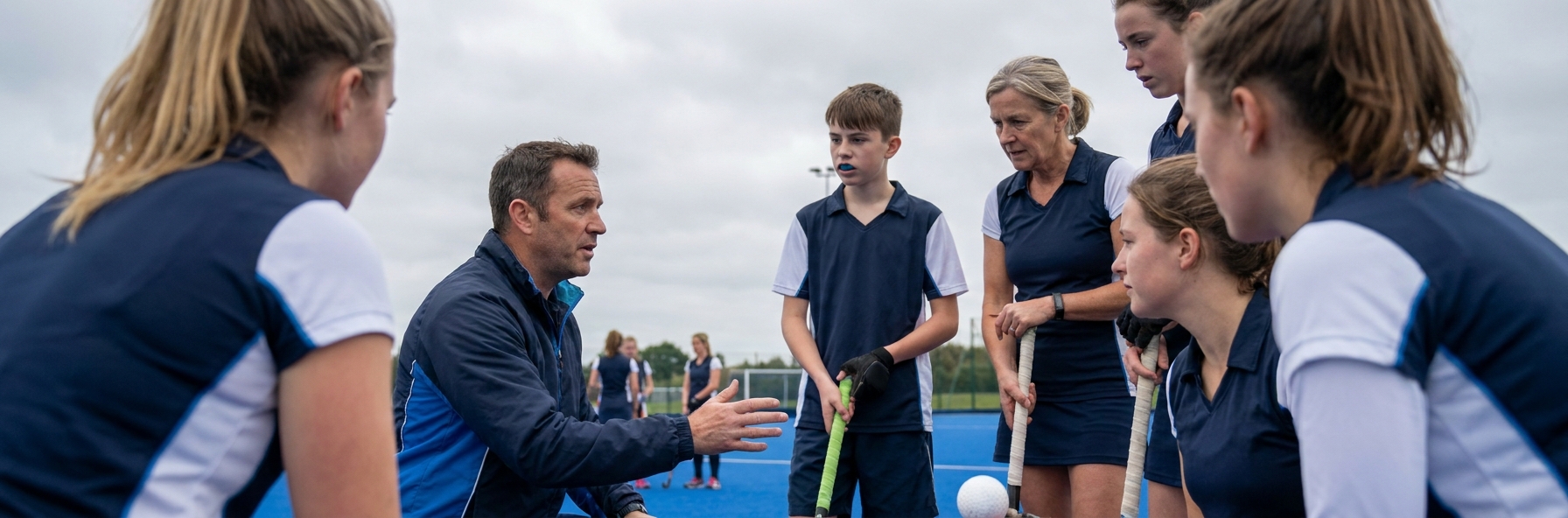
Connection-Based Coaching has emerged as a significant movement in hockey coaching. The core idea is simple but powerful: the relationship between coach and player is the foundation upon which all development is built. Without trust, without genuine connection, coaching effectiveness is limited.

This isn't soft philosophy. Research consistently shows that athletes who feel psychologically safe, who trust their coach, who believe their coach genuinely cares about them, perform better and develop faster.

What is Psychological Safety?

Psychological safety is the belief that you can take risks without being punished or humiliated. In a hockey context, it means players who feel safe to:

  • Try new skills without fear of criticism for failure
  • Ask questions without being made to feel stupid
  • Offer ideas without being dismissed
  • Make mistakes in matches without losing their place
  • Express concerns without negative consequences

When psychological safety exists, players are more creative, more willing to stretch themselves, and more honest about their development needs.

Building Connection

Know Your Players

Do you know what motivates each player? Their life outside hockey? Their hopes and concerns? Connection requires knowledge, and knowledge requires investment in getting to know people.

This doesn't mean becoming best friends. It means showing genuine interest, remembering what players tell you, and demonstrating that you see them as people, not just performers.

Listen More Than You Speak

Many coaches do too much telling. Connection-based coaching emphasises listening. When players speak, give them full attention. Ask follow-up questions. Reflect back what you've heard to show understanding.

Listening builds trust because it demonstrates respect. When players feel heard, they're more receptive to coaching.

Consistency and Reliability

Trust is built through consistent behaviour over time. If you say you'll do something, do it. If you have standards, apply them equally to everyone. Inconsistency destroys trust faster than almost anything else.

Appropriate Vulnerability

Coaches who admit mistakes, acknowledge what they don't know, and share their own development journey build stronger connections than those who project infallibility. Appropriate vulnerability models the openness you want from players.

Connection in Practice

Individual Check-Ins

Brief one-to-one conversations build connection over time. Not always about hockey - sometimes just "How are you?" delivered with genuine interest. These small interactions accumulate into strong relationships.

Personalised Feedback

Generic feedback shows you're not paying attention. Specific, personalised feedback shows you see the individual. "Good work" is less powerful than "I noticed you recovered really quickly after that turnover - that's the response we need."

Celebrating Progress

Connection-based coaches celebrate development, not just outcomes. The player who improves from poor to average has achieved as much as the player who was always excellent. Recognition should reflect effort and progress.

Managing Difficult Conversations

Strong connections make difficult conversations possible. When players trust you, they can hear hard truths. When they don't, the same truths are rejected as unfair criticism. Build the connection first; the honest feedback can follow.

Team-Level Application

Connection isn't just coach-to-player. Teams with strong player-to-player connections perform better. The coach's role includes creating conditions for these connections:

  • Team-building activities that build genuine relationships
  • Training structures that encourage collaboration
  • Addressing behaviours that damage team connection
  • Celebrating collective achievements

Common Barriers

"I don't have time": Connection doesn't require separate time - it's embedded in how you do everything. A two-minute conversation while setting up equipment still counts.

"It's soft": The evidence says otherwise. High-performance environments increasingly recognise that connection underpins performance, not detracts from it.

"Not all players want it": Different players need different levels and types of connection. Read what each individual needs and adjust accordingly.

Key Coaching Points

  • Psychological safety enables risk-taking and growth
  • Know your players as people, not just performers
  • Listen more, tell less
  • Be consistent and reliable
  • Personalise your interactions and feedback
  • Create conditions for player-to-player connection

Drills That Build Team Connection

VIEW ALL SMALL-SIDED GAMES

JOIN SPORTPLAN FOR FREE

  • search our library of 1000+ hockey drills
  • create your own professional coaching plans
  • or access our tried and tested plans
match play DRILLS
View All
Unfortunately there were no results for your search! Please try again
match play ANSWERS
View All

Can you give me your ideas of a one test only assessment to split a large mixed ability group of players (20 to 60) into the right ability groups in less than 2 hours?

Here is one example I use.I put out this slalom as the test whenever confronted with a large group of mixed ability players that need to be put into equal ability groups to play a game or to be coached. The slalom incorporates lots of the aspects of the techniques required by the individual players to play the game of hockey. I.e. running with the ball, fast and controlled, changing direction with the ball pivoting, stopping the ball etc.I normally set up 2 - 4 identical slaloms, see attachment, and have 4 coaches or helpers with a stopwatch (mobile phones are great for this).To record the score I normally put a label on the stick of each player so they can write down their time. Once all players have recorded a time, ask the players to stand in time order on the sideline. Once the players are in order you can put the 10 fastest times to play a 5 aside game across 23 meter area and the next 10 in the next 23 meter area and so on up to 40 players playing on one full pitch. The last few changes you might now need to make are the players that perform better or weaker on any particular pitch (should not be to many).

Bram van Asselt Coach, England

I am the Skipper of an under-achieving 2XI.

I am the Skipper of an under-achieving 2XI. Individually most of my players could play 1XI but opted for an easier life lower down the Club. I struggle to get them to training on-mass and so I'm limited to pre-match warm ups to get them all together. We tend to do well against strong oppo but take far too long to get going against weaker teams. Any suggestions to help us start with the correct momentum?

Archived User Coach

Games to encourage more passing

I coach an under 14 team and some of the players tend to dribble more often then pass (which is somewhat normal at that age). Anybody could suggest any training/ conditioned games where I could encourage more passing?

Archived User Coach

does anyone have a rota programme for substitutes during the game based on pitch time with squads upto 16?

would like to set up a rota programme for subs with a squad of 16 so everyone gets pitch time and maximise fitness

Martyn Webb Coach, England

Best method to teach junior aside players positions and responsibilities?

What are the best methods to teach Junior 8 aside hockey players their positional roles and responsibilities?

Archived User Coach

Question about playing 3-3-3-1

Can you please assist me, I am coaching the 1st school team (0/18). we are playing 3-3-3-1 but there is a big gap between the forwards and links and also between the links and the backs. How can I change that. Is there any excercises that I can do with them or must we rather change the system??

Mariana Lotz Coach, South Africa

Looking for a 6-a good side hockey formation?

I am looking for 6 a side hockey formations. We have been playing 3-1-1-1. Worked very well, however sweeper was so good, goalie never touched the ball. I want to move sweeper to goalie/ sweeper but our mid field player is too good to just play right. What to do? 2-2-1-1 or 1-3-1-1?     

Archived User Coach

How to encourage positional play (spreading out) to U9 players?

How do you encourage positional play and spreading out on hockey field U9 girls level?

Archived User Coach

Preparing plan for an assessment?

need some help with preparing a lesson plan for an assessment

Archived User Coach

How do I motivate my Hockey Players! HELP

I have recently taken on the role involving coaching junior hockey players (aged 10-13) who mostly have never played hockey before, and are very uninterested. Their basics are not good enough to play some games. How do I motivate them, and what kind of things shall I do in my session?

Tom Manley Coach, England

drills for backpassing

Have a team of older group of ladies who need to learn to pass the ball back, any good drills for this?

trudy adamson Coach, New Zealand

How do you teach children aged 7 how to play a hockey match?

I coach aged 7 children and I don't know how to teach them how to play a proper hockey match without all of them going for the ball and not staying in their positions. Do I put lines where they are not allowed to pass? or what?

Bev Coach, South Africa

URGENT!!! Hockey coaching plan needed for A level PE

I am doing A level PE and I need to find a coaching plan that includes a number of drills that get progressively harder. The plan has to be game based, I was thinking of doing one on possession but I cannot find drills that link together and get harder. Please help, Thanks

Erin Parry Coach, Wales

How to coach school team with novices and experienced players?

Hi,I perhaps naively, expected to have most of our team from last year carry over and only have a few new comers to integrate and get up to speed with the rest. However meeting the team at our first practice last night i find I have five players still at school from last year and the rest all new comers, most of whom had not held a hockey stick at all till practice.This being only my second season coaching (year 9 to year 13 boys) has left me feeling a little blindsided, and feeling quite unsure how to prepare practices that target both groups of boys. Do i lump them both groups together, keep them separate? What drills/exercises to best bring the new comers up to speed.I don't want to neglect either group, keep practice worthwhile for the experienced boys, but also bringing the new comers up to a level were they can mix in with the others and learn organically from them while practicing as a team. David

David Smith Coach, New Zealand

Match Videos for training

I find it impossible to find recent full match videos to show to my youngsters especially on those frosty mornings when training is cancelled. I have tried FIH and England Hockey who frankly are woeful at providing coaching support. Can anybody help me source recent full matches. Thanks Mark

mark beard Coach, England

7-a-side Formation suggestions for u-18 league

Hi all,I would like to ask what is the best formation to play a 7-a-side match(under-18) when u have strong defence(key player in defence) but unexperienced midfield. I had in mind 3-2-1 while defending and 2-3-1 while attacking. Any suggestions please?

Alessandro Amore Coach, Malta

How do you teach children aged...

I coach aged 7 children and I don't know how to teach them how to play a proper hockey match without all of them going for the ball and not staying in their positions. Do I put lines where they are not allowed to pass? or what?

Bev Coach, South Africa

How to coach school team with ...

Hi,I perhaps naively, expected to have most of our team from last year carry over and only have a few new comers to integrate and get up to speed with the rest. However meeting the team at our first practice last night i find I have five players still at school from last year and the rest all new comers, most of whom had not held a hockey stick at all till practice.This being only my second season coaching (year 9 to year 13 boys) has left me feeling a little blindsided, and feeling quite unsure how to prepare practices that target both groups of boys. Do i lump them both groups together, keep them separate? What drills/exercises to best bring the new comers up to speed.I don't want to neglect either group, keep practice worthwhile for the experienced boys, but also bringing the new comers up to a level were they can mix in with the others and learn organically from them while practicing as a team. David

David Smith Coach, New Zealand

My u/15 girls can't play as a ...

I really have a big problem with my u/15 girls.  They just can't play as a team. Any advice please. There's always a fight between someone. Mariette

Archived User Coach

Receiving the ball forward fac...

Anybody any ideas on a conditioned game to encourage receiving the ball in a forward facing position?

Mark Stuart-Thompson Coach, England

JOIN SPORTPLAN FOR FREE

  • search our library of 1000+ hockey drills
  • create your own professional coaching plans
  • or access our tried and tested plans

Sportplan App

Give it a try - it's better in the app

YOUR SESSION IS STARTING SOON... Join the worlds largest hockey coaching resource for 1000+ drills and pro tools to make coaching easy.
LET'S DO IT