Field Hockey: mixed ability

England Hockey's "25 in 2025" initiative has been touring the country, bringing two-hour on-pitch workshops to 25 locations. The focus: practical practice ideas that coaches can take straight back to their clubs. Here's a summary of the key concepts being shared.

The Philosophy

The workshops are designed for everyone involved in delivering hockey, from experienced coaches to volunteers just starting out. The emphasis is on fun, engaging sessions that keep players coming back - because player retention depends on the quality of the experience we create.

Each workshop covers arrival activities, carrying and passing progressions, and game-based learning. Participants leave with a bank of ideas they can implement immediately.

Arrival Activities That Work

The first few minutes of any session set the tone. Arrival activities should be:

Self-managing: Players can start without detailed instruction. This lets the coach focus on organisation while early arrivals get active.

Engaging: Not just standing in lines. Movement, decision-making, maybe a competitive element.

Scalable: Works with 2 players or 20. As more arrive, they join seamlessly.

Examples include: grid-based possession games where players can join any team, skill stations with clear visual instructions, and small-sided games that expand as numbers grow.

Carrying and Moving with Purpose

A significant portion of the workshops focuses on ball carrying. The key insight: carrying isn't just about technique, it's about purpose. Why are you carrying? Where are you taking the ball? What's your next action?

Practices progress from technique-focused (head up, ball position, change of pace) to decision-focused (when to carry vs pass, reading space, timing runs with teammates).

The workshops emphasise "game-realistic" carrying - not just running through cones, but carrying with pressure, carrying to eliminate, carrying to create passing angles.

Passing as Communication

The workshops reframe passing as communication between players. A good pass says "here's where I want you to receive." A great pass also says "here's what I want you to do next."

Practices focus on:

  • Weight of pass - firm enough to arrive quickly, soft enough to control
  • Timing - not too early (intercepted), not too late (receiver can't use it)
  • Receiver's next action - passing to the correct foot/side for what follows

Games-Based Learning

Perhaps the biggest takeaway from the workshops is the shift toward games-based learning. Instead of isolated drills, players learn through modified games that naturally develop the required skills.

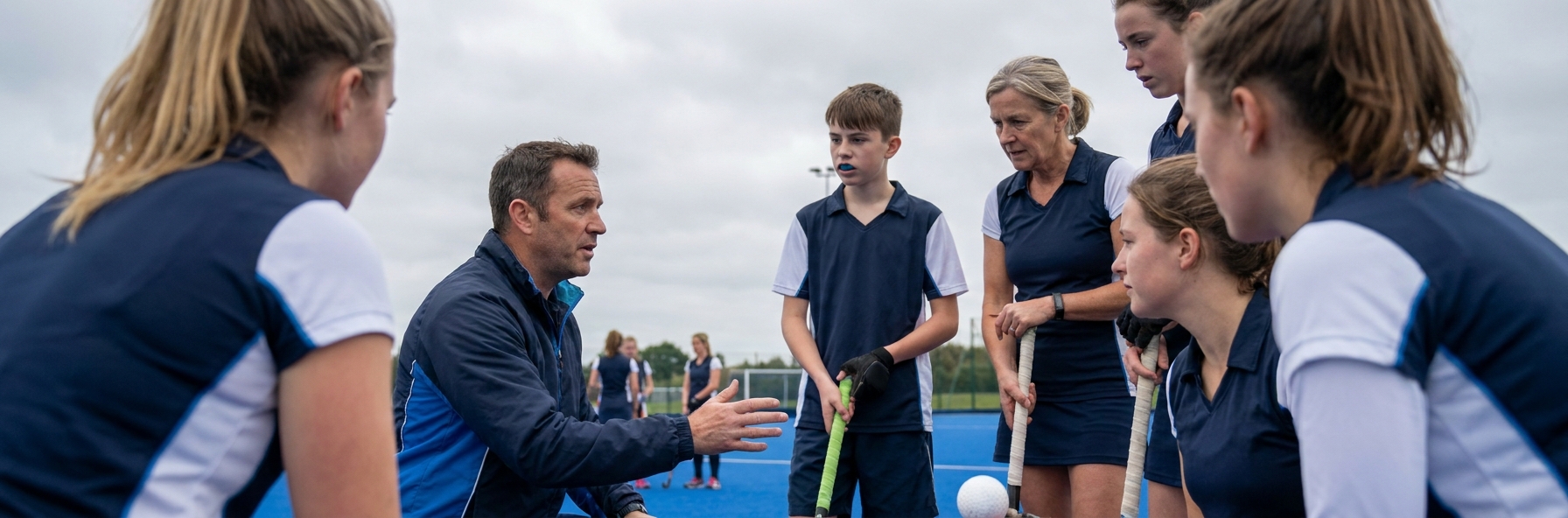
The coach's role becomes designing games that create the learning outcomes, then facilitating rather than instructing. Questions replace commands: "What did you notice there?" "Why did that work?" "What could you try differently?"

This approach develops players who can problem-solve, adapt, and transfer learning to match situations.

Making Sessions Engaging

The workshops share specific techniques for keeping energy high:

Quick transitions: Minimise time between activities. Have the next game ready before the current one finishes.

Appropriate challenge: Too easy is boring, too hard is frustrating. Find the "just right" level for your group.

Variety within structure: Keep the same game framework but change small elements - scoring methods, playing areas, team compositions.

Player voice: Give players choices. "Do you want to play again or try something new?" This builds ownership.

Video Support

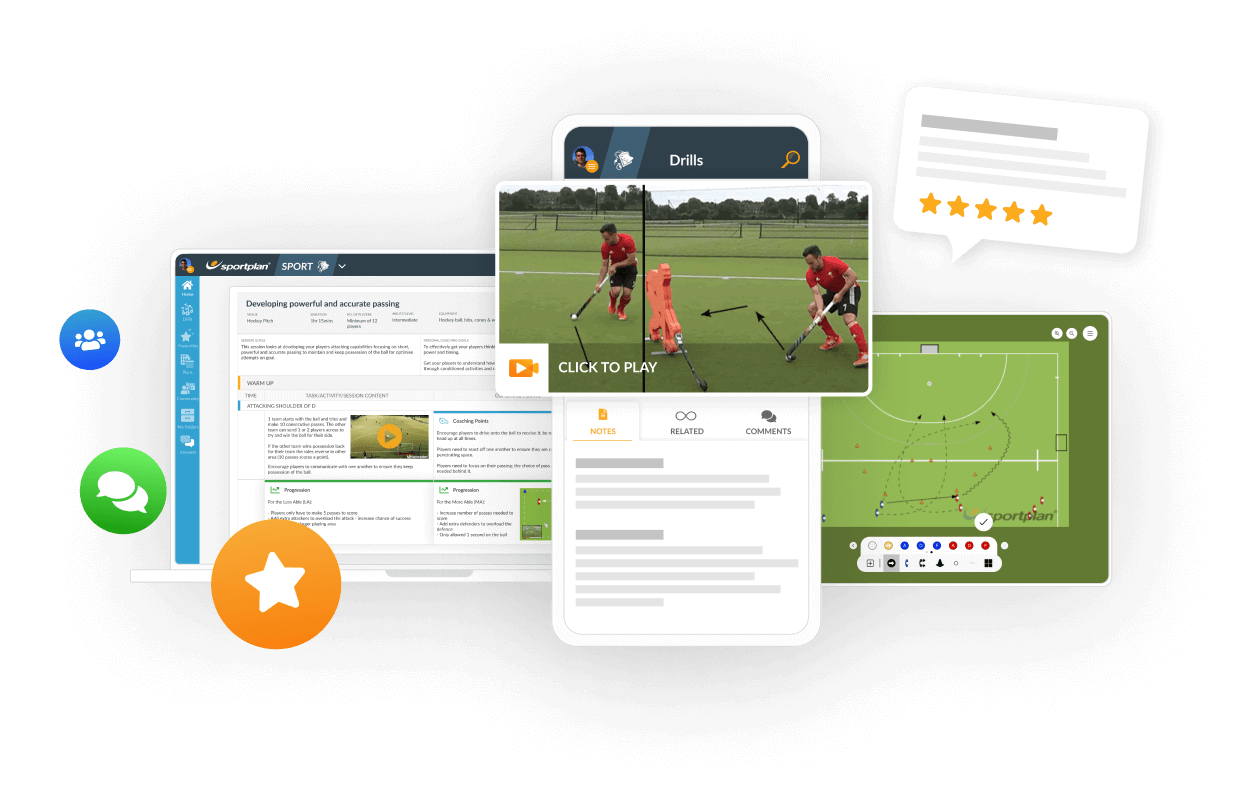
All workshop practices are available on YouTube, allowing coaches to revisit and refine after attending. This resource bank is growing as the roadshow continues.

Who Should Attend?

The workshops are pitched at all levels. Experienced coaches report learning new ideas and getting reinforcement of good practice. New coaches gain confidence and practical tools. The shared experience of learning together builds community within the sport.

If a workshop is coming to your area, it's worth attending. The time investment is small; the return in practical ideas is significant.

Key Coaching Points

  • Arrival activities set the tone - make them engaging
  • Carrying with purpose, not just technique
  • Passing is communication between players
  • Games-based learning develops problem-solvers
  • Keep sessions varied and appropriately challenging

Drills to Build Your Practice Bank

VIEW ALL WARM-UP DRILLS

JOIN SPORTPLAN FOR FREE

  • search our library of 1000+ field hockey drills
  • create your own professional coaching plans
  • or access our tried and tested plans
Unfortunately there were no results for your search! Please try again
mixed ability ANSWERS
View All

Can you give me your ideas of a one test only assessment to split a large mixed ability group of players (20 to 60) into the right ability groups in less than 2 hours?

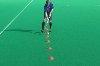
Here is one example I use.I put out this slalom as the test whenever confronted with a large group of mixed ability players that need to be put into equal ability groups to play a game or to be coached. The slalom incorporates lots of the aspects of the techniques required by the individual players to play the game of hockey. I.e. running with the ball, fast and controlled, changing direction with the ball pivoting, stopping the ball etc.I normally set up 2 - 4 identical slaloms, see attachment, and have 4 coaches or helpers with a stopwatch (mobile phones are great for this).To record the score I normally put a label on the stick of each player so they can write down their time. Once all players have recorded a time, ask the players to stand in time order on the sideline. Once the players are in order you can put the 10 fastest times to play a 5 aside game across 23 meter area and the next 10 in the next 23 meter area and so on up to 40 players playing on one full pitch. The last few changes you might now need to make are the players that perform better or weaker on any particular pitch (should not be to many).

Bram van Asselt Coach, England

I have an assessment and the task is "Working?

I have an assessment and the task is "Working the ball out of the back left hand corner of defence" - I have a mixed ability group of male and female players including a goalkeeper and have to train them for a one hour session including warm up skills sessions and game related play including progression. Does anyone have any ideas? At presnt I am thinking about focusing on positional play and perhaps doing a bit on possessional play/posting up before the game play situation...any thoughts?

Archived User Coach

Mixed ability school children and practice matches.

Hello Everyone! I coach at many schools and a reoccouring problem is that there are always 2/3 players that are too good for the rest of the team. I can't keep giving special conditions to the these children to make it fair (E.g. they have to play in defence) or they will feel I am picking on them. Any ideas? Robert

Archived User Coach

Mixed ability PE group - any suggestions?

I'm really struggling with teaching a really big mixed ability group at school. 35 girls ranging from county level to struggling to hold the stick correctly. i've done mixed ability tournaments and splitting them, but its getting a bit stale. any ideas? Pretty basic I know, but hey, we've got to start somewhere!

Jennifer theeditor Coach, United Kingdom

Where can I find the Junior 10 week hockey programme?

In one of your weekly email, Sportplan advertised a Junior 10 week Hockey Session Plan, is this still available and if so,  where can I download this from please?? I need the plan to suit various skill levels of players as we've got a mixed ability of players to coach in the session.

Greg Cunningham Coach, England

Best way to train 30 girls ahead of trials and get everyone involved?

Training 30 Girls as a group before trials. What drills are best to get everyone involved. Take into account ages between 14 and 17.

Glenn Hutchinson Coach, Australia

Any ideas for a mixed ability warm up drill?

I help coach around 30 players, they are of completely differing abilities and ages. For a while I have been using the same first drill/warm up of getting into groups of 4/5 players and having cones in a line in front of them which they have to use different methods of getting the ball to and then passing back to the rest of the team from the 1st cone, then next time from the 2nd cone (and so on) I find this works ok but would like a new/more fun way to get them ready after our run and dynamic stretches. Any help/suggestions gratefully received.

Archived User Coach

Level 2 Practical Assessment - Help needed!

Hi all,I've got my level 2 assessment coming up on Sunday and I just wanted to quickly check whether there's a 'recommended' structure to the session plan.Btw, this is a level 2 practical assessment and is with juniors (U14s).One coach has suggested a 3 part approach:1) techniques and skills required2) unopposed 3) opposedThe theme I'm choosing, which is a bit of a generic one, is defending in a channel (as I'm a defender and it's pretty straight forward).I'm not really looking for info on what exactly to include (i.e. theme specific) but rather general structure or whether E.H. have an approved structure to sessions?My session's on Sunday, so a quick reply would be awesome.Thanks,Gary

Gary Thompson Coach, England

Receiving the ball forward facing

Anybody any ideas on a conditioned game to encourage receiving the ball in a forward facing position?

Mark Stuart-Thompson Coach, England

Attacking Mindset | Sportplan

Hi,I coach a university team that has a group of mixed abilities, ranging good players with some previous hockey experience to some who are starting from the basics. We've managed to polish on basics and now the team is able to play together. They move the ball well around the pitch using the wider areas, good defence and tackles, but the big problem is creating scoring opportunities. Without goals we can't win matches... The best is draws which we get most times. I was wondering if anyone could share a small sided game or drill that could help create the attack mindset so my team can have that hunger for goas and go for it.

Ian Smith Coach, Kenya

Where can I find the Junior 10...

In one of your weekly email, Sportplan advertised a Junior 10 week Hockey Session Plan, is this still available and if so,  where can I download this from please?? I need the plan to suit various skill levels of players as we've got a mixed ability of players to coach in the session.

Greg Cunningham Coach, England

Receiving the ball forward fac...

Anybody any ideas on a conditioned game to encourage receiving the ball in a forward facing position?

Mark Stuart-Thompson Coach, England

How do I arrange substitutes f...

Who can help me to develop a tool to manage the substitutional players during a match? I manage a team of 15 girls of 12-14 years old with different levels of hockey experience. To arrange the substitutes is quite complicated and I am searching for a helpful tool.

Archived User Coach

1st ever training Session Stru...

I have been given my first team ever!! They are 11 year old girls and I wanted guide/ recommendation on how I should structure my one hour sessions? E.g. how long should I spend on a warm up, drill etc. .Cheers,Freya

Archived User Coach

JOIN SPORTPLAN FOR FREE

  • search our library of 1000+ field hockey drills
  • create your own professional coaching plans
  • or access our tried and tested plans

Sportplan App

Give it a try - it's better in the app

YOUR SESSION IS STARTING SOON... Join the growing community of field hockey coaches plus 1000+ drills and pro tools to make coaching easy.
LET'S DO IT