Field Hockey: open side

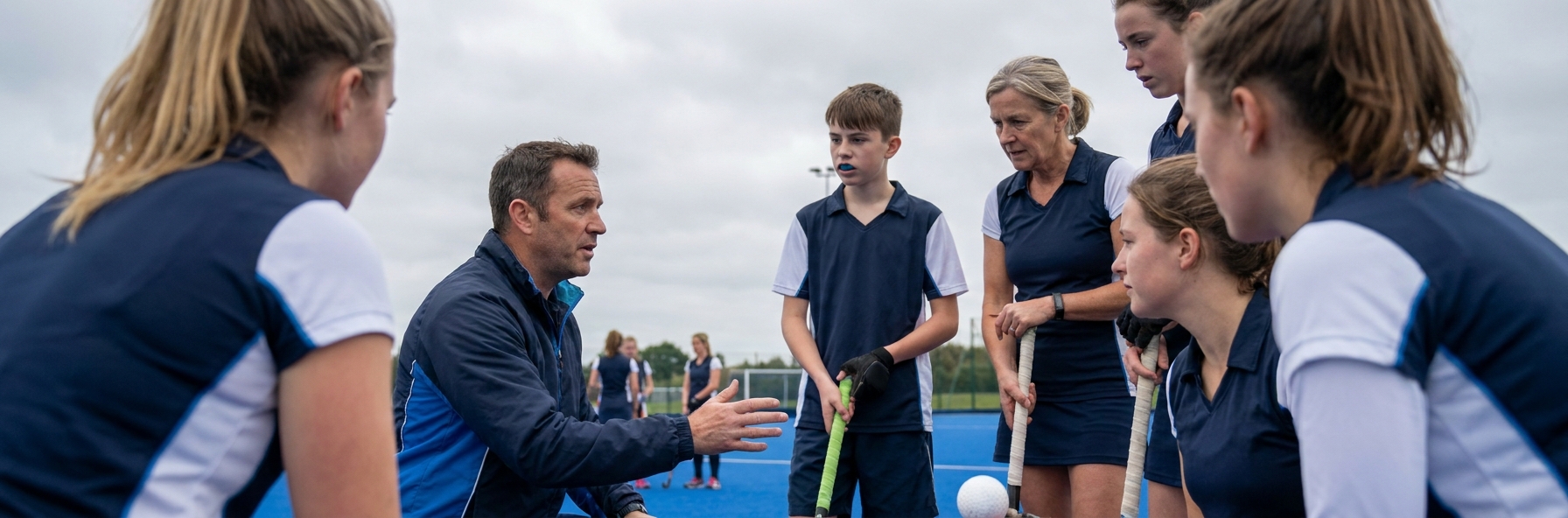
Connection-Based Coaching has emerged as a significant movement in hockey coaching. The core idea is simple but powerful: the relationship between coach and player is the foundation upon which all development is built. Without trust, without genuine connection, coaching effectiveness is limited.
This isn't soft philosophy. Research consistently shows that athletes who feel psychologically safe, who trust their coach, who believe their coach genuinely cares about them, perform better and develop faster.

What is Psychological Safety?

Psychological safety is the belief that you can take risks without being punished or humiliated. In a hockey context, it means players who feel safe to:
  • Try new skills without fear of criticism for failure
  • Ask questions without being made to feel stupid
  • Offer ideas without being dismissed
  • Make mistakes in matches without losing their place
  • Express concerns without negative consequences

When psychological safety exists, players are more creative, more willing to stretch themselves, and more honest about their development needs.

Building Connection

Know Your Players

Do you know what motivates each player? Their life outside hockey? Their hopes and concerns? Connection requires knowledge, and knowledge requires investment in getting to know people.

This doesn't mean becoming best friends. It means showing genuine interest, remembering what players tell you, and demonstrating that you see them as people, not just performers.

Listen More Than You Speak

Many coaches do too much telling. Connection-based coaching emphasises listening. When players speak, give them full attention. Ask follow-up questions. Reflect back what you've heard to show understanding.

Listening builds trust because it demonstrates respect. When players feel heard, they're more receptive to coaching.

Consistency and Reliability

Trust is built through consistent behaviour over time. If you say you'll do something, do it. If you have standards, apply them equally to everyone. Inconsistency destroys trust faster than almost anything else.

Appropriate Vulnerability

Coaches who admit mistakes, acknowledge what they don't know, and share their own development journey build stronger connections than those who project infallibility. Appropriate vulnerability models the openness you want from players.

Connection in Practice

Individual Check-Ins

Brief one-to-one conversations build connection over time. Not always about hockey - sometimes just "How are you?" delivered with genuine interest. These small interactions accumulate into strong relationships.
Personalised Feedback

Generic feedback shows you're not paying attention. Specific, personalised feedback shows you see the individual. "Good work" is less powerful than "I noticed you recovered really quickly after that turnover - that's the response we need."

Celebrating Progress

Connection-based coaches celebrate development, not just outcomes. The player who improves from poor to average has achieved as much as the player who was always excellent. Recognition should reflect effort and progress.

Managing Difficult Conversations

Strong connections make difficult conversations possible. When players trust you, they can hear hard truths. When they don't, the same truths are rejected as unfair criticism. Build the connection first; the honest feedback can follow.

Team-Level Application

Connection isn't just coach-to-player. Teams with strong player-to-player connections perform better. The coach's role includes creating conditions for these connections:

  • Team-building activities that build genuine relationships
  • Training structures that encourage collaboration
  • Addressing behaviours that damage team connection
  • Celebrating collective achievements

Common Barriers

"I don't have time": Connection doesn't require separate time - it's embedded in how you do everything. A two-minute conversation while setting up equipment still counts.

"It's soft": The evidence says otherwise. High-performance environments increasingly recognise that connection underpins performance, not detracts from it.

"Not all players want it": Different players need different levels and types of connection. Read what each individual needs and adjust accordingly.

Key Coaching Points

  • Psychological safety enables risk-taking and growth
  • Know your players as people, not just performers
  • Listen more, tell less
  • Be consistent and reliable
  • Personalise your interactions and feedback
  • Create conditions for player-to-player connection

Drills That Build Team Connection

VIEW ALL SMALL-SIDED GAMES

JOIN SPORTPLAN FOR FREE

  • search our library of 1000+ hockey drills
  • create your own professional coaching plans
  • or access our tried and tested plans
open side DRILLS
View All
Unfortunately there were no results for your search! Please try again
open side ANSWERS
View All

What is the best drill for teach hit outs at 16's?

My team have asked for drills to help them at 16s, can anyone help me

Jax Pheiffer Coach, England

HELP! When i have the ball, am moving quicly and a defender comes, i cant' get past them, and i can't recover fast enough

Whenever i have the ball, and i'm moving up the field, everytime a defender comes and tries to take the ball, they always succed. This is a big problem of mine, i almost always lose the ball to a defender when i'm moving, and i usually can't recover (not that i literallyy CAN'T, the defender is just to far past me to be able for me to get the ball back)and get back the ball, and i feel really dumb because i'm a very talented player, but i'm alwayse afraid to take the ball mainly just because when i move fast and a defender comes, i try to lift the ball and it just doesn't work, and i normally can't pull the ball far enough either cause the grass is thik. PLEASSEEE help me adn give me some advice on recovering and better techniques on how to get by a defender while moving very quickly.
Archived User Coach

What is your best advice to a boy playing sweeper in a team with a poor defense

My son has been given the role of sweeper in a team that has only won  twice in two years.  He is probably the weakest player in the team.  What advice can I give him to think about when playing, so that he can improve and enjoy a personal sense of achievement. In training sessions I have never seen any drills designed to organise the defence which is amazing since the teams ambition is usually to keep the goals against to single figures! Are there standard apporoaches as to how close to be  to the player you are marking or which side to stand to stop the attacker getting free with the ball on his open stick?.

Archived User Coach

Getting out of High Press

What are the best things to get your players to do when you come up against a full press / 3/4 press, anything that's putting a lot of pressure on high up the pitch?

Simon Lowry Coach, Ireland

How should my team react when opposition uses a full press at 16yd hit?

How should a women team,that cannot use the scoup or an overhead,do when the oposit uses a full press at a 16yd hit??Thank you...

Archived User Coach

How do I motivate my Hockey Players! HELP

I have recently taken on the role involving coaching junior hockey players (aged 10-13) who mostly have never played hockey before, and are very uninterested. Their basics are not good enough to play some games. How do I motivate them, and what kind of things shall I do in my session?

Tom Manley Coach, England

Outletting against a half court press?

overlapping outside halves ? or drop Midfield in hole?

Archived User Coach

Distance between the Cones

I would like to see the distances between the cones shown for most of the exercises

Graham Bone Coach, New Zealand

Base line defence - How to prevent teams scoring?

Baseline defence: How to prevent teams from Scoring goals from the left and Right baseline.Do I tell my left and Right half to channel player outwards ,protect feet,frontal pressure and allow other defenders to tuck infield.Or do I opt to tell defenders to go man to man inside 23 and then apply frontal pressure ,channel player outwards ,watch angle of engagment.As recently we only conceded through attack on our baseline

Jason Adams Coach, South Africa

Drills for beginners age 9-10?

HI, I'm an inexperienced hockey coach about to coach 9-10 year old kids at school. It's been 20 years since I played myself, so not always familiar with the drills I read here. Anyone has some tips for basic drills for kids to learn the basics? Thanks!

Judikje Coach, New Zealand

Problems Clearing the Circle

I'm in the U.S., coaching a team of 11-12 year olds, with 1-2 years of experience. Defending the circle, when the ball is loose, my players are not getting control of the ball to hit out of the circle. It's congested with opponent and my team's players. If my players get control, they lose it quickly. If the opponent has control, my players aren't very good at taking the ball or stopping the opponent from taking a shot. Luckily we have a good goalie but she can only do so much. (Full disclosure: I didn't play FH but have a decent understanding of the game. No one else in my community would step up to coach so it's fallen to me.)

Brandon Cowart Coach, United States of America

6 a side without a goalie formation

Would you say switching it around to a 1-2-3 would make for better attacking formations?

Coach, United Kingdom

explan about diving

explan about diving

REHEMA Coach, United Kingdom

Receiving the ball forward fac...

Anybody any ideas on a conditioned game to encourage receiving the ball in a forward facing position?

Mark Stuart-Thompson Coach, England

Decision making and moving for...

Recently been working hard developing the use of the dish around the back to create space. Working great but would now like to develop this with more drills.We have discussed decision making, leading runs and movement but I'm now looking for ideas of exercises that will develop these thoughts amongst the guys. All ideas for exercises we could use at training gratefully received

Amanda wood Coach, England

JOIN SPORTPLAN FOR FREE

  • search our library of 1000+ hockey drills
  • create your own professional coaching plans
  • or access our tried and tested plans

Sportplan App

Give it a try - it's better in the app

YOUR SESSION IS STARTING SOON... Join the worlds largest hockey coaching resource for 1000+ drills and pro tools to make coaching easy.
LET'S DO IT