Field Hockey: post ups

England Hockey's "25 in 2025" initiative has been touring the country, bringing two-hour on-pitch workshops to 25 locations. The focus: practical practice ideas that coaches can take straight back to their clubs. Here's a summary of the key concepts being shared.

The Philosophy

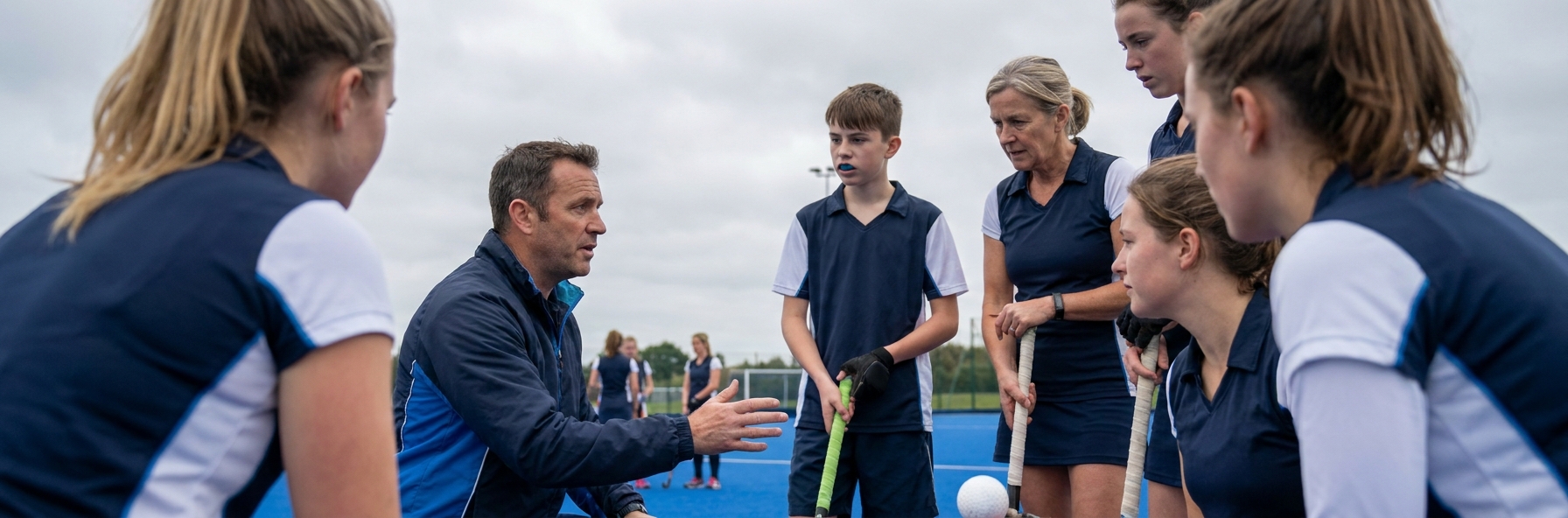
The workshops are designed for everyone involved in delivering hockey, from experienced coaches to volunteers just starting out. The emphasis is on fun, engaging sessions that keep players coming back - because player retention depends on the quality of the experience we create.

Each workshop covers arrival activities, carrying and passing progressions, and game-based learning. Participants leave with a bank of ideas they can implement immediately.

Arrival Activities That Work

The first few minutes of any session set the tone. Arrival activities should be:

Self-managing: Players can start without detailed instruction. This lets the coach focus on organisation while early arrivals get active.

Engaging: Not just standing in lines. Movement, decision-making, maybe a competitive element.

Scalable: Works with 2 players or 20. As more arrive, they join seamlessly.

Examples include: grid-based possession games where players can join any team, skill stations with clear visual instructions, and small-sided games that expand as numbers grow.

Carrying and Moving with Purpose

A significant portion of the workshops focuses on ball carrying. The key insight: carrying isn't just about technique, it's about purpose. Why are you carrying? Where are you taking the ball? What's your next action?

Practices progress from technique-focused (head up, ball position, change of pace) to decision-focused (when to carry vs pass, reading space, timing runs with teammates).

The workshops emphasise "game-realistic" carrying - not just running through cones, but carrying with pressure, carrying to eliminate, carrying to create passing angles.

Passing as Communication

The workshops reframe passing as communication between players. A good pass says "here's where I want you to receive." A great pass also says "here's what I want you to do next."

Practices focus on:

  • Weight of pass - firm enough to arrive quickly, soft enough to control
  • Timing - not too early (intercepted), not too late (receiver can't use it)
  • Receiver's next action - passing to the correct foot/side for what follows

Games-Based Learning

Perhaps the biggest takeaway from the workshops is the shift toward games-based learning. Instead of isolated drills, players learn through modified games that naturally develop the required skills.

The coach's role becomes designing games that create the learning outcomes, then facilitating rather than instructing. Questions replace commands: "What did you notice there?" "Why did that work?" "What could you try differently?"

This approach develops players who can problem-solve, adapt, and transfer learning to match situations.

Making Sessions Engaging

The workshops share specific techniques for keeping energy high:

Quick transitions: Minimise time between activities. Have the next game ready before the current one finishes.

Appropriate challenge: Too easy is boring, too hard is frustrating. Find the "just right" level for your group.

Variety within structure: Keep the same game framework but change small elements - scoring methods, playing areas, team compositions.

Player voice: Give players choices. "Do you want to play again or try something new?" This builds ownership.

Video Support

All workshop practices are available on YouTube, allowing coaches to revisit and refine after attending. This resource bank is growing as the roadshow continues.

Who Should Attend?

The workshops are pitched at all levels. Experienced coaches report learning new ideas and getting reinforcement of good practice. New coaches gain confidence and practical tools. The shared experience of learning together builds community within the sport.

If a workshop is coming to your area, it's worth attending. The time investment is small; the return in practical ideas is significant.

Key Coaching Points

  • Arrival activities set the tone - make them engaging
  • Carrying with purpose, not just technique
  • Passing is communication between players
  • Games-based learning develops problem-solvers
  • Keep sessions varied and appropriately challenging

Drills to Build Your Practice Bank

VIEW ALL WARM-UP DRILLS

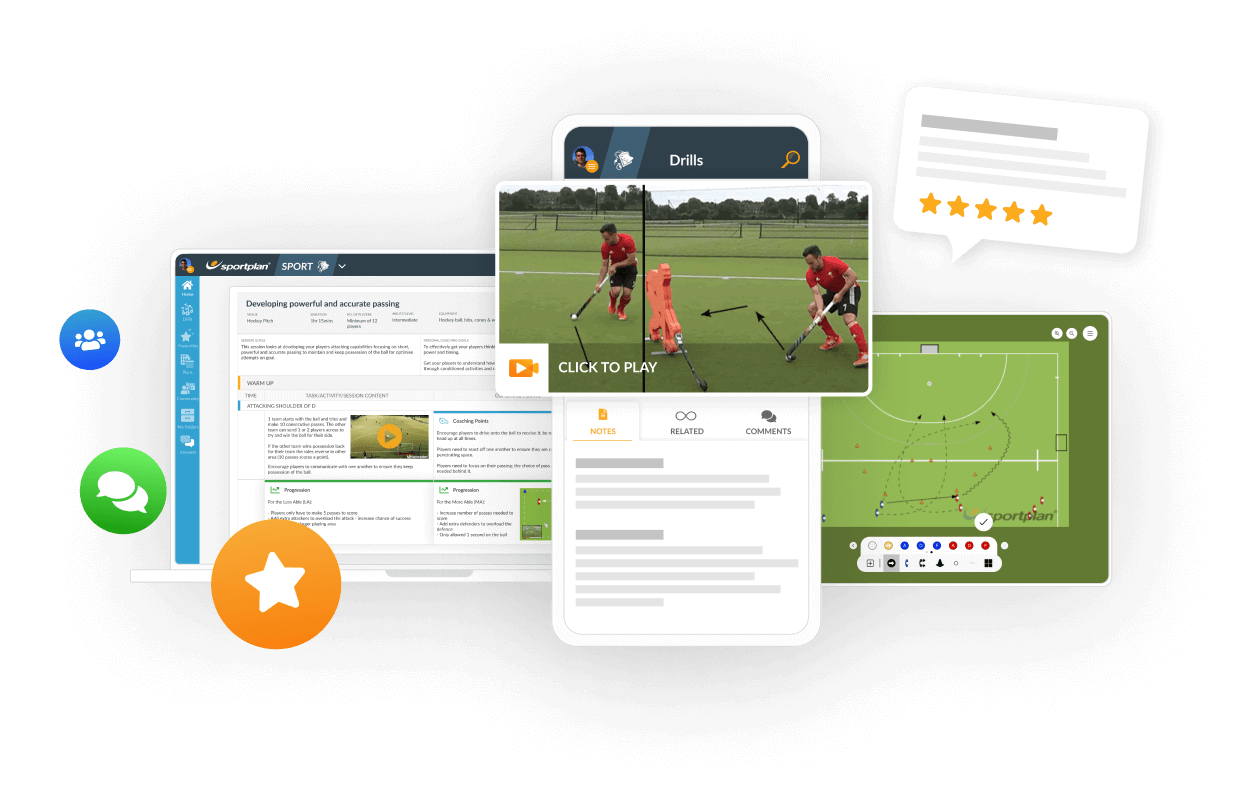
JOIN SPORTPLAN FOR FREE

  • search our library of 1000+ hockey drills
  • create your own professional coaching plans
  • or access our tried and tested plans
post ups DRILLS
View All
Unfortunately there were no results for your search! Please try again
post ups ANSWERS
View All

"Outside the box" formation ideas?

To John Royce: Formations Hey John just wondered your thoughts have taken over ane A1 Womens Side was trying to think a bit outside the box thought of trying a 1-1-3-4-2 formation or 1-1-3-3-3. had any success or heartache with either. Have varying degrees of age in this team which make it a little for younger ones to comprehend. Regards Ian Manhire Newtown A1 Womens Coach

Ian Manhire Coach, Australia

Posting up in hockey | Sportpl...

What does it mean when a forward in hockey post up?

Fiona Cafolla Coach, Scotland

How to coach school team with ...

Hi,I perhaps naively, expected to have most of our team from last year carry over and only have a few new comers to integrate and get up to speed with the rest. However meeting the team at our first practice last night i find I have five players still at school from last year and the rest all new comers, most of whom had not held a hockey stick at all till practice.This being only my second season coaching (year 9 to year 13 boys) has left me feeling a little blindsided, and feeling quite unsure how to prepare practices that target both groups of boys. Do i lump them both groups together, keep them separate? What drills/exercises to best bring the new comers up to speed.I don't want to neglect either group, keep practice worthwhile for the experienced boys, but also bringing the new comers up to a level were they can mix in with the others and learn organically from them while practicing as a team. David

David Smith Coach, New Zealand

Tournament prep -building fitn...

I have just returned from coaching my first high school hockey tournament. It was great fun but the girls really felt it by the end of the tournament. I want to offer guidance in the form of a fitness build up to the girls for next season but am not sure what my expectations should be. How fit should you be looking to get if you are preparing to play 7 50min games over 5 days? And what types of fitness should I be suggesting? Sprinting and Intervals along with Swimming are things I feel that could be introduced. Ideally it needs to be accessable (not expensive or require special equipment), self managed (to an extent) and let it fit in with their daily rountine as best possible to give them the best chance to commit (i.e. I feel like suggesting they power walk to school rather than get dropped off will work better than asking them to join a gym to do the pelaton classes) Any ideas? Or things that have worked in the past?

Archived User Coach

Midfield positioning on 16yd h...

hi there I'm using 4-4-2 and on sometimes 3-1-4-2 with a lower level hockey team.I've chosen this over other formations, simply because the hockey experience and ability of my players is not of a high level (and most people have an approximate understanding of 442). Also, I believe that one must choose a formation based on players traits and what they can deliver. For example, I'd ideally prefer to have 3 forwards, to help with more height and width but then would have to either play 3 in the middle or 3 at the back... and my player strengths don't permit this. In short, I simply don't believe I have a strong enough CH / CM to handle 3 in the middle and I'm not convinced that the off-the-ball support from other players is strong enough to allow 3 in the middle. OFFENSIVE PLAYS Anyway, I'm not 100% where to get my centre mids to stand when we have a 16 yd hit to take (i.e. our possession). Obviously one of the CMs comes deep to offer a potential direct outlet from the centre backs or offer an overload option if the ball goes out to the sides (which is more likely, since I've pretty much banned the high risk play of releasing up the middle - we've had far too many turnovers in our final third or quarter because we tried to play up the middle). My players are 'aware' of posting up and leading runs. However, I'm not sure about the 2nd CM. On the one hand I'd ideally like the 2nd CM to come deep as well, in order to potentially help break up the opposition press but by doing so, I distort the midfield and if we do manage to get the ball to one of the CMs, he won't have the 2nd CM in a higher position to release to, etc. DEFENSIVE POSITIONING Can someone suggest, again, about midfield positioning using 4-4-2 or 3-1-4-2, when we are setting up a general press? I have traditionally encouraged man marking, simply because our general positional awareness is weak (which makes zonal play a no-no IMO) + our tracking and attitude to committed defending (i.e. you don’t give up if one tackle fails) could be better! However, looking at suggested presses on Sportplan, some zonal positioning seems a necessity and I think if I can help my players make the step, success will come because they've been forced to become more aware of their pitch positioning, etc. Also, looking at some of the presses, it looks like the midfield can go 'flat' to create a barrier... and as I encourage a diamond shape in midfield, I need to explain to my players what to do and when. Sorry for the wordy question. I hope this all makes sense. Regards, Gary

Gary Thompson Coach, England

Receiving the ball forward fac...

Anybody any ideas on a conditioned game to encourage receiving the ball in a forward facing position?

Mark Stuart-Thompson Coach, England

tips for training sessions wit...

Hi allI'm running a session on friday night (21 April 2017) and was hoping to move beyond stuff like deflection goals only, to compensate for not having any goalkeepers.Session theme is unfortunately on goalscoring too.Any tips/suggestions?I have some rebound nets (crazy catch), which might actually work brilliantly to simulate saves but any other ideas would be welcomed.Regards,Gary

Gary Thompson Coach, England

How to lob/chip in a hockey sh...

im twelve, i play for my school team and i am going for a trial at southgate hockey. I  play up front, and i can shoot pretty well but i cant lift it over the keeper. any tips would be much appreiciated

Archived User Coach

Rolling player substitution pl...

Need help with planning a rolling subs with 11 players and 5 subs.Keeper,4 backs, 4 midfied, 2 strikers.Any ideas please

Barry Prestney Coach, New Zealand

How do you teach children aged...

I coach aged 7 children and I don't know how to teach them how to play a proper hockey match without all of them going for the ball and not staying in their positions. Do I put lines where they are not allowed to pass? or what?

Bev Coach, South Africa

Re involving GKs in junior coa...

I really struggle to make practice fun and useful for the GKs. My attention is naturally focussed on the outfield players, meaning most of the time I simply have drills finishing with a shot on goal to keep the GK involved. Pretty boring for them. Any ideas how I can involve them more? Thanks, Charlie

Carol Ridge Coach, England

What should I do? Team Captain...

I have taken over a club as head coach this year and inherited a captain. She is a good player but is not my ideal captain and is used to communicating almost exclusively by email. I had a successful meeting setting objectives for the 1st team last weekend and following that meeting received lots of feedback for how well it was received. My captain yesterday sent a long email about her thoughts on the meeting and where we are and what the players should be doing in order to progress from her perspective. It is a long rambling email that I think has no objective or point to it that I think is completely inappropriate, now I know her heart is in the right place but this is really stepping on my toes as a coach as it is my place to do these type of emails. I am looking for advice on how I should be dealing with this, I am happy to pull her up but as she is very unconfident about herself I feel this might push her back into her shell even more and then she might do something daft like send another email apologising to the team! I am not sure if I should just ignore it as I wonder if it undermines me? Thoughts?

Ian Hardingham Coach, England

JOIN SPORTPLAN FOR FREE

  • search our library of 1000+ hockey drills
  • create your own professional coaching plans
  • or access our tried and tested plans

Sportplan App

Give it a try - it's better in the app

YOUR SESSION IS STARTING SOON... Join the worlds largest hockey coaching resource for 1000+ drills and pro tools to make coaching easy.
LET'S DO IT