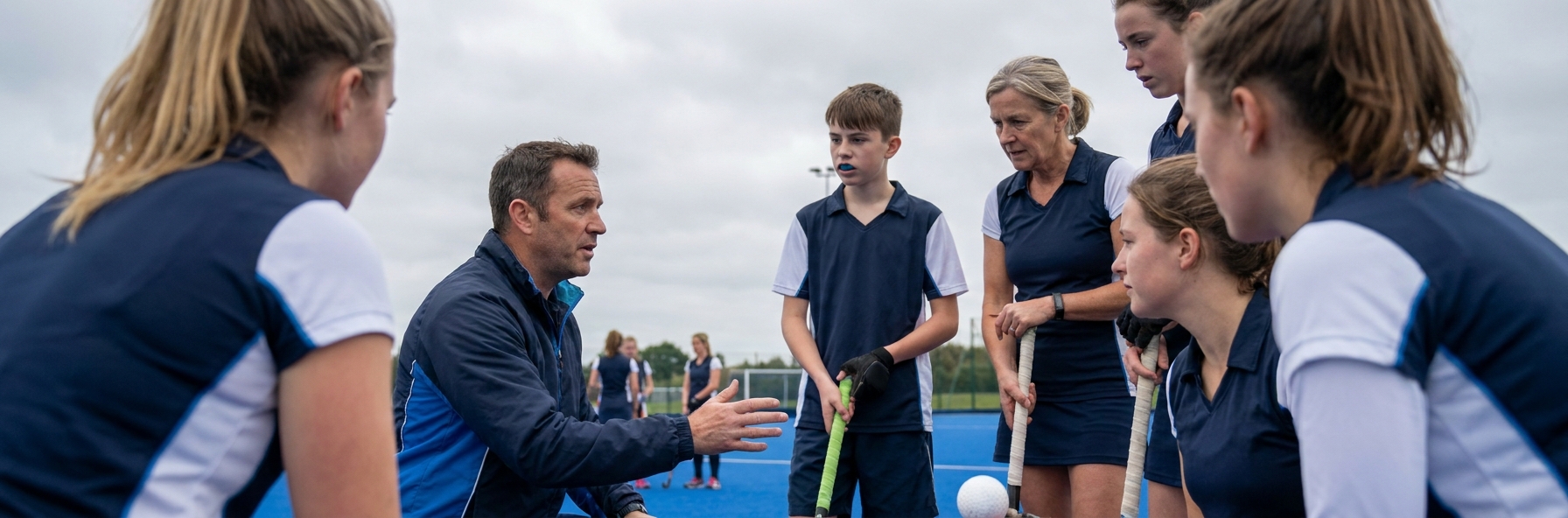
Field Hockey: pre game warm up

Connection-Based Coaching has emerged as a significant movement in hockey coaching. The core idea is simple but powerful: the relationship between coach and player is the foundation upon which all development is built. Without trust, without genuine connection, coaching effectiveness is limited.

This isn't soft philosophy. Research consistently shows that athletes who feel psychologically safe, who trust their coach, who believe their coach genuinely cares about them, perform better and develop faster.

What is Psychological Safety?

Psychological safety is the belief that you can take risks without being punished or humiliated. In a hockey context, it means players who feel safe to:

  • Try new skills without fear of criticism for failure
  • Ask questions without being made to feel stupid
  • Offer ideas without being dismissed
  • Make mistakes in matches without losing their place
  • Express concerns without negative consequences

When psychological safety exists, players are more creative, more willing to stretch themselves, and more honest about their development needs.

Building Connection

Know Your Players

Do you know what motivates each player? Their life outside hockey? Their hopes and concerns? Connection requires knowledge, and knowledge requires investment in getting to know people.

This doesn't mean becoming best friends. It means showing genuine interest, remembering what players tell you, and demonstrating that you see them as people, not just performers.

Listen More Than You Speak

Many coaches do too much telling. Connection-based coaching emphasises listening. When players speak, give them full attention. Ask follow-up questions. Reflect back what you've heard to show understanding.

Listening builds trust because it demonstrates respect. When players feel heard, they're more receptive to coaching.

Consistency and Reliability

Trust is built through consistent behaviour over time. If you say you'll do something, do it. If you have standards, apply them equally to everyone. Inconsistency destroys trust faster than almost anything else.

Appropriate Vulnerability

Coaches who admit mistakes, acknowledge what they don't know, and share their own development journey build stronger connections than those who project infallibility. Appropriate vulnerability models the openness you want from players.

Connection in Practice

Individual Check-Ins

Brief one-to-one conversations build connection over time. Not always about hockey - sometimes just "How are you?" delivered with genuine interest. These small interactions accumulate into strong relationships.

Personalised Feedback

Generic feedback shows you're not paying attention. Specific, personalised feedback shows you see the individual. "Good work" is less powerful than "I noticed you recovered really quickly after that turnover - that's the response we need."

Celebrating Progress

Connection-based coaches celebrate development, not just outcomes. The player who improves from poor to average has achieved as much as the player who was always excellent. Recognition should reflect effort and progress.

Managing Difficult Conversations

Strong connections make difficult conversations possible. When players trust you, they can hear hard truths. When they don't, the same truths are rejected as unfair criticism. Build the connection first; the honest feedback can follow.

Team-Level Application

Connection isn't just coach-to-player. Teams with strong player-to-player connections perform better. The coach's role includes creating conditions for these connections:

  • Team-building activities that build genuine relationships
  • Training structures that encourage collaboration
  • Addressing behaviours that damage team connection
  • Celebrating collective achievements

Common Barriers

"I don't have time": Connection doesn't require separate time - it's embedded in how you do everything. A two-minute conversation while setting up equipment still counts.

"It's soft": The evidence says otherwise. High-performance environments increasingly recognise that connection underpins performance, not detracts from it.

"Not all players want it": Different players need different levels and types of connection. Read what each individual needs and adjust accordingly.

Key Coaching Points

  • Psychological safety enables risk-taking and growth
  • Know your players as people, not just performers
  • Listen more, tell less
  • Be consistent and reliable
  • Personalise your interactions and feedback
  • Create conditions for player-to-player connection

Drills That Build Team Connection

VIEW ALL SMALL-SIDED GAMES

JOIN SPORTPLAN FOR FREE

  • search our library of 1000+ hockey drills
  • create your own professional coaching plans
  • or access our tried and tested plans
pre game warm up DRILLS
View All
Unfortunately there were no results for your search! Please try again
pre game warm up DRILL CATEGORIES
View All
pre game warm up ANSWERS
View All

Hello all, im coaching a ladies first team and im trying?

Hello all, im coaching a ladies first team and im trying to motivate them to take it a lot more seriously then they currently do. They want to train hard but are afraid of making mistakes defensively. Instead of getting back behind the ball when they make a mistake they almost seem embarrassed and stand there with their arm up. I give them as much encouragement as possible without following them round with a pillow!! Also only 2/3 of the squad come to training which is frustrating as both forwards never attend training but the captain wont drop them and come saturday, they have no clue as to what we have been working on. So im having to take 15 minutes out of my pre-game warm up with the rest of the ladies to explain whats going to happen. I get paid to coach them on Tuesday nights but i do saturdays for free. It is frustrating to say the least and i would love any help you can give pleeeaaasseee!!! Mike

Archived User Coach

Looking for new pre game drills!

Any idea's on new pre game drills? We are now playing the '5' just passing and the last one shoots, but after a few months it got bored. So looking for new drills! Any suggestions?

Archived User Coach

Receiving the ball forward facing

Anybody any ideas on a conditioned game to encourage receiving the ball in a forward facing position?

Mark Stuart-Thompson Coach, England

Hello all, im coaching a ladie...

Hello all, im coaching a ladies first team and im trying to motivate them to take it a lot more seriously then they currently do. They want to train hard but are afraid of making mistakes defensively. Instead of getting back behind the ball when they make a mistake they almost seem embarrassed and stand there with their arm up. I give them as much encouragement as possible without following them round with a pillow!! Also only 2/3 of the squad come to training which is frustrating as both forwards never attend training but the captain wont drop them and come saturday, they have no clue as to what we have been working on. So im having to take 15 minutes out of my pre-game warm up with the rest of the ladies to explain whats going to happen. I get paid to coach them on Tuesday nights but i do saturdays for free. It is frustrating to say the least and i would love any help you can give pleeeaaasseee!!! Mike

Archived User Coach

1st ever training Session Stru...

I have been given my first team ever!! They are 11 year old girls and I wanted guide/ recommendation on how I should structure my one hour sessions? E.g. how long should I spend on a warm up, drill etc. .Cheers,Freya

Archived User Coach

How to coach school team with ...

Hi,I perhaps naively, expected to have most of our team from last year carry over and only have a few new comers to integrate and get up to speed with the rest. However meeting the team at our first practice last night i find I have five players still at school from last year and the rest all new comers, most of whom had not held a hockey stick at all till practice.This being only my second season coaching (year 9 to year 13 boys) has left me feeling a little blindsided, and feeling quite unsure how to prepare practices that target both groups of boys. Do i lump them both groups together, keep them separate? What drills/exercises to best bring the new comers up to speed.I don't want to neglect either group, keep practice worthwhile for the experienced boys, but also bringing the new comers up to a level were they can mix in with the others and learn organically from them while practicing as a team. David

David Smith Coach, New Zealand

My u/15 girls can't play as a ...

I really have a big problem with my u/15 girls.  They just can't play as a team. Any advice please. There's always a fight between someone. Mariette

Archived User Coach

Beginner Coach NEED HELP PLEAS...

I'm new to coaching and i'm coaching a team that barely knows how to even hold a stick properly. Where can i start with improving there skills and hockey kowledge ?

Liancke Laureti Coach, South Africa

How can I stop my team from di...

I am coaching my first season as head coach. I am confident that my team has improved on alot of skills (mostly due to sportplan.net, thank you!). The only thing that is driving me crazy that my team has not improved on is the over committing block tackle. When an opponent is coming down the field on a breakway, my defense runs up and block tackles, and the opponent shoots right past them. This will happen two or three times in a row, one defender after the other. I've told them to keep their feet moving and to keep off their toes, keeping their momentum with the opponent. I don't know how to practice this with them. We only have 9 players (this is a high school varsity team) so we can't scrimmage full field during practice. Please help! I'm desperate for a solution.

Archived User Coach

How to keep kids from getting ...

Hi all just wondering if there are any coach's that have any good tip for a new coach like me. I am coaching under 6/8yr olds and find they get bored very easy. How do you keep them from getting bored and what fun drills do you use? Cheer James first time coach

James Batt Coach, New Zealand

I am a new coach and need poin...

I just became the head coach of a middle school field hockey team and would like some pointers on how to coach. I have experience with goal keeping and defensive drills, I was a keeper, so I would like to learn more about offense as well. Any help is appreciated!!

Amanda Emerich Coach, United States of America

Fun Warm ups with 7-11 year ol...

What fun warm ups can I use with a group of 7-11 year olds with and without hockey sticks? Many thanks xx

Natty Coach, England

JOIN SPORTPLAN FOR FREE

  • search our library of 1000+ hockey drills
  • create your own professional coaching plans
  • or access our tried and tested plans

Sportplan App

Give it a try - it's better in the app

YOUR SESSION IS STARTING SOON... Join the worlds largest hockey coaching resource for 1000+ drills and pro tools to make coaching easy.
LET'S DO IT