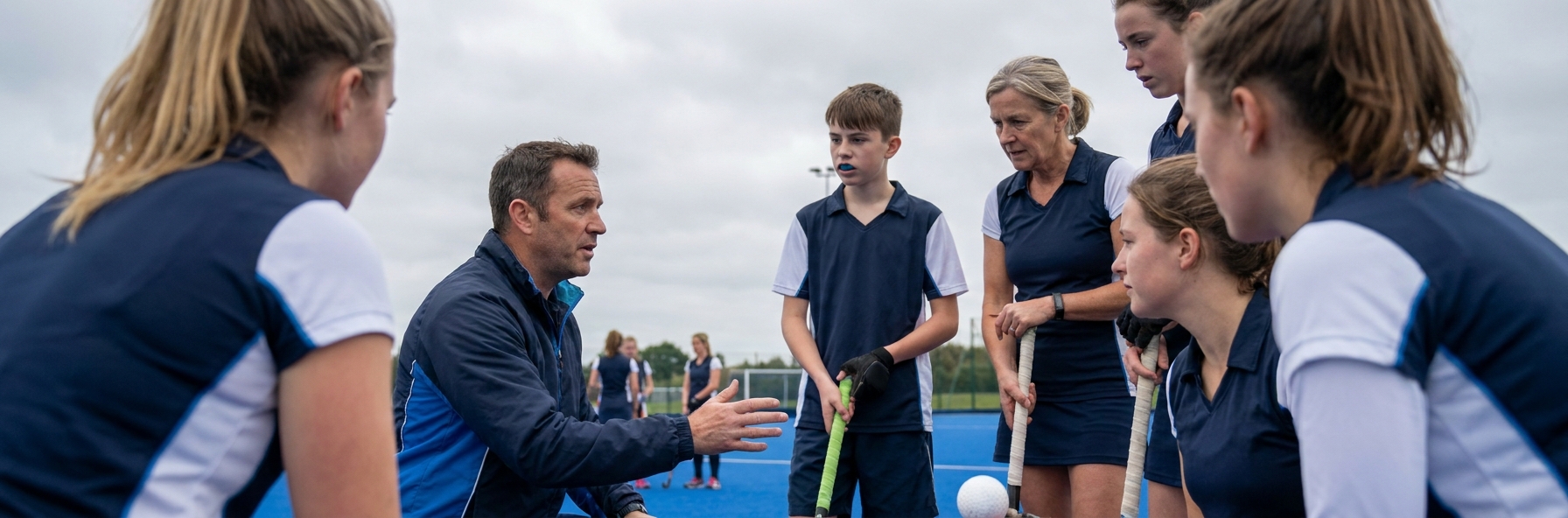
Field Hockey: pressure play

England Hockey's "25 in 2025" initiative has been touring the country, bringing two-hour on-pitch workshops to 25 locations. The focus: practical practice ideas that coaches can take straight back to their clubs. Here's a summary of the key concepts being shared.

The Philosophy

The workshops are designed for everyone involved in delivering hockey, from experienced coaches to volunteers just starting out. The emphasis is on fun, engaging sessions that keep players coming back - because player retention depends on the quality of the experience we create.

Each workshop covers arrival activities, carrying and passing progressions, and game-based learning. Participants leave with a bank of ideas they can implement immediately.

Arrival Activities That Work

The first few minutes of any session set the tone. Arrival activities should be:

Self-managing: Players can start without detailed instruction. This lets the coach focus on organisation while early arrivals get active.

Engaging: Not just standing in lines. Movement, decision-making, maybe a competitive element.

Scalable: Works with 2 players or 20. As more arrive, they join seamlessly.

Examples include: grid-based possession games where players can join any team, skill stations with clear visual instructions, and small-sided games that expand as numbers grow.

Carrying and Moving with Purpose

A significant portion of the workshops focuses on ball carrying. The key insight: carrying isn't just about technique, it's about purpose. Why are you carrying? Where are you taking the ball? What's your next action?

Practices progress from technique-focused (head up, ball position, change of pace) to decision-focused (when to carry vs pass, reading space, timing runs with teammates).

The workshops emphasise "game-realistic" carrying - not just running through cones, but carrying with pressure, carrying to eliminate, carrying to create passing angles.

Passing as Communication

The workshops reframe passing as communication between players. A good pass says "here's where I want you to receive." A great pass also says "here's what I want you to do next."

Practices focus on:

  • Weight of pass - firm enough to arrive quickly, soft enough to control
  • Timing - not too early (intercepted), not too late (receiver can't use it)
  • Receiver's next action - passing to the correct foot/side for what follows

Games-Based Learning

Perhaps the biggest takeaway from the workshops is the shift toward games-based learning. Instead of isolated drills, players learn through modified games that naturally develop the required skills.

The coach's role becomes designing games that create the learning outcomes, then facilitating rather than instructing. Questions replace commands: "What did you notice there?" "Why did that work?" "What could you try differently?"

This approach develops players who can problem-solve, adapt, and transfer learning to match situations.

Making Sessions Engaging

The workshops share specific techniques for keeping energy high:

Quick transitions: Minimise time between activities. Have the next game ready before the current one finishes.

Appropriate challenge: Too easy is boring, too hard is frustrating. Find the "just right" level for your group.

Variety within structure: Keep the same game framework but change small elements - scoring methods, playing areas, team compositions.

Player voice: Give players choices. "Do you want to play again or try something new?" This builds ownership.

Video Support

All workshop practices are available on YouTube, allowing coaches to revisit and refine after attending. This resource bank is growing as the roadshow continues.

Who Should Attend?

The workshops are pitched at all levels. Experienced coaches report learning new ideas and getting reinforcement of good practice. New coaches gain confidence and practical tools. The shared experience of learning together builds community within the sport.

If a workshop is coming to your area, it's worth attending. The time investment is small; the return in practical ideas is significant.

Key Coaching Points

  • Arrival activities set the tone - make them engaging
  • Carrying with purpose, not just technique
  • Passing is communication between players
  • Games-based learning develops problem-solvers
  • Keep sessions varied and appropriately challenging

Drills to Build Your Practice Bank

VIEW ALL WARM-UP DRILLS

JOIN SPORTPLAN FOR FREE

  • search our library of 1000+ hockey drills
  • create your own professional coaching plans
  • or access our tried and tested plans
pressure play DRILLS
View All
Unfortunately there were no results for your search! Please try again
pressure play ANSWERS
View All

To man mark or zone?

My Girls team I coach get caught a lot between man marking and zonal marking in the 23 yard area and sometimes end up with half the team doing one and the rest the other. Suggestions on the ideal defensive set up inside the 23?

Archived User Coach

Is there some basic info (DVD, video or manuals) that?

Is there some basic info (DVD, video or manuals) that outline basic positional play and roles for new players to the game. I have entered a school team (15-16 yr old girls) into a weekend comp. They are coming up against strong club teams who have been playing for several years. It has been difficult getting them to maintain some structure in their play - possession is a big problem. Also, hitting the ball is an issue - a skill that I have taken for granted as it has never been a problem with all the boys teams I have coached (even 7 amp; 8 yr olds) Any advice greatly appreciated.

Archived User Coach

i am 35yrs old and playing hockey, i am good when practicing?

i am 35yrs old and playing hockey, i am good when practicing but could not show such performance in the matches.

Archived User Coach

How do you go out of defence when the another team play full press?

Does any other coach have any ideas to how my team can go out of defence when the another team play full press?

Archived User Coach

Defending with slow players

I coach a ladies two side, our defesive players are all rather slow on their feet due to age, injuries etc, this isn't to bad against slow attacking teams however we are now playing very fast forwards, how can my slower defensive players combat this.

Archived User Coach

Indoor hockey defending

Dear colleagues, what are the best ways to defend an attacking team that is playing with a field player with goalkeeping privileges? Te question concerns indoor hockey only.

Marco Koudijs Coach, Netherlands

Midfield positioning on 16yd hits and presses when using 4-4-2?

hi there I'm using 4-4-2 and on sometimes 3-1-4-2 with a lower level hockey team.I've chosen this over other formations, simply because the hockey experience and ability of my players is not of a high level (and most people have an approximate understanding of 442). Also, I believe that one must choose a formation based on players traits and what they can deliver. For example, I'd ideally prefer to have 3 forwards, to help with more height and width but then would have to either play 3 in the middle or 3 at the back... and my player strengths don't permit this. In short, I simply don't believe I have a strong enough CH / CM to handle 3 in the middle and I'm not convinced that the off-the-ball support from other players is strong enough to allow 3 in the middle. OFFENSIVE PLAYS Anyway, I'm not 100% where to get my centre mids to stand when we have a 16 yd hit to take (i.e. our possession). Obviously one of the CMs comes deep to offer a potential direct outlet from the centre backs or offer an overload option if the ball goes out to the sides (which is more likely, since I've pretty much banned the high risk play of releasing up the middle - we've had far too many turnovers in our final third or quarter because we tried to play up the middle). My players are 'aware' of posting up and leading runs. However, I'm not sure about the 2nd CM. On the one hand I'd ideally like the 2nd CM to come deep as well, in order to potentially help break up the opposition press but by doing so, I distort the midfield and if we do manage to get the ball to one of the CMs, he won't have the 2nd CM in a higher position to release to, etc. DEFENSIVE POSITIONING Can someone suggest, again, about midfield positioning using 4-4-2 or 3-1-4-2, when we are setting up a general press? I have traditionally encouraged man marking, simply because our general positional awareness is weak (which makes zonal play a no-no IMO) + our tracking and attitude to committed defending (i.e. you don’t give up if one tackle fails) could be better! However, looking at suggested presses on Sportplan, some zonal positioning seems a necessity and I think if I can help my players make the step, success will come because they've been forced to become more aware of their pitch positioning, etc. Also, looking at some of the presses, it looks like the midfield can go 'flat' to create a barrier... and as I encourage a diamond shape in midfield, I need to explain to my players what to do and when. Sorry for the wordy question. I hope this all makes sense. Regards, Gary

Gary Thompson Coach, England

Good shooting drill for a very small group?

I am looking for a more complicated drill but for around 4 players. Needs to involve hitting in the circle and shooting on goal. Maybe looking for shooting under pressure like a defender or something?

Alix Morrison Coach, Scotland

Typical session for Juniors

Why wont this session open for me when i log in its not there ??

Onny Gajadhar Coach, New Zealand

Looking to play a 3-2-3-2-1 formation.

Have some questions about two inners. Also anyone running it. Do you like it?

Ed kolnaski Coach, United States of America

How to mark against speedy forwards

I have a ladies team with slow defenders who insist on playing 5-10 yards (sometimes more) off of their attacker. They do this as they say they are much slower and therefore need the space to catch up to them and as a 'buffer'. This is an argument I have heard used by a lot of slower players.I however have been arguing that they'd have more success if they marked closer and tried to prevent them from turning and gathering speed/or being within range to make the interception in the first place. They may get beaten on occasion if the player has the wherewithal to turn with skill and beat their marker, but I feel for a lot of players, the mere pressure of having a defender in close proximity may discourage them from attempting to turn and force them to play the ball backwards.My argument is that if you give a player with speed 10 yards to build up speed against you then it will be harder to stop them/catch them, especially in a wide space. The way I think about it is, if two cars are in a race, but the first one is allowed to get up to 30 mph before the start line AND is the faster vehicle, it's a no-brainer as to who will win. I'm interested to see what everyone else thinks - am I thinking about this incorrectly or does my thinking make sense?

Luke Garner Coach, England

I need some drills for both category's

I don't know what to do, I'm coaching 2 teams at the same time same practice and they know. the problem is that one team is 5/6 advance and the other team is 5/6 beginners. I can't pull out of this and I need some drills that both can do...

Danni Coach, New Zealand

Pass under pressure drill

What drill I wanna give my players for push pass under pressure?

RIYAS MASTER MPM Coach, India

How to play hulf press

how to play half press and full press

Ritu Khanom Coach, Bangladesh

left mid job in defending a high press

what is the positioning and tips to no left them through the centre by heading to the lineand them cutting in

Rachel Sweetnam Coach, Northern Ireland

protecting inexperienced keeper

Playing adult mens at a low league level, mixture of ageing experienced players, inexperienced young and not so young players.We normally play 343 diamond, with mixed results, when I works it works well.We are without our keeper , so an outfield player (me , not so young, not so good) padding up.Really need a formation that is going to discourage pressure on the last line of defence (this section has the best, older experienced players).Bit vague and difficult to answer, I would think but a pointer would be good. Many thanks

Jimmy Harwood Coach, England

To man mark or zone? | Sportpl...

My Girls team I coach get caught a lot between man marking and zonal marking in the 23 yard area and sometimes end up with half the team doing one and the rest the other. Suggestions on the ideal defensive set up inside the 23?

Archived User Coach

Base line defence - How to pre...

Baseline defence: How to prevent teams from Scoring goals from the left and Right baseline.Do I tell my left and Right half to channel player outwards ,protect feet,frontal pressure and allow other defenders to tuck infield.Or do I opt to tell defenders to go man to man inside 23 and then apply frontal pressure ,channel player outwards ,watch angle of engagment.As recently we only conceded through attack on our baseline

Jason Adams Coach, South Africa

Where do the defensive players...

Where do the defensive players stand during a corner?

Archived User Coach

Getting out of High Press | Sp...

What are the best things to get your players to do when you come up against a full press / 3/4 press, anything that's putting a lot of pressure on high up the pitch?

Simon Lowry Coach, Ireland

JOIN SPORTPLAN FOR FREE

  • search our library of 1000+ hockey drills
  • create your own professional coaching plans
  • or access our tried and tested plans

Sportplan App

Give it a try - it's better in the app

YOUR SESSION IS STARTING SOON... Join the worlds largest hockey coaching resource for 1000+ drills and pro tools to make coaching easy.
LET'S DO IT