Field Hockey: push

August 2026

New rule guidance lands every season and most of it never touches a Saturday. This year is a little different. England Hockey's guidance for 2026/27, following the latest revisions to the FIH Rules of Hockey, includes a change that has been running as a trial and is now permanent, plus a handful of clarifications that will catch out any squad that has not been told about them.

The changes apply from 1 September and cover both adult and junior competitions. Some leagues and clubs choose to adopt them early in pre-season friendlies, which is a sensible way to get everyone familiar before the points start counting.

The Aerial Ball Rule Becomes Permanent

The headline change is that the aerial ball rule has been permanently adopted across all England Hockey competitions. Under it, a defender may approach once the receiver has touched the ball, rather than having to wait until the receiver has controlled it and brought it to the ground, provided the initial five metres of safe space were respected.

That sounds like a small distinction and it is not. The window in which a receiver is protected is now shorter, and the moment the contest becomes live is earlier and easier for umpires to see. Receivers who were used to taking a comfortable extra second to settle the ball will find an opponent arriving sooner than they expect.

Penalty Corner Equipment and the Yellow Card

There is revised guidance on the disposal of penalty corner protective equipment. If a person is hit on or above the knee in a normal stance by discarded equipment, the player who threw it receives a yellow card.

This is worth ten minutes of your pre-season time, because it is a purely behavioural change. Defenders coming out of a corner have historically flung masks and gloves aside without much thought. Teach the squad to place equipment down and to the side rather than throwing it, and you will never have to think about the rule again.

Goalkeeper Equipment and Other Clarifications

The maximum permitted size of a goalkeeper's left-hand protector has increased to 365mm, which allows manufacturers to produce larger gloves that remain legal under FIH regulations. If your keeper is due new kit, this is useful to know before they buy.

Alongside these, the guidance includes clearer sanctions for having too many players on the pitch, and further clarifications for goalkeepers and umpires. None of these should change how you play, but a squad that knows about them is a squad that does not argue with the umpire in week one.

How to Brief Your Squad

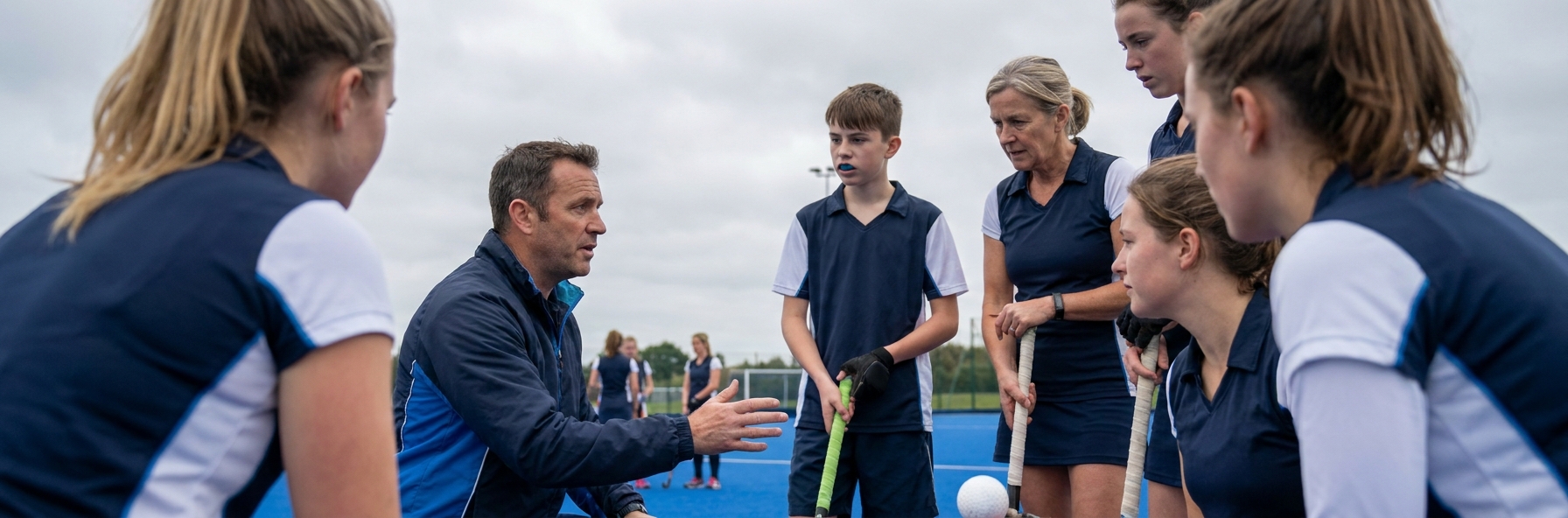
Step One: Cover it once, properly, in a pre-season session rather than drip-feeding it. Ten focused minutes with everyone present beats five separate conversations.

Step Two: Coach the aerial change with the ball, not the whiteboard. Set up receipts under a falling ball with an approaching defender and let players feel how much less time they have.

Step Three: Rehearse the equipment habit at your first penalty corner practice, so placing kit down becomes automatic before anyone is under pressure.

Step Four: Tell your umpires and your captains what you have briefed. A captain who understands the change is far more useful than one who reacts to it.

Step Five: Use any early-adopting pre-season fixtures as live rehearsal, and review what actually happened rather than what you expected.

Key Coaching Points

  • The aerial rule is now permanent: defenders may approach once the receiver has touched the ball.
  • The five metres of initial safe space still has to be respected before any approach.
  • Receivers have less settling time, so first touch under a falling ball matters more than ever.
  • Place penalty corner equipment down and to the side; throwing it can now earn a yellow card.
  • Goalkeeper left-hand protectors may now be up to 365mm, useful before buying new kit.
  • Brief the whole squad once in pre-season rather than correcting individuals in September.

Recommended Drills

VIEW ALL PASSING DRILLS

Frequently Asked Questions

When exactly do the 2026/27 rules apply?

From 1 September 2026, across both adult and junior competitions. Leagues, clubs and organisers may adopt them earlier in pre-season or summer competitions, which many do specifically to help everyone get familiar before the league campaign starts.

Does the aerial change mean the five metre rule has gone?

No. The initial five metres of safe space still has to be respected. What has changed is when a defender may approach after that: once the receiver has touched the ball, rather than once they have controlled it and brought it to the ground.

Do I need to change how we train aerials?

Only in emphasis. Spend more time on a clean, decisive first touch under a falling ball and on what the receiver does immediately afterwards, because the contest now arrives sooner. The receiving technique itself is unchanged.

push DRILLS
View All
Unfortunately there were no results for your search! Please try again
push SESSIONS
View All
push ANSWERS
View All

how do i stop my defenders form panicking when they have possession in there own circle

Ask a question and have it answered by Coaches from around the world and Sportplan's team of Experts.

luke connolly Coach, Ireland

Are there any drills to force players to stay low

Are there any drills to force players to stay low

Archived User Coach

How can we overcome a 1-4-4-2 formation?

I coach a women's team wide range in age 16 - 54 , when the stars align we are a very strong team hard to beat and very stingy when it comes to goals against, the games we do lose are usually 1-0 games,The exception comes when we play a team that plays a 1-4-4-2 ,what makes it worse is that we play a 4-4-2 and are very successful with it, but when it comes to defending against it my Defense and Mids become confused. I have not had any luck in figuring out a way to explain to my team how to defend against it. Any ideas on an easy way to fix this? Thanks

William Phillips Coach, Canada

Defending against 2 center halves

Hi can you help me setting a defence against a team playing 2 centre halves. My team plays conventional style 5321 . Thanks

MARK Coach, Australia

How to coach school team with novices and experienced players?

Hi,I perhaps naively, expected to have most of our team from last year carry over and only have a few new comers to integrate and get up to speed with the rest. However meeting the team at our first practice last night i find I have five players still at school from last year and the rest all new comers, most of whom had not held a hockey stick at all till practice.This being only my second season coaching (year 9 to year 13 boys) has left me feeling a little blindsided, and feeling quite unsure how to prepare practices that target both groups of boys. Do i lump them both groups together, keep them separate? What drills/exercises to best bring the new comers up to speed.I don't want to neglect either group, keep practice worthwhile for the experienced boys, but also bringing the new comers up to a level were they can mix in with the others and learn organically from them while practicing as a team. David

David Smith Coach, New Zealand

coaching points push pass

what are the coaching points for push pass?

Courtney Dowdie Coach, Jamaica

Break through a team that is playing half court press?

How can you train to break through a team that starts half court and your team starts with the ball? Four players in the defence start maybe playing the ball first to the left wing and this player hits the ball back to the free defence player who passes the ball to the right defence player who is over the 23 meter line... I like to understand the different tactical approaches. Can you share some ideas with me?

R.P. Witkamp Coach, Netherlands

Pass under pressure drill

What drill I wanna give my players for push pass under pressure?

RIYAS MASTER MPM Coach, India

throwing games away in last quarter

we are often the better team,for three quarters we push the opposition but in the last quarter we concede 2 or more goals.We have a massive national tournament coming up with the best teams in the country,and I am afraid that this might cost us dearly.Does anyone have a drill or structure plan I could use?

Leone Lanuti Coach, South Africa

drills to teach a beginner on push pass

drills toteach a beginner on push pass

Collins Acheampong Coach, Ghana

rules of free hit

rules of free hit

Coach, United Kingdom

passing drills for girls age 8 to 12

passing drills for girls age 8 to 12

Michelle Hart Coach, Australia

junior hockey

drills using the push and demo

undefined undefined Coach, United Kingdom

can you give me passing drills for u12

can you give me passing drills for u12

Cathriona Coach, Ireland

indoor pcd

I need something for indoor pcd

Matthias Heine Coach, Germany

skill practice for U7 girls

I need Skill practices for u7 girls, please.

Vanessa Rachel Coach, United Kingdom

Drag flick for teen girls - Sp...

Hi just wondering the best way to teach drag flicks to young ladies. I've tried a following videos by make players and am not getting results. Any ideas? Thanks in advance Asked using Sportplan Mobile App

Leesa Coach, Australia

teaching presses on free hits ...

Hi allI am looking for advice on how to implement processes in my girls school hockey team. processes of setting up presses, defensive structures and counter attacking thinking. I have 14 players in the team from 15 years old to 18. we train twice a week. only a few play club hockey as well. We either play a 3-1-4-2 or a 3-1-3-3.I find it difficult for example, when you want to teach a press on the opposition 16, to simulate gameplay with only 14 players (if they are all at training). I can have my halves setup for taking the 16 and then get my strikers and links to setup, but then I still want defenders to see things from the back but they are taking the 16? Also when taking the 16 they then don't have any support in the drill because everyone else is setting up a press?I know we need to work on our basics in order for the other tactics and skills and game plans to work. However I find it frustrating with this team that on counter attacks for a few reasons which I am struggling to mend;- they only head forward. No one holds up the ball to wait for support.- they run straight and don't use angles- they pass too late and get tackled - they don't have the vision to see an early pass or pass into space- players without the ball do not run into useful positions and angles and get caught out by the person with the ball who then makes a pass to no one and it runs out of play.So suggestions please for;- open, creative but simple counter attacking- teaching processes for presses on free hits and 16s- coaching how to take 16s and work your way out- coaching vision and expecting your players to be in support. RegardsMatt
Matthew Lydall Coach, South Africa

Opposed shooting- how to score...

I need some opposed shooting drills to improve my teams goal scoring ratio. Unopposed drills have not been working, and I really need to avoid cueing - any ideas ?

James Clark Coach, England

rules of free hit | Sportplan

rules of free hit

Coach, United Kingdom

JOIN SPORTPLAN FOR FREE

  • search our library of 1000+ hockey drills
  • create your own professional coaching plans
  • or access our tried and tested plans

Sportplan App

Give it a try - it's better in the app

YOUR SESSION IS STARTING SOON... Join the worlds largest hockey coaching resource for 1000+ drills and pro tools to make coaching easy.
LET'S DO IT