Field Hockey: rules

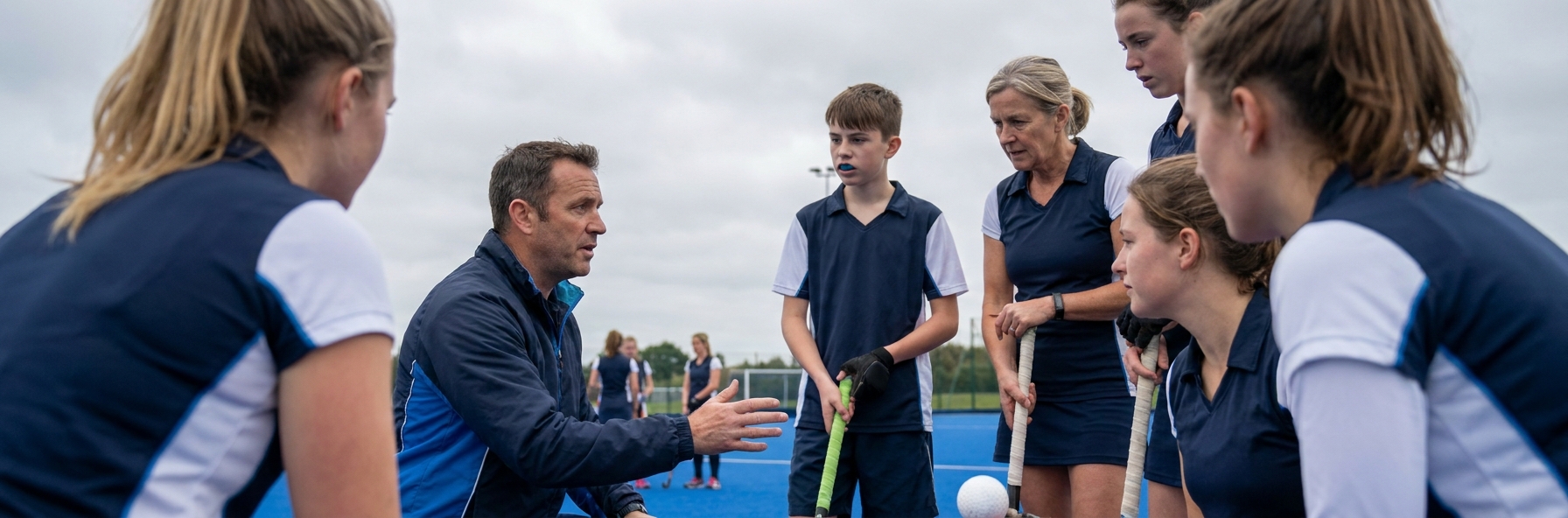
Connection-Based Coaching has emerged as a significant movement in hockey coaching. The core idea is simple but powerful: the relationship between coach and player is the foundation upon which all development is built. Without trust, without genuine connection, coaching effectiveness is limited.

This isn't soft philosophy. Research consistently shows that athletes who feel psychologically safe, who trust their coach, who believe their coach genuinely cares about them, perform better and develop faster.

What is Psychological Safety?

Psychological safety is the belief that you can take risks without being punished or humiliated. In a hockey context, it means players who feel safe to:

  • Try new skills without fear of criticism for failure
  • Ask questions without being made to feel stupid
  • Offer ideas without being dismissed
  • Make mistakes in matches without losing their place
  • Express concerns without negative consequences

When psychological safety exists, players are more creative, more willing to stretch themselves, and more honest about their development needs.

Building Connection

Know Your Players

Do you know what motivates each player? Their life outside hockey? Their hopes and concerns? Connection requires knowledge, and knowledge requires investment in getting to know people.

This doesn't mean becoming best friends. It means showing genuine interest, remembering what players tell you, and demonstrating that you see them as people, not just performers.

Listen More Than You Speak

Many coaches do too much telling. Connection-based coaching emphasises listening. When players speak, give them full attention. Ask follow-up questions. Reflect back what you've heard to show understanding.

Listening builds trust because it demonstrates respect. When players feel heard, they're more receptive to coaching.

Consistency and Reliability

Trust is built through consistent behaviour over time. If you say you'll do something, do it. If you have standards, apply them equally to everyone. Inconsistency destroys trust faster than almost anything else.

Appropriate Vulnerability

Coaches who admit mistakes, acknowledge what they don't know, and share their own development journey build stronger connections than those who project infallibility. Appropriate vulnerability models the openness you want from players.

Connection in Practice

Individual Check-Ins

Brief one-to-one conversations build connection over time. Not always about hockey - sometimes just "How are you?" delivered with genuine interest. These small interactions accumulate into strong relationships.

Personalised Feedback

Generic feedback shows you're not paying attention. Specific, personalised feedback shows you see the individual. "Good work" is less powerful than "I noticed you recovered really quickly after that turnover - that's the response we need."

Celebrating Progress

Connection-based coaches celebrate development, not just outcomes. The player who improves from poor to average has achieved as much as the player who was always excellent. Recognition should reflect effort and progress.

Managing Difficult Conversations

Strong connections make difficult conversations possible. When players trust you, they can hear hard truths. When they don't, the same truths are rejected as unfair criticism. Build the connection first; the honest feedback can follow.

Team-Level Application

Connection isn't just coach-to-player. Teams with strong player-to-player connections perform better. The coach's role includes creating conditions for these connections:

  • Team-building activities that build genuine relationships
  • Training structures that encourage collaboration
  • Addressing behaviours that damage team connection
  • Celebrating collective achievements

Common Barriers

"I don't have time": Connection doesn't require separate time - it's embedded in how you do everything. A two-minute conversation while setting up equipment still counts.

"It's soft": The evidence says otherwise. High-performance environments increasingly recognise that connection underpins performance, not detracts from it.

"Not all players want it": Different players need different levels and types of connection. Read what each individual needs and adjust accordingly.

Key Coaching Points

  • Psychological safety enables risk-taking and growth
  • Know your players as people, not just performers
  • Listen more, tell less
  • Be consistent and reliable
  • Personalise your interactions and feedback
  • Create conditions for player-to-player connection

Drills That Build Team Connection

VIEW ALL SMALL-SIDED GAMES

JOIN SPORTPLAN FOR FREE

  • search our library of 1000+ hockey drills

  • create your own professional coaching plans
  • or access our tried and tested plans
rules DRILLS
View All
Unfortunately there were no results for your search! Please try again
rules DRILL CATEGORIES
View All
rules ANSWERS
View All

5-yard rule in hockey? | Sport...

could someone comment on the 5 yard rule when entering the scoring area? There always seams to be a lot of wrong information regarding this rule.

Gaby Coach, United States of America

What are the rules for a penal...

What is the rules for a penalty corner pusher or injector? Must have one leg in or u can have both leg out to use a sweep?

Dahlia Borhan Coach, Singapore

rules of free hit | Sportplan

rules of free hit

Coach, United Kingdom

yellow card rule | Sportplan

can a player take a stroke in a penalty stroke comp if is still on a yellow card suspension at the end of extra time.

bob bulasch Coach, Australia

Any tips for the new hockey self pass rules
Any tips for the new hockey self pass rules

Archived User Coach

New rules%3A taking the 16 yd hit - adjusting to the?

New rules%3A taking the 16 yd hit - adjusting to the new rules - what do other coaches think?

sue shelswell Coach, New Zealand

The new rules - what will UK coaches be focussing on?

The new rules - what will UK coaches be focussing on most? (Living in NZ, we're playing them now!)

sue shelswell Coach, New Zealand

are the new hockey rules ie hitting into the d direct?

are the new hockey rules ie hitting into the d direct from a free hit being applied to junior hockey

Grant Homann Coach, England

Hello all, im coaching a ladies first team and im trying?

Hello all, im coaching a ladies first team and im trying to motivate them to take it a lot more seriously then they currently do. They want to train hard but are afraid of making mistakes defensively. Instead of getting back behind the ball when they make a mistake they almost seem embarrassed and stand there with their arm up. I give them as much encouragement as possible without following them round with a pillow!! Also only 2/3 of the squad come to training which is frustrating as both forwards never attend training but the captain wont drop them and come saturday, they have no clue as to what we have been working on. So im having to take 15 minutes out of my pre-game warm up with the rest of the ladies to explain whats going to happen. I get paid to coach them on Tuesday nights but i do saturdays for free. It is frustrating to say the least and i would love any help you can give pleeeaaasseee!!! Mike

Archived User Coach

self pass rule confusion

Hi everyone, I have been hunting for a more detailed explanation on the self pass rule for hockey. My under standing of it is that a self pass must involve the ball moving five meters before it is hit by the player or it must be hit from a dead positon (not moving) I have umpired many games where the players 'tap and hit' the ball, often with another player rushing in to tackle just as the 'tap' is played. This seems dangerous but im not sure if the tackler is playing dangerously or if the 'tap and hit' player is dangerous? I have read the rule book but this rule is not explicit enough. Any interpretaions welcome. Thanks

Archived User Coach

How to encourage positional play (spreading out) to U9 players?

How do you encourage positional play and spreading out on hockey field U9 girls level?

Archived User Coach

New indoor rules: What will be the new layout/formation?

G'day guys. I just read the new rules for indoor hockey and I am wondering what peoples thoughts are on the reduction to 5 players. Will the norm become playing with only one forward, or no center, or only one back? It seems this will now make the game more dynamic, teams will have to adapt on the run and change their strategies for pressing and for beating the press. A great center (or three) will become like gold. Cheers

Mick Mason Coach, Australia

Mini games I could use in a school enviroment?

I help out at local skill teaching children from yr 1 to yr 7 the skills of hockey. I am always looking for fun mini games which encases all skill types. This is from non hockey to excellent hockey players.

Rodney Johnson Coach, Australia

FIH format change - for better or for worse?

As of 1 September, major FIH events such as the Champions Trophy, Hockey World League Final and Rio 2016 Olympic Games will assume a new format that includes moving to four 15-minute quarters and having 40-second time-outs when a penalty corner is awarded and after a goal is scored. Do you think this a positive or negative for the future of hockey?

Sportplan Team Coach, United Kingdom

Rules for 7-11 year olds

Would anyone have a powerpoint suitable for 7-11 year olds to introduce them to the game of hockey, basically explaining the game, rules, equipment, game play and so on?I'd love to inspire the children.Many thanks

Natty Coach, England

claiming fouls by hitting the ...

if a player in possession of the ball intentionally hits the ball at the foot of the opposing player in order to slow down the game or for any other advantage is it permissible,what if the same scenario occurs in the shooting circle.

Archived User Coach

How long do you play the advan...

How long do you play the advantage rule? If the ball hits the defenders feet in the D and then you have a shot at goal playing the advantage, but you miss and the defender clears the ball. Is that the advatage over or would you pull it back for a penalty corner?

Susan Barbour Coach, England

I am a new coach and need poin...

I just became the head coach of a middle school field hockey team and would like some pointers on how to coach. I have experience with goal keeping and defensive drills, I was a keeper, so I would like to learn more about offense as well. Any help is appreciated!!

Amanda Emerich Coach, United States of America

Re involving GKs in junior coa...

I really struggle to make practice fun and useful for the GKs. My attention is naturally focussed on the outfield players, meaning most of the time I simply have drills finishing with a shot on goal to keep the GK involved. Pretty boring for them. Any ideas how I can involve them more? Thanks, Charlie

Carol Ridge Coach, England

white board sessions | Sportpl...

any ideas on what to cover in a white board session for adults and junior during a wet night when training is postponed thanks

Onny Gajadhar Coach, New Zealand

JOIN SPORTPLAN FOR FREE

  • search our library of 1000+ hockey drills
  • create your own professional coaching plans
  • or access our tried and tested plans

Sportplan App

Give it a try - it's better in the app

YOUR SESSION IS STARTING SOON... Join the worlds largest hockey coaching resource for 1000+ drills and pro tools to make coaching easy.
LET'S DO IT