Field Hockey: support

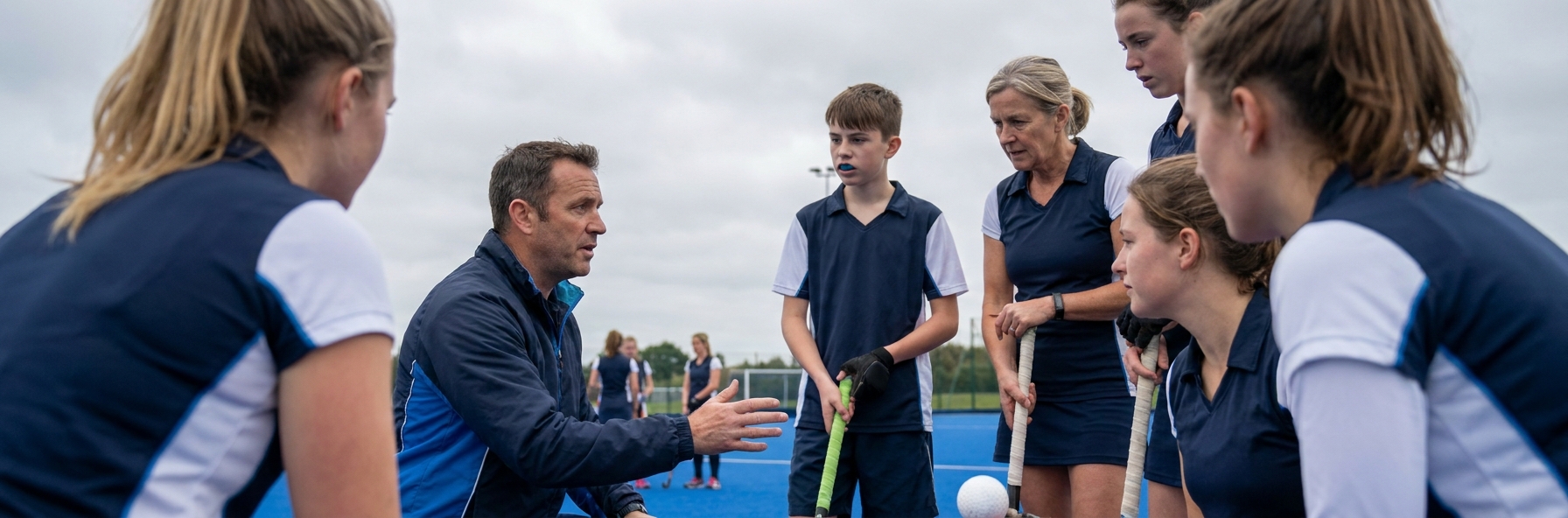
Connection-Based Coaching has emerged as a significant movement in hockey coaching. The core idea is simple but powerful: the relationship between coach and player is the foundation upon which all development is built. Without trust, without genuine connection, coaching effectiveness is limited.
This isn't soft philosophy. Research consistently shows that athletes who feel psychologically safe, who trust their coach, who believe their coach genuinely cares about them, perform better and develop faster.

What is Psychological Safety?

Psychological safety is the belief that you can take risks without being punished or humiliated. In a hockey context, it means players who feel safe to:
  • Try new skills without fear of criticism for failure
  • Ask questions without being made to feel stupid
  • Offer ideas without being dismissed
  • Make mistakes in matches without losing their place
  • Express concerns without negative consequences

When psychological safety exists, players are more creative, more willing to stretch themselves, and more honest about their development needs.

Building Connection

Know Your Players

Do you know what motivates each player? Their life outside hockey? Their hopes and concerns? Connection requires knowledge, and knowledge requires investment in getting to know people.

This doesn't mean becoming best friends. It means showing genuine interest, remembering what players tell you, and demonstrating that you see them as people, not just performers.

Listen More Than You Speak

Many coaches do too much telling. Connection-based coaching emphasises listening. When players speak, give them full attention. Ask follow-up questions. Reflect back what you've heard to show understanding.

Listening builds trust because it demonstrates respect. When players feel heard, they're more receptive to coaching.

Consistency and Reliability

Trust is built through consistent behaviour over time. If you say you'll do something, do it. If you have standards, apply them equally to everyone. Inconsistency destroys trust faster than almost anything else.

Appropriate Vulnerability

Coaches who admit mistakes, acknowledge what they don't know, and share their own development journey build stronger connections than those who project infallibility. Appropriate vulnerability models the openness you want from players.

Connection in Practice

Individual Check-Ins

Brief one-to-one conversations build connection over time. Not always about hockey - sometimes just "How are you?" delivered with genuine interest. These small interactions accumulate into strong relationships.
Personalised Feedback

Generic feedback shows you're not paying attention. Specific, personalised feedback shows you see the individual. "Good work" is less powerful than "I noticed you recovered really quickly after that turnover - that's the response we need."

Celebrating Progress

Connection-based coaches celebrate development, not just outcomes. The player who improves from poor to average has achieved as much as the player who was always excellent. Recognition should reflect effort and progress.

Managing Difficult Conversations

Strong connections make difficult conversations possible. When players trust you, they can hear hard truths. When they don't, the same truths are rejected as unfair criticism. Build the connection first; the honest feedback can follow.

Team-Level Application

Connection isn't just coach-to-player. Teams with strong player-to-player connections perform better. The coach's role includes creating conditions for these connections:

  • Team-building activities that build genuine relationships
  • Training structures that encourage collaboration
  • Addressing behaviours that damage team connection
  • Celebrating collective achievements

Common Barriers

"I don't have time": Connection doesn't require separate time - it's embedded in how you do everything. A two-minute conversation while setting up equipment still counts.

"It's soft": The evidence says otherwise. High-performance environments increasingly recognise that connection underpins performance, not detracts from it.

"Not all players want it": Different players need different levels and types of connection. Read what each individual needs and adjust accordingly.

Key Coaching Points

  • Psychological safety enables risk-taking and growth
  • Know your players as people, not just performers
  • Listen more, tell less
  • Be consistent and reliable
  • Personalise your interactions and feedback
  • Create conditions for player-to-player connection

Drills That Build Team Connection

VIEW ALL SMALL-SIDED GAMES

JOIN SPORTPLAN FOR FREE

  • search our library of 1000+ hockey drills
  • create your own professional coaching plans
  • or access our tried and tested plans
support DRILLS
View All
Unfortunately there were no results for your search! Please try again
support DRILL CATEGORIES
View All
support SESSIONS
View All
support ANSWERS
View All

switch to field hockey | Sport...
I would like to pay for the field hockey membership right now and pause the basketball.
Jennifer McGovern Coach, United States

change sport to hockey | Sport...

I am a new user and probably I made something wrong at the beginning. My sport is Hockey and in the app appears Netball. I don't know how to change it. could you please change my sport to hockey? thanks.

Marc Ribes Coach, Spain

Sportplan and England Hockey C...

Hi,Before I upgrade to a paid account for the current season I wanted to check to see if there is still a discounted rate or free access for England Hockey Coach Members.All the best.Andy

Andy Fairbrother Coach, England

teaching presses on free hits ...

Hi allI am looking for advice on how to implement processes in my girls school hockey team. processes of setting up presses, defensive structures and counter attacking thinking. I have 14 players in the team from 15 years old to 18. we train twice a week. only a few play club hockey as well. We either play a 3-1-4-2 or a 3-1-3-3.I find it difficult for example, when you want to teach a press on the opposition 16, to simulate gameplay with only 14 players (if they are all at training). I can have my halves setup for taking the 16 and then get my strikers and links to setup, but then I still want defenders to see things from the back but they are taking the 16? Also when taking the 16 they then don't have any support in the drill because everyone else is setting up a press?I know we need to work on our basics in order for the other tactics and skills and game plans to work. However I find it frustrating with this team that on counter attacks for a few reasons which I am struggling to mend;- they only head forward. No one holds up the ball to wait for support.- they run straight and don't use angles- they pass too late and get tackled - they don't have the vision to see an early pass or pass into space- players without the ball do not run into useful positions and angles and get caught out by the person with the ball who then makes a pass to no one and it runs out of play.So suggestions please for;- open, creative but simple counter attacking- teaching processes for presses on free hits and 16s- coaching how to take 16s and work your way out- coaching vision and expecting your players to be in support. RegardsMatt

Matthew Lydall Coach, South Africa

membership | Sportplan

what does my subscription allow me to look at

Janette Mcwhirter Coach, England

Cancelling a Subscription | Sp...

Hello, I am no longer coaching Field Hockey so I would like to cancel my subscription. Please advise on the proper procedures to do so.Thank you,Mary Quinn

Mary Quinn Coach, United States of America

What is the best way to share ...

...where it will list and describe playing terminology such as shave, tackle-back, steal, forehand.

Ejaz Syed Coach, United States of America

Adding Drills to My Folder | S...

Hi, how do I add a practice from the Drills section to My Folders - e.g. a hockey passing drill into a Hockey folder in My Folders? Thank you.

Andy Kenward Coach, England

Help with drills for getting players to relead after?

I coach both adults and juniors and find that it is very hard to get them to make another run once they have initially moved into a certain space, any simple drills for this?

Archived User Coach

How do I balance players personalities to get results

I want our team to make our team and hopefully get promoted, however in my opinion player personalities are holding us back such disliking position and certain players wanting to do things that other players are better at.

Jack Rhodes Coach, Wales

drills for backpassing

Have a team of older group of ladies who need to learn to pass the ball back, any good drills for this?

trudy adamson Coach, New Zealand

Communication of the ball

Can anyone recommend a drill to get my players talking more during the game as I trying to teach them how important it is to do things off the ball?

Glenn Hutchinson Coach, Australia

How to coach school team with novices and experienced players?

Hi,I perhaps naively, expected to have most of our team from last year carry over and only have a few new comers to integrate and get up to speed with the rest. However meeting the team at our first practice last night i find I have five players still at school from last year and the rest all new comers, most of whom had not held a hockey stick at all till practice.This being only my second season coaching (year 9 to year 13 boys) has left me feeling a little blindsided, and feeling quite unsure how to prepare practices that target both groups of boys. Do i lump them both groups together, keep them separate? What drills/exercises to best bring the new comers up to speed.I don't want to neglect either group, keep practice worthwhile for the experienced boys, but also bringing the new comers up to a level were they can mix in with the others and learn organically from them while practicing as a team. David

David Smith Coach, New Zealand

role of center midfielders in a 3223 system

what are the key responsibilities of midfielders in a 3223 system ie how do the centre midfielders organise themselves and who do they mark

peter garlick Coach, Australia

7-a-side Formation suggestions for u-18 league

Hi all,I would like to ask what is the best formation to play a 7-a-side match(under-18) when u have strong defence(key player in defence) but unexperienced midfield. I had in mind 3-2-1 while defending and 2-3-1 while attacking. Any suggestions please?

Alessandro Amore Coach, Malta

How teach defense match-up zone roles to U13?

Hi, I have a complicated set of questions which shows my limited understanding of field hockey. I’m coaching a U13 team of 22 girls in the U.S., and each player has at least one year of experience. I’ve played FH only with my kids though I have a basic understanding of the game and its concepts from playing soccer and basketball, and watching games for many years. I've coached kids in other sports, this is my first year coaching field hockey. (If you’re wondering why I’m coaching, no parent in my community with playing experience would step up and my daughter loves the game.)A warming: This is a long set of interrelated questions but your taking the time will be greatly appreciated. Problem: The core problem is responsibility conflicts on defense. My players understand concepts of zone and marking separately. I don’t know enough to explain how they should manage the two responsibilities in field hockey. I “get it” by playing other sports for so long and therefore am able to see how they aren’t “getting it.” For clarity, I have in mind two kinds of offense players: OP1 (has the ball); OP2 (doesn’t). The girls understand that zone means each has a certain area to protect; and marking, how to position themselves in relation to offensive player without the ball (OP2), and when to mark tight vs. loose, and to what it means to follow her mark. Situation 1 (Off-ball play): if one OP2 (OP2-A) enter zone of Left Midfield (LM), for example, how LM apply marking principles (a) when OP2-A enters zone; (b) a second OP2 (OP-B) enters zone; (c) if OP2-A leaves zone, LM should (i) release OP2-A and stay on OP2-B or (ii) follow OP1-A and leave OP2-B. How resolve these zone/marking conflicts for other positions: CM/RM? For RD/LD/CD? (We play a basic 3-3-1-3.)Situation 2 (Support teammate pressuring ball (D1). The girls understand basics of channeling, approaching OP1 to tackle, and how D2 should support D1 (e.g., D2 is cover for D2). We’ve done drills (1v2), but transferring into game situations is difficult. How explain D2 maintain zone responsibilities (a) if supporting D1 means D2 (a) vacates assigned zone and/or (b) or OP2 in zone). Situation 3 (Forwards). They are having trouble with changing defensive responsibilities from within the opposing team’s quarter of the field, the middle quarters, and our quarter of the field nearest to our goal. I’ve thought about just making the defense solely marking but that creates its own chaos and tires out the girls. Without these basic concepts, the result is a joyless scrum: players are bunched up on defense, so if there’s a turnover, the players are too close together for a counterattack. This is unfortunate because the speed of field hockey games should appeal to kids in the U.S. Thanks

Brandon Cowart Coach, United States of America

deleting folders

How do I delete a folder I have created for future use?

Donald Smith Coach, England

Refund Request

Hi, when I signed up I wasn't aware it was a reoccurring payment, as you will be able to see I until today I haven't login and used this service since the first month that I joined, I request that you refund the payments, thank you for your help

Austin Treacy Coach, Australia

Adding to Clipboard

Is there any way of adding plans to my clipboard in the same way as drills are added to my clipboard?

Kenneth Coach, Malta

customer support

I have been automatically debited for mmembership and I did not approve. You reference contact live chat or email customer suppoert through webiste, neither are on your website and therefore I have no way of contacting you. Please give me an appropriate email that I can contact!

kylie mcveigh Coach, Australia

JOIN SPORTPLAN FOR FREE

  • search our library of 1000+ hockey drills
  • create your own professional coaching plans
  • or access our tried and tested plans

Sportplan App

Give it a try - it's better in the app

YOUR SESSION IS STARTING SOON... Join the worlds largest hockey coaching resource for 1000+ drills and pro tools to make coaching easy.
LET'S DO IT