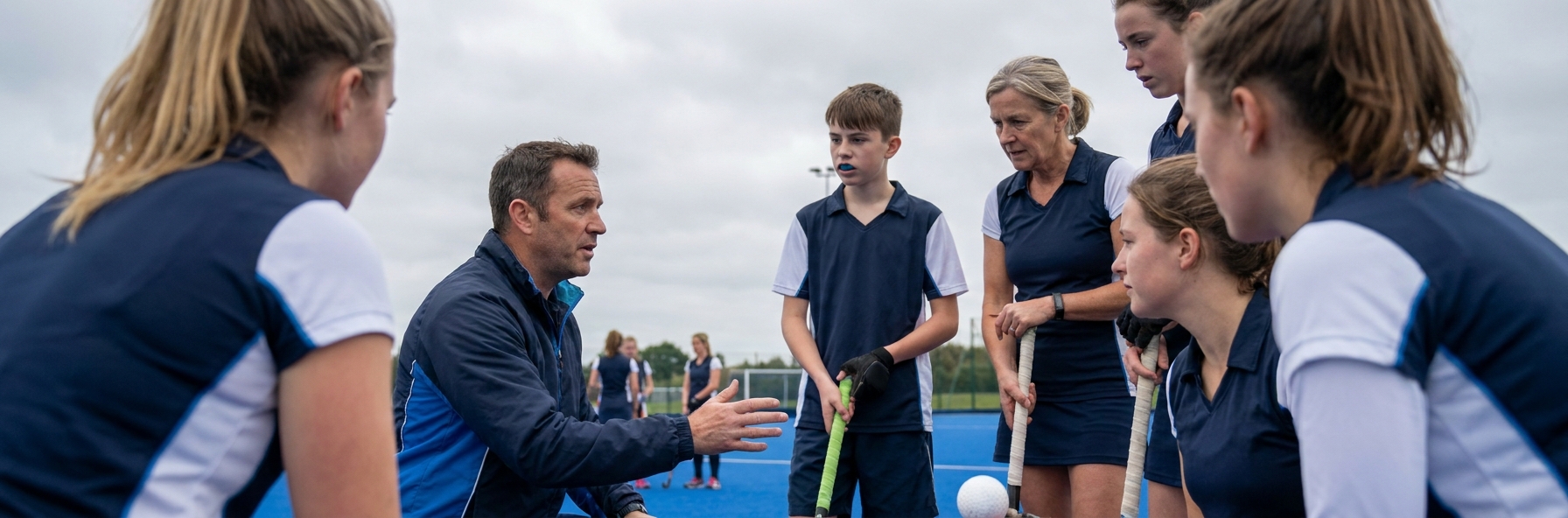
Field Hockey: teaching

Connection-Based Coaching has emerged as a significant movement in hockey coaching. The core idea is simple but powerful: the relationship between coach and player is the foundation upon which all development is built. Without trust, without genuine connection, coaching effectiveness is limited.

This isn't soft philosophy. Research consistently shows that athletes who feel psychologically safe, who trust their coach, who believe their coach genuinely cares about them, perform better and develop faster.

What is Psychological Safety?

Psychological safety is the belief that you can take risks without being punished or humiliated. In a hockey context, it means players who feel safe to:

  • Try new skills without fear of criticism for failure
  • Ask questions without being made to feel stupid
  • Offer ideas without being dismissed
  • Make mistakes in matches without losing their place
  • Express concerns without negative consequences

When psychological safety exists, players are more creative, more willing to stretch themselves, and more honest about their development needs.

Building Connection

Know Your Players

Do you know what motivates each player? Their life outside hockey? Their hopes and concerns? Connection requires knowledge, and knowledge requires investment in getting to know people.

This doesn't mean becoming best friends. It means showing genuine interest, remembering what players tell you, and demonstrating that you see them as people, not just performers.

Listen More Than You Speak

Many coaches do too much telling. Connection-based coaching emphasises listening. When players speak, give them full attention. Ask follow-up questions. Reflect back what you've heard to show understanding.

Listening builds trust because it demonstrates respect. When players feel heard, they're more receptive to coaching.

Consistency and Reliability

Trust is built through consistent behaviour over time. If you say you'll do something, do it. If you have standards, apply them equally to everyone. Inconsistency destroys trust faster than almost anything else.

Appropriate Vulnerability

Coaches who admit mistakes, acknowledge what they don't know, and share their own development journey build stronger connections than those who project infallibility. Appropriate vulnerability models the openness you want from players.

Connection in Practice

Individual Check-Ins

Brief one-to-one conversations build connection over time. Not always about hockey - sometimes just "How are you?" delivered with genuine interest. These small interactions accumulate into strong relationships.

Personalised Feedback

Generic feedback shows you're not paying attention. Specific, personalised feedback shows you see the individual. "Good work" is less powerful than "I noticed you recovered really quickly after that turnover - that's the response we need."

Celebrating Progress

Connection-based coaches celebrate development, not just outcomes. The player who improves from poor to average has achieved as much as the player who was always excellent. Recognition should reflect effort and progress.

Managing Difficult Conversations

Strong connections make difficult conversations possible. When players trust you, they can hear hard truths. When they don't, the same truths are rejected as unfair criticism. Build the connection first; the honest feedback can follow.

Team-Level Application

Connection isn't just coach-to-player. Teams with strong player-to-player connections perform better. The coach's role includes creating conditions for these connections:

  • Team-building activities that build genuine relationships
  • Training structures that encourage collaboration
  • Addressing behaviours that damage team connection
  • Celebrating collective achievements

Common Barriers

"I don't have time": Connection doesn't require separate time - it's embedded in how you do everything. A two-minute conversation while setting up equipment still counts.

"It's soft": The evidence says otherwise. High-performance environments increasingly recognise that connection underpins performance, not detracts from it.

"Not all players want it": Different players need different levels and types of connection. Read what each individual needs and adjust accordingly.

Key Coaching Points

  • Psychological safety enables risk-taking and growth
  • Know your players as people, not just performers
  • Listen more, tell less
  • Be consistent and reliable
  • Personalise your interactions and feedback
  • Create conditions for player-to-player connection

Drills That Build Team Connection

VIEW ALL SMALL-SIDED GAMES

JOIN SPORTPLAN FOR FREE

  • search our library of 1000+ hockey drills
  • create your own professional coaching plans
  • or access our tried and tested plans
teaching DRILLS
View All
Unfortunately there were no results for your search! Please try again
teaching ANSWERS
View All

what was the basic skills in teaching hockey?

what was the basic skills in teaching hockey for the students

Archived User Coach

I need help in teaching my midfielders what their role is

I need help in teaching my midfielders what their role is and drills to practice this. I often find they are running around too much . Please help

Ann Maclean Coach, United States of America

teaching how to drag flick. could anyone point me?

teaching how to drag flick. could anyone point me in the right direction on how's the best way to teach drag clicking, considering footwork, holding of the stick ext.

Archived User Coach

Anyone got a drill for teaching how to defend aainst?

Anyone got a drill for teaching how to defend against a full or 2/3 press?

Archived User Coach

I am teaching 7 weeks of Hockey to a Mixed set of about?

I am teaching 7 weeks of Hockey to a Mixed set of about twenty 14/15 year olds. I'm unsure of what to teach them each week i.e. week one attacking, week two defending etc. Any ideas for a seven week overview?

Archived User Coach

How to keep kids from getting Bored at practise.

Hi all just wondering if there are any coach's that have any good tip for a new coach like me. I am coaching under 6/8yr olds and find they get bored very easy. How do you keep them from getting bored and what fun drills do you use? Cheer James first time coach

James Batt Coach, New Zealand

Best way to teach shape and positional awareness to U12s and U13s?

hi allI'm currently coaching 12 and 13 yr olds and the team has a massive problem with shape and being disciplined positionally.Any tips, ideas, drills etc for helping with / teaching this?many thanks,Gary

Gary Thompson Coach, England

How to teach the "slider" ?

I would like to teach some of my Ladies the 'slider' for next Season. Is there a step by step guide, or Master Class I could access. Thx. :-)

lawrie okeeffe Coach, England

URGENT!!! Hockey coaching plan needed for A level PE

I am doing A level PE and I need to find a coaching plan that includes a number of drills that get progressively harder. The plan has to be game based, I was thinking of doing one on possession but I cannot find drills that link together and get harder. Please help, Thanks

Erin Parry Coach, Wales

teaching presses on free hits and 16s

Hi allI am looking for advice on how to implement processes in my girls school hockey team. processes of setting up presses, defensive structures and counter attacking thinking. I have 14 players in the team from 15 years old to 18. we train twice a week. only a few play club hockey as well. We either play a 3-1-4-2 or a 3-1-3-3.I find it difficult for example, when you want to teach a press on the opposition 16, to simulate gameplay with only 14 players (if they are all at training). I can have my halves setup for taking the 16 and then get my strikers and links to setup, but then I still want defenders to see things from the back but they are taking the 16? Also when taking the 16 they then don't have any support in the drill because everyone else is setting up a press?I know we need to work on our basics in order for the other tactics and skills and game plans to work. However I find it frustrating with this team that on counter attacks for a few reasons which I am struggling to mend;- they only head forward. No one holds up the ball to wait for support.- they run straight and don't use angles- they pass too late and get tackled - they don't have the vision to see an early pass or pass into space- players without the ball do not run into useful positions and angles and get caught out by the person with the ball who then makes a pass to no one and it runs out of play.So suggestions please for;- open, creative but simple counter attacking- teaching processes for presses on free hits and 16s- coaching how to take 16s and work your way out- coaching vision and expecting your players to be in support. RegardsMatt

Matthew Lydall Coach, South Africa

Hockey SOW- any out there?

Hello- Teaching KS4 hockey in prep for the new GCSE. Any good SOW out there that someone would like to share? Group are all girls and of a good ability, just looking to develop my teaching as well as students progress. Willing to exchange SOW- I have a Netball and Trampoline for the new spec. Thanks

Jade Powell Coach, England

Pressing for HS? Resources to teach press?

What kind of defensive presses do you all run for highshoolers? And is there a resource that will make it easier to teach to them? We play a 4-4-3 with 2 sitters in the midline. I’m used to a Fall Away Press, but am having a hard time teaching it. Asked using Sportplan Mobile App

Misty Brady Coach, United States of America

drills to teach a beginner on push pass

drills toteach a beginner on push pass

Collins Acheampong Coach, Ghana

Aerial Ball

what steps do I need to teach to build the technique so that students get proper form

Camlyn Victor Coach, Trinidad and Tobago

tackling

best drill for teaching tackles

Cheryl Price Coach, Australia

teaching the drive

Drives

Rob Viola Coach, United States of America

teaching presses on free hits ...

Hi allI am looking for advice on how to implement processes in my girls school hockey team. processes of setting up presses, defensive structures and counter attacking thinking. I have 14 players in the team from 15 years old to 18. we train twice a week. only a few play club hockey as well. We either play a 3-1-4-2 or a 3-1-3-3.I find it difficult for example, when you want to teach a press on the opposition 16, to simulate gameplay with only 14 players (if they are all at training). I can have my halves setup for taking the 16 and then get my strikers and links to setup, but then I still want defenders to see things from the back but they are taking the 16? Also when taking the 16 they then don't have any support in the drill because everyone else is setting up a press?I know we need to work on our basics in order for the other tactics and skills and game plans to work. However I find it frustrating with this team that on counter attacks for a few reasons which I am struggling to mend;- they only head forward. No one holds up the ball to wait for support.- they run straight and don't use angles- they pass too late and get tackled - they don't have the vision to see an early pass or pass into space- players without the ball do not run into useful positions and angles and get caught out by the person with the ball who then makes a pass to no one and it runs out of play.So suggestions please for;- open, creative but simple counter attacking- teaching processes for presses on free hits and 16s- coaching how to take 16s and work your way out- coaching vision and expecting your players to be in support. RegardsMatt

Matthew Lydall Coach, South Africa

Best way to teach shape and po...

hi allI'm currently coaching 12 and 13 yr olds and the team has a massive problem with shape and being disciplined positionally.Any tips, ideas, drills etc for helping with / teaching this?many thanks,Gary

Gary Thompson Coach, England

what was the basic skills in t...

what was the basic skills in teaching hockey for the students

Archived User Coach

How can I stop my team from di...

I am coaching my first season as head coach. I am confident that my team has improved on alot of skills (mostly due to sportplan.net, thank you!). The only thing that is driving me crazy that my team has not improved on is the over committing block tackle. When an opponent is coming down the field on a breakway, my defense runs up and block tackles, and the opponent shoots right past them. This will happen two or three times in a row, one defender after the other. I've told them to keep their feet moving and to keep off their toes, keeping their momentum with the opponent. I don't know how to practice this with them. We only have 9 players (this is a high school varsity team) so we can't scrimmage full field during practice. Please help! I'm desperate for a solution.

Archived User Coach

JOIN SPORTPLAN FOR FREE

  • search our library of 1000+ hockey drills
  • create your own professional coaching plans
  • or access our tried and tested plans

Sportplan App

Give it a try - it's better in the app

YOUR SESSION IS STARTING SOON... Join the worlds largest hockey coaching resource for 1000+ drills and pro tools to make coaching easy.
LET'S DO IT