Rugby: drift defence

Rugby is a game of decisions. Every second, players choose: pass, carry, or kick? Blitz or drift? Jackal or get back in the line? The team that makes better decisions more consistently wins matches - not necessarily the team with more talent or better fitness.

Game management is the skill of making these decisions correctly under pressure, with fatigue setting in, with the crowd noise, with the stakes rising. It can be developed.

The Decision-Making Framework

Good decisions start with good information. Players need to see the game clearly before they can choose correctly.

The OODA loop in rugby:

  • Observe: What do I see? Defensive structure, space, support
  • Orient: What does this mean? Opportunity, threat, neutral
  • Decide: What's my best option? Pass, carry, kick, hold
  • Act: Execute with commitment

The faster and more accurately players cycle through this loop, the better their decisions. Training should develop each stage.

Developing Observation Skills

Many poor decisions come from poor observation. Players who don't see the full picture can't make informed choices.

Training observation:

  • Pre-scan: look before receiving the ball
  • Peripheral awareness: what's beside you, not just ahead
  • Key cues: what specifically to look for (defender's hips, space, numbers)

Drills for observation: Play games where the coach calls "freeze" and asks players to describe what they see. What options exist? Where's the space? Where's the threat?

Situational Awareness

Understanding the game situation frames decision-making. The right decision at 0-0 in the first minute differs from 3-0 down in the 79th minute.

Situation factors:

  • Score: leading, trailing, or level
  • Time: first half, second half, final minutes
  • Field position: own 22, midfield, attacking 22
  • Conditions: wind, rain, surface
  • Momentum: who's on top right now?

Players need to know the situation without thinking about it. Score, time, and field position should be automatic awareness.

Risk Management

Every rugby decision involves risk. The question is whether the potential reward justifies the risk in this specific situation.
High-risk decisions:

  • Running out of your own 22
  • Offloads under pressure
  • Speculative kicks without chase support
  • Committing extra players to the ruck

When high-risk is acceptable:

  • Trailing with time running out
  • Attacking in the opposition 22
  • Momentum strongly in your favour

When to play conservative:

  • Protecting a lead late in the game
  • Deep in your own half
  • Opposition on top and looking for turnovers

Pressure Moments

Certain moments in matches carry extra pressure. Decision-making under pressure deteriorates without specific training.

High-pressure scenarios:

  • Final play of the half or game
  • Penalty opportunity to win/draw the match
  • Defending a one-point lead in your 22
  • Restart after conceding a score

Training pressure: Create pressure in training through consequences, time limits, and competitive scenarios. Players who've experienced pressure in training cope better when it matters.

Communication in Decision-Making

Rugby decisions are rarely individual. Communication coordinates group decision-making and ensures everyone understands the plan.

Essential communications:

  • Ball carrier: "Carrying!" "Kicking!" "Looking left!"
  • Support: "With you!" "On your shoulder!"
  • Defence: "Up!" "Drift!" "Numbers!"
  • General: "Time!" "Space outside!" "Keep it!"

Leaders must take ownership of communication. The fly-half and captain should constantly talk, directing the team's decision-making.

Learning from Decisions

Post-match review should examine decisions as much as execution. Why did we make that choice? What did we see? What would we do differently?

Effective review questions:

  • "What was your thinking there?"
  • "What options did you see?"
  • "Given what you know now, what would you do?"
  • "What can we learn from this?"

Avoid blame. Focus on understanding and improvement. Players who fear judgment stop taking responsibility for decisions.

Developing Decision-Makers

Coaching approaches:

  • Guided discovery: ask questions rather than give answers
  • Constrained games: rules that force specific decisions
  • Decision overload: faster game speed to develop instinct
  • Post-play review: brief discussions about choices made

The goal is players who can read, decide, and act without waiting for coach instruction. Games move too fast for external direction - players must be autonomous decision-makers.

Key Coaching Points

  • Good decisions require good observation - train players to see
  • Situation awareness frames every choice
  • Risk must match the situation
  • Pressure can be trained - create it in practice
  • Communication coordinates group decisions

Drills to Develop Game Intelligence

VIEW ALL DECISION MAKING DRILLS

JOIN SPORTPLAN FOR FREE

  • search our library of 1100+ rugby drills

  • create your own professional coaching plans
  • or access our tried and tested plans
drift defence DRILLS
View All

Defense vs attack drill School...

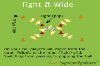
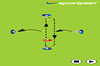
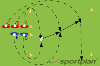
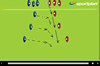
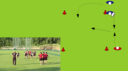
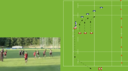
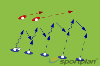
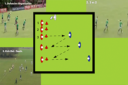
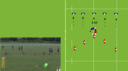
The aim is to the defensive situation to keep changing the defence gets used to drifting or pressing. The aim of the attack is to realign using the full width, get the ball out of the breakdown quickly (no matter what position you play), seeing space, communicating options and reading the defence. Can be done with any number of players but best suited to around 7. You will need 7 cones, 1 ball, a 40 m area, attack of line and try line. Players passed the ball quickly down the line. When the ball gets halfway, the coach shouts out a number. Number reflects the number of defenders. The end player puts down the ball by pad, then the 2 defenders get onside (beyond defensive line) and defend against the other attackers. The defenders need to work together. Stay tight and use the sideline extra defender. Drifting from the inside and pushing up and out. Attack looks to use, player pace and beat the drift. Important defence talks and understand what they are doing in the changing circumstances. With 4 attackers and 3 defenders, defenders might look for a blitz defence or up then drift. Scrum-half can break so defence must defend at guard. Attack should be looking up and reading the situation. If we have an overlap then as a unit we must understand how to fix defenders. You must start to add a kicking option to advance the drill. 8 players, you can have a forward runner offering a shadow line of 10. He is involved in the passing down the line but is on a separate cone in the front of the 7. This fits in with the patterns and philosophy of attack. You might get the forward to press ups or other exercise to replicate fatigue.
General

Rugby Netball Agility & Runnin...

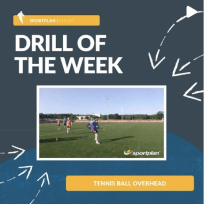
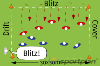
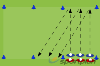
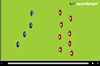
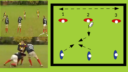
Drill to practice skills and creating space.Set up a pitch (roughly 25m x 20m depending on age and number of players) with two scoring zones at each end (green cones). Split the players into two even teams and give each team different colour bibs.Teams are aiming to score points by passing the ball to a team mate who is standing in the scoring zone (see diagram). Each time a player catches the ball on the full from a pass from a team mate in the scoring zone their team scores one point, and they turn and attack back the other way. Players cannot run while holding the ball, they must be standing still when they pass.The defending team cannot get closer than 2m to the player with the ball, and can only gain possession by intercepting a pass or if the attacking team drop the ball or give a poor pass which goes to ground. PROGRESSION:Players can only have possession of the ball for 2 seconds. If they hold the ball for longer than two seconds then possession is turned over. This means that the defending team can gain possession if they cut down the attacking players passing options.Players can run when in possession of the ball, but still can only have possession of the ball for 2 seconds.Passes must be over head.Passes must be below waist height.Chip kick / grubber kick instead of pass.Passes must be out of the back of the hand.Passes must be behind the back.Defenders can touch the attacking player in possession of the ball. If the defending team makes two touches on the attacking team then possession is turned over.

General

Unfortunately there were no results for your search! Please try again
drift defence ANSWERS
View All

Translation Please

I recently received this in my "inbox"%3A Building a Flat Line Defence System Dear Rugby Coach, Whether your in the northern hemisphere and winding down for this season, or maybe already planning for next, or your in the southern hemisphere and the new season has just begun, this week we are pleased to present the workings of a Flat Line Defensive System. The following is the principles of how the system is implemented, Full Members can download the training drills to coach the system with their team. Upgrade to full access today. When teaching any defensive formation, you must always consider, how it works both in open play / set-pieces and from the breakdown, and that all players understand the roles they play. Priniciples for Open Play Key pointsThe make sure you choose the system to fit playing strength%3A Either IN-2-OUT or OUT-2-IN. Considering using INSIDE-2-OUT Midfield Gain-Line never broken. Surrender very wide attack to cover defence. Offensive 2m tackles. Pendulum wide cover. Huge communication requirements. Step-in System. Up and Drift. Forgive me but I haven't got a scooby do (clue) what the above means - please could the technobabble be explained (maybe we should start a dictionary of coaching terms?)

Gary D Coach, Northern Ireland

how do i coach the miss pass

Ask a question and have it answered by Coaches from around the world and Sportplan's team of Expert how do i coach the miss pass

Archived User Coach

Big Hit or Step Up tackle

Describe a 'step-up' or 'big hit' tackle. How would you coach it, what is the technique and what are the key factors technically?

Archived User Coach

What are the main coaching points when introducing?

What are the main coaching points when introducing the drift defence? I'm talking mainly about senior players.

0lymp1an Coach, England

HOW CAN I IMPROVE PLAYERS ABILITY TO PERFORM THE LATERAL?

HOW CAN I IMPROVE PLAYERS ABILITY TO PERFORM THE LATERAL PASS ?

dean Coach, England

Not sure if this question has been asked...but is drift?

Not sure if this question has been asked...but is drift defence REALLY the BEST way to combat the fullback entering the line?

Archived User Coach

coach your back-line to utalise the drift defence from a lineout

Ask a question and have it answered by Coaches from around the world and Sportplan's team of Experts.

Archived User Coach

Flanker protecting the Scrum Half?How can a Flanker?

Flanker protecting the Scrum Half? How can a Flanker protect the Scrum-Half at a scrum without holding on to the oppositions Scrum Half? Also any advice for an Openside flanker on tackling the fly-half from scrums?

Archived User Coach

What role does the five eight play in the defensive?

What role does the five eight play in the defensive line and how can they best postition themselves during this time?

Archived User Coach

I have to coach a drift defence from a lineout and?

I have to coach a drift defence from a lineout and include decision making. Can anyone give any ideas of drills for adults and what are the key factors to work on? Thanks

Archived User Coach

Scoring tries - habit?

Why is it important to get players to score the try when completing a handling/running drill?

Archived User Coach

key factors of a miss pass

plaese tell me the key factors of a miss pass

Archived User Coach

Defence System Blitz/Drift

Hi,I am just looking to see if I am right in saying the below:If we are the defending team, and have more players then the attackers then we should use the blitz attack and vice-versa for the drift? Asked using Sportplan Mobile App

Archived User Coach

Team warm up drills that incorporates all the backs

Looking for some drills that use all 7 backs for pre match warm up. Something that we can use other than running through moves Asked using Sportplan Mobile App

Stewart Ley Coach, England

Drift Defence?

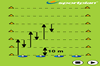
thers no drifting at all becuase the tackle bags dont move. the defnders are hitting the same bag at the same postion always. just becuase the last palyer loops round doesnt means the defences has drifted. i dont see how this drill is implemneted into a game senario. is your last defending man going to circle all the way to the start of the defending line? no drfit D whatsoever. unless you;re letting your team get ready to be set and make a hit theres no point in this drill being sewd for a 'Drift' defence.

Lochlainn McKenzie Coach, Ireland

Please can someone explain the...

Please can someone explain the benefits of a Drift defense and why or what situation you would use it.

Archived User Coach

Which defence system is the mo...

Which defence system is the most effective for 15-man rugby and what drills can I use for the rush/sliding defence...especially to get the guys in the inside to slide with and close up the inside gap from the 2nd phase onwards.

Rossi Marx Coach, South Africa

JOIN SPORTPLAN FOR FREE

  • search our library of 1100+ rugby drills
  • create your own professional coaching plans
  • or access our tried and tested plans

Sportplan App

Give it a try - it's better in the app

YOUR SESSION IS STARTING SOON... Join the growing community of rugby coaches plus 1100+ drills and pro tools to make coaching easy.
LET'S DO IT