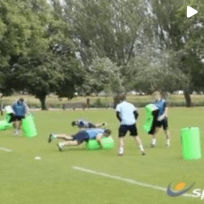
Watch enough rugby at this time of year and you will see it: a ball carrier hits contact, goes to ground, and looks up to find nobody there. No support player arriving, no options, just the ball sitting in no-man's land until the opposition pounces. It is the coaching nightmare that haunts clubs through September and October, and it rarely shows up in training. It shows up on matchday, when it is already too late.
The frustrating part is that this is usually not a fitness problem or a skill problem with the carrier. It is an organisational one. Support runners switch off, forwards jog instead of sprint, and nobody calls early enough to let the carrier know help is on the way. Fix the habits around the carry and the turnovers quietly costing you field position and points start to disappear.
Why This Happens
Most isolated carries trace back to the same three faults. The nearest support player watches the collision instead of already moving towards it. The ball carrier runs too far from their support before committing to contact, often chasing extra metres rather than keeping options alive. And nobody talks, so a carrier going to ground has no idea whether help is one stride away or fifteen metres back.
None of this looks like a dramatic error. It looks like normal rugby, right up until the referee's arm goes up for a turnover penalty or the opposition scrum-half is already clearing the loose ball. By the time a coach spots the pattern from the sideline, it has usually cost three or four phases of possession already.
The Five-Step Fix for Phase Ball
Step One: Set a support trigger. The nearest unengaged player calls "support" the moment contact looks likely, not after the tackle has happened. This single habit buys the carrier a second of certainty and gets the next player moving early.
Step Two: Sprint the first five metres. Support running is won or lost in the first few steps after the call. Coach players to accelerate hard towards the ball rather than jog and assess, so they arrive while the carrier is still on their feet or just going to ground.
Step Three: Arrive through the gate. Support players must come through the right side of the ruck, low and square, not from the side or with momentum running across the pitch. Arriving offside or at an angle wins nothing and gives away cheap penalties.
Step Four: Present and clear with intent. The carrier presents the ball away from the defender immediately on the ground, and the first arriving player clears out with a real drive rather than simply standing over the ball. A ruck that is technically "won" but not cleared is still vulnerable.
Step Five: Reload instantly. The moment the ball is secure, the next support player is already moving towards the new point of contact. Teams that look dangerous phase after phase are rarely faster individually, they just never stop arriving.
How to Train It
Start the warm-up with simple support-running patterns: pairs jogging in channels, with the trailing player calling and arriving on the shoulder of the ball carrier before any contact is involved. This grooves the calling and arriving habit with no pressure attached.
Move into technical work on ball presentation and clear-out technique in twos and threes, isolating the moment of contact so players can build good body position without worrying about the wider picture.
Add a decision-making phase with small-sided support-running games, where attackers have to find support under increasing defensive pressure. Finish with a conditioned game that turns possession over automatically after a set number of unsupported carries, so players start policing the habit themselves.
Spotting It Before It Costs You
From the sideline, watch for forwards standing upright after a tackle instead of driving through it, support players arriving a half-second late and square-on rather than through the gate, and ball carriers glancing around for help that is not there. Any one of these on its own is not a crisis. All three together is a turnover waiting to happen.
Key Coaching Points
- Call support early, before contact happens, not after.
- Coach players to sprint the first five metres into support, not jog and assess.
- Arrive through the gate, low and square, never from the side.
- Present the ball away from the defender the instant you are on the ground.
- Clear out with a genuine drive; do not just stand over the ball.
- Reload immediately, the next support player should already be moving.
Recommended Drills
 Ball Presentation on Tackle
 Continuous Ruck Support
 3 vs 2 Sprint to Support
 Quick Removal Beyond the Ruck
Frequently Asked Questions
Why do we keep getting turned over at the breakdown?
In most club and school sides it is rarely a strength issue. It is a timing and organisation issue: the nearest support player reacts late, the carrier runs on alone, and nobody arrives through the gate quickly enough to secure the ball. Fix the calling and the sprint to support first, and turnovers usually fall sharply.
How many players should arrive in support of the ball carrier?
At club and school level, two close support players are usually enough: one to clear out and one to reload for the next phase. The priority is not numbers, it is making sure at least one of them arrives early and through the gate, rather than three players arriving late and from the side.
Is this a conditioning problem rather than a skills problem?
It can look that way late in games, but the root cause is usually habit rather than fitness. Players who call early and sprint the first five steps into support will out-perform fitter players who hesitate and jog. Build the habit at training pace first, then let conditioning work make it hold up for longer.

 sportplan_rugby