Rugby: rugby touch 5

August 2026

After two seasons of trials involving eleven unions around the world, World Rugby Council has adopted a lower tackle height into full law for community rugby. It takes effect from 1 July 2026 for seasons starting after that date, with unions able to choose either the waist or the base of the sternum as the legal maximum.

If your season starts this month or next, this is not something to read about in October. Across the trial unions, with more than 150,000 tackles studied, tackle-related concussion rates fell by 37 per cent in adult men and 63 per cent in adult women. But the behaviour change that produced those numbers came from coaching, not from the law appearing on a page.

What the Law Actually Requires

The change lowers the maximum legal height of contact. Depending on which option your union has adopted, the ceiling is either the waist or the base of the sternum, and contact above that line is penalised.

Which ceiling applies to you depends on your union, and the good news is that the biggest unions have already made their choice and published it. The section below covers England, Australia and New Zealand. If you are outside those, check your own union before your first session, because the coaching emphasis genuinely differs: a waist ceiling demands a target around the hips and thighs, while a sternum ceiling is more forgiving on entry height but still rules out the upright, chest-high hit.

What the Top Unions Have Chosen

England: the RFU settled on the base of the sternum. The history is worth knowing, because it still causes confusion in clubhouses. The RFU initially announced a waist-height limit in early 2023 and revised it to the base of the sternum after a strong reaction from clubs, and English community rugby has operated at sternum height since the 2023/24 season.

Australia: Rugby Australia also went with below the sternum, written into Law 9.13, which deems it dangerous to tackle or attempt to tackle an opponent above the line of the sternum. It applied to every competition below Super Rugby from February 2024, including all premier grades, school and pathway competitions.

New Zealand: New Zealand Rugby uses below the sternum for the first tackler, with the coaching cue to target the belly. Their version carries one distinction worth knowing: the second tackler may still legally tackle below the shoulders under existing law, which changes how you coach double tackles.

Wales, Scotland and Ireland have also been operating under the trial laws since 2023/24. For most of the home nations and the largest southern hemisphere unions, this month's change formalises what your players have already been doing rather than introducing something new. The practical takeaway is that the sternum is the near-universal choice, and the waist option is the outlier.

Why Players Get It Wrong

The tackles that infringe are rarely deliberate. They happen when a defender arrives too upright, too late and too fast, with no time to adjust. Height at contact is decided several strides earlier, in the approach, not in the final moment.

The second cause is eye position. A defender who watches the ball carrier's hands or the ball itself ends up making contact wherever their body happens to be. A defender who fixes their eyes on the target area arrives at the right height almost automatically.

The third is fatigue. Tackle technique degrades badly in the last quarter of a match, which is exactly when penalties and head contact incidents cluster. Technique trained only when players are fresh will not survive to the eightieth minute.

A Five-Step Retraining Plan

Step One: Rebuild from walking pace. Start every tackle block with static and walking repetitions, focused purely on body height, foot position and eye focus. Speed comes back quickly once the shape is right.

Step Two: Coach the approach, not the contact. Shorten the final strides, sink the hips and get the chest over the front knee before contact. If the approach is right, the height takes care of itself.

Step Three: Give players a clear target. Whether it is the shorts, the thigh or just below the sternum, name it and make it consistent across every coach at the club so players hear one message.

Step Four: Train it tired. Put tackle repetitions at the end of a conditioning block so players practise good technique in the state where they normally lose it.

Step Five: Use the free resources. World Rugby's Rugby Ready, Tackle Ready and Breakdown Ready modules are free and were made to support exactly this transition, for players as well as coaches.

What Changes in the Game

Lower tackles change the game around them, and it is worth preparing your squad for the knock-on effects. Ball carriers stay on their feet longer and the offload becomes more available, because the tackler's arms are no longer wrapping the ball.

Defensively, that means the second player into contact matters more than ever. A low, legal tackle that stops the legs is only half the job if nobody arrives to contest or to stop the offload. Train your tackle and your support as one unit rather than two separate skills.

Key Coaching Points

  • England, Australia and New Zealand have all chosen the base of the sternum; the waist option is the outlier.
  • In New Zealand the second tackler may still tackle below the shoulders, so coach double tackles accordingly.
  • Height at contact is decided in the approach, so coach the last three strides.
  • Fix the eyes on the target area rather than on the ball or the carrier's hands.
  • Rebuild technique from walking pace before adding speed and contact intensity.
  • Practise tackling under fatigue, because that is when technique and discipline fail.
  • Train the tackle and the support player together, as lower tackles produce more offloads.

Recommended Drills

VIEW ALL TACKLING DRILLS

Frequently Asked Questions

Which tackle height applies to my team?

England, Australia and New Zealand have all adopted the base of the sternum, and Wales, Scotland and Ireland have been running the trial laws since 2023/24. If you coach in any of those, sternum is your ceiling. Unions outside that group may choose the waist instead, so check locally before your first session.

Will lower tackling make the game less effective defensively?

Not if you coach it properly. A low tackle that takes the legs is one of the most effective ways to stop a carrier, and it has always been the technique good defences prefer. What changes is that the upright, ball-height hit is no longer an option, so support at the breakdown becomes more important.

What about junior players who already tackle low?

They will adapt fastest, which is one of the arguments for the change. The bigger job is with senior players who have twenty years of upright tackling habits. Expect that group to need genuine repetition at low speed before it holds up in a match.

rugby touch 5 DRILLS
View All

Tabata Touch Tag Rugby - Rugby...

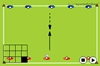
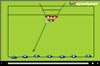
You can play any version of touch you like, I'm going to suggest One Touch Off-Load - but you can change this to suit your training goals for the session ahead. Mark out your training area for the game, but include one or more Tabata training zones for your players (these zones don't have to be very big). If you only have one other person helping you - you might have only one zone, but if you have more assistant coaches or helpers standing around, create more zones - you'll find they will be used. Split your players into two teams, giving them bibs if needed. Keep your law briefing, brief - telling the players the laws of the version of touch you have decided to play. Tell them that as an addition to the normal laws, we now have a sin binning for mistakes e.g. you may decide that all mistakes are sent to the sin bin (The Tabata Zone), you might just focus on forward passes, or penalties. My point is that you can tailor this to suit your coaching goals. Players sent to the sin bin will be there unit sent back by the supervising coach. Don't forget to swap the defense and the attack. Also you can focus the sin binning on the defence for not meeting your defensive goals. Using the Tabata Zones Small areas with one coach/helper. The Tatbata protocol is often 8 periods of intense 20 second activity - with 10 seconds of rest in between (sound simple - try it!). Tell the sin binned player they have 20 seconds to complete as many press-ups as they can, then give them 10 seconds to rest. Repeat 8 times, or reduce to a number of repetitions that work for you and your players. When the player has completed their reps - return them to the game. What you could do in the zones: Press ups, Lunges, Burpees, Sit ups, Etc.

General

Realignment & Depth - 5 v 4 Ha...

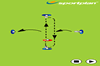
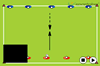
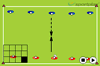
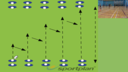
The realignment and depth hands drill is a quick drill to focus the players in sharpening their alignment and depth before a session. You can spend as long or as short on this drill as you need. The aim of the drill is to develop the speed at which players realign themselves, to support their early hand-catch, quick and accurate transfer of the ball to a support player.Set a 5 cones 1.5 meter apart in straight line. This will mark where the players will start the drill fromSet 4 cones at a diagonal in line with the starting cones from one edge. This will be the cones that the defending players need to retreat to before coming up to pressure the attacking players.The first attacking player needs to step back 1 meter and will receive the ball from the first defending player who has also stepped back 1 meter to his designated coneDivide the group into 4 attacking player and 5 defending players, there should be a free attacking playerThe ball starts with the defending playerOn the coaches call, all defending players need to work back to their designated cone and then come forward in a straight line to their opposite attacking playerThe attacking players set their own depth to ensure they have time to catch and pass effectivelyOn the coaches call, the first defending player will move back to their cone, once they get to the cone they pass the ball to the first attacking player, and then the first defending player tries to put pressure on the first attacking playerThe attacking players try to get the ball to the 5th player without being ‘touched’ by a defending player

General

3 Touch Kick Warm Up - Rugby D...

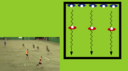
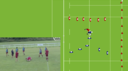
Split your players into two teams, giving one group of players a set of coloured bibs to set them apart, and quickly tell your players the following laws: We will be playing a rugby league style touch. When touched: set the ball down, stand over the ball, allow the scum-half to move the ball away from the point of contact. The defenders should stay on side following a touch, and should not compete for the ball. Any infringements in defence should result in the defending team conceding 10 Meters or possibly giving 1 or more extra touches to the attacking team. I'll leave this to your judgement depending on your team's age, skill level, and your session target/s. The attacking team can sustain three touches before they have to kick. Their kick should be as it would be in the game: a kick to touch, a kick for territory, or a kick that can be regained e.g. a grubber kick. The defenders should behave as they would in a real game. Quick put in's from the touchlines replace lineouts. Defenders who take the ball from an attacking kick should counter attack. A forth touch results in a turn over. The Scrum Half has a maxium of 5 seconds to move the ball from the point of touch. A ball kicked directly to touch from outside the attacking teams 22, or where the ball has been taken into the 22 by the attacking team and then kicked into touch - will result in a turn over with play starting on the five meter line closest to where the kick was made. The defence should be 10 meters back. A ball kicked from inside the attacking teams 22 can go directly to touch, as long as the attacking team did not carry the ball into their own 22 before the kick. The resulting put in will be to the opposition from where the ball has went into touch. Quick put-in's are enoucraged, if not possible the ball is played from the 5 meter line with the defence 10 meters back. Give points for quick put ins that work. Feel free to play with any of noted laws, let us know the law variations that work for you!

General

Unfortunately there were no results for your search! Please try again
rugby touch 5 ANSWERS
View All

Top Tips for Girls U12 Tag Rugby

About to start a Girls U12 Tag Rugby team (hopefully) to run over the Summer months. Has anyone any particular top tips?

Gary D Coach, Northern Ireland

I am looking for Loop pass coaching games to improve?

I am looking for Loop pass coaching games to improve my player game.

Archived User Coach

what are the rules of tag rugby?

what are the rules of tag rugby?

Chris Mason Coach, England

ANYBODY GOT ANY DRILL FOR UNDER 6 RUGBY AS AN INTRODUCTION?

ANYBODY GOT ANY DRILL FOR UNDER 6 RUGBY AS AN INTRODUCTION TO THE GAME?

Garry Windle Coach, Wales

Under 10 - Pre Match Preparation

If you have 30 min before the start of a match how should you prepare a team of under 10 players. How do you get them suitably motivated to hit the ground runnung with a high level of intensity.

William OBrien Coach, England

I'm 19 years old in Canada and have started a new rugby team?

I'm 19 years old in Canada and have started a new team. All the students that have signed up are new to the game and are about 14/15.. Any tips on how to introduce rugby to them?

Archived User Coach

Hi, I'm required to coach the tight 5 to right wheel?

Hi, I'm required to coach the tight 5 to right wheel a scrum - yes, it's for an exam. I have researched it - including talking to forwards - and all of the sparse info out there describes unlawful techniques. I can make a stab at almost anything apart from this 'black art' as I have no references to use. Help!

Archived User Coach

What are some simple drills for touch rugby?

Hi I am a new 19 year old coach, it is my first time coaching and currently am looking after a year 3/4 team for touch rugby. I was wondering if anyone could give me some simple drills to help build the students passing and spreading out skills for touch rugby

Zac Coach, New Zealand

what are the rules of touch rugby

what are the rules of touch rugby

Archived User Coach

problem- slow start at 7s games

I coach a womans 7s team. Every two weeks we have a two game tournament. The problem is that for the whole first game the girls play like they haven't woken up yet, and only in the second game their real rugby comes out. How do I help them play strong from the start?

eli Coach, Israel

Italian mini rugby rules?

I am hoping to take our U11-U12 team to a mini rugby tournament in Italy in May. What are the main rule differences between UK and Italian mini rugby at this age group?

Coach, Northern Ireland

Looking for day 0 skills to teach children?

I am looking for a Day 0 type of session for American children who may have never held a rugby ball. If I move forward with a rugby exhibition/team creation in the neighborhood, I want to make sure I know how/what to teach Day 0. I'm hoping that interest is growing for touch and flag rugby due to the recent in Philadelphia between the USA Eagles and the Maori All Blacks. I was there. It was fantastic. Tickets sold out so fast, I think there will be more of these in the area. Thanks.

Doug Jones Coach, United States of America

. What actions are available to the referee?

An in-goal player catches the ball from an opponent's kick and touches it down. That player is then late tackled. What actions are available to the referee?

Archived User Coach

Rugby Laws - Touch, quick throw and lineout

Except when closer than 5 metres to the goal-line, which of the following statements are correct in relation to the place of the throw-in when the ball is in touch?

Marcos Mello Coach, England

Looking for day 0 skills to te...

I am looking for a Day 0 type of session for American children who may have never held a rugby ball. If I move forward with a rugby exhibition/team creation in the neighborhood, I want to make sure I know how/what to teach Day 0. I'm hoping that interest is growing for touch and flag rugby due to the recent in Philadelphia between the USA Eagles and the Maori All Blacks. I was there. It was fantastic. Tickets sold out so fast, I think there will be more of these in the area. Thanks.

Doug Jones Coach, United States of America

(U11 Rugby) - How to referee t...

I'm coaching and reffing U11 rugby and one of my players is the definitive 'big lad'. His 'strength' is his size and his power, but last weekend he didn't seem to get reffed fairly. The opposition couldn't tackle him down, one on one and when another two joined in to make a mini maul, that didn't slow him down much either. The ref then let other people join in the (one sided) struggle to tackle him down, which seemed very unfair as A) it's outside the laws of U11 rugby,, B) it makes it nigh on impossible for him to offload, C) when he is brought to ground, he has 4-5 players all over him and he got pinged for 'holding on'. He is a recent arrival to rugby and it was our first game for a couple of months, so the situation hadn't reared his head before. We are keen that he learns all of the core skills of rugby and doesn't get used as a battering ram, but after seeing a pack of hyenas trying to pull down the big fella, something just didn't seem right to me.I'd be grateful for any thoughts and opinions.

Archived User Coach

How do I coach women the game ...

I just finished my collegiate rugby career. I feel inspired I would love to coach rugby to women in countries that have a lower popularity of women's rugby. How do I get started?

Archived User Coach

JOIN SPORTPLAN FOR FREE

  • search our library of 1100+ rugby drills
  • create your own professional coaching plans
  • or access our tried and tested plans

Sportplan App

Give it a try - it's better in the app

YOUR SESSION IS STARTING SOON... Join the growing community of rugby coaches plus 1100+ drills and pro tools to make coaching easy.
LET'S DO IT